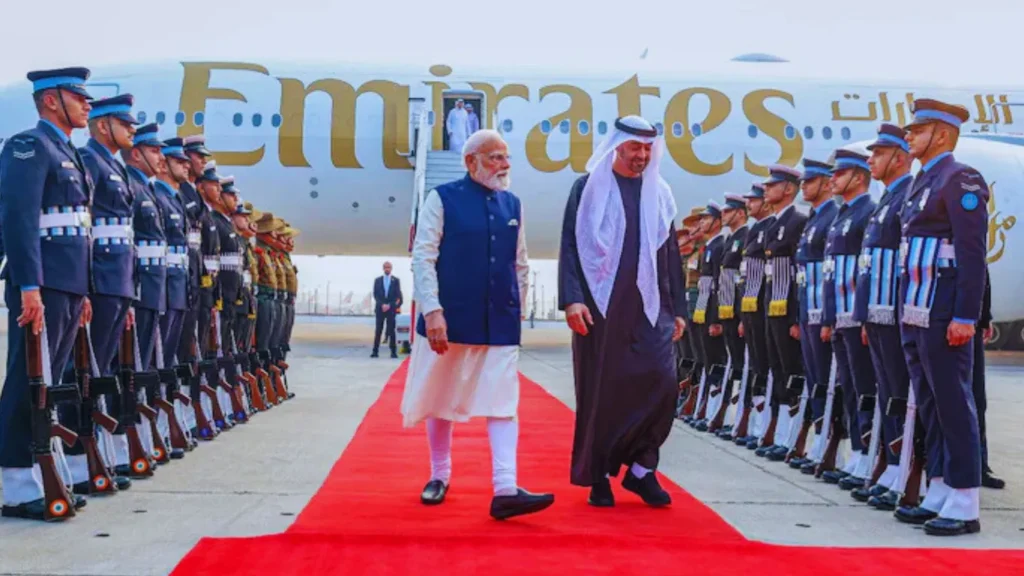
In a significant diplomatic event marking the deepening ties between India and the United Arab Emirates, UAE President Sheikh Mohammed bin Zayed Al Nahyan arrived in India on Monday evening at 4:30 PM. Breaking traditional protocol, Prime Minister Narendra Modi personally received the UAE president at Delhi’s Palam Airport, showcasing the warmth and closeness of the bilateral relationship. PM Modi later described the moment on social media, saying, “I have come to personally receive my brother,” highlighting the personal rapport between the two leaders.
This visit is widely seen as a milestone in India-UAE relations, emphasizing not only the countries’ strategic and economic alignment but also their shared cultural heritage and people-to-people connections.
A Royal Welcome at PM Modi’s Residence
Following the airport reception, PM Modi hosted President Sheikh Mohammed and his family at his official residence on Lok Kalyan Marg in Delhi. The Indian prime minister went beyond customary diplomatic gestures by presenting a series of culturally significant gifts. Among these were a hand-carved wooden “Henchko” from Gujarat, symbolizing Indian craftsmanship, and a Kashmiri Pashmina shawl elegantly presented in a silver box crafted in Telangana.
The Pashmina shawl, renowned for its fine wool, lightweight texture, softness, and warmth, represents the pinnacle of India’s traditional handloom artistry. This thoughtful gesture underscores India’s commitment to showcasing its rich heritage and skilled artisanship to visiting dignitaries.
PM Modi also gifted President Sheikh Mohammed’s mother, Sheikha Fatima bint Mubarak Al Ketbi, a Pashmina shawl, alongside saffron cultivated in the valleys of Kashmir. This saffron, noted for its deep red hue and aromatic fragrance, is one of the world’s most prized spices and symbolizes India’s unique agricultural legacy.
Strengthening Bilateral Cooperation: Trade, Defence, and Investment
The visit comes at a time of expanding India-UAE strategic and economic cooperation. Although President Sheikh Mohammed was initially scheduled to depart India at 6 PM on Monday, discussions with PM Modi were expected to focus on long-term collaboration in trade, investment, defense, energy, and global geopolitical issues.
According to India’s Ministry of External Affairs (MEA), the leaders’ discussions may also touch upon the current geopolitical situation in the Middle East, particularly tensions in Yemen involving UAE and Saudi Arabia. With Western Asia experiencing a period of heightened sensitivity, such high-level engagement is seen as crucial to maintaining regional stability.
MEA officials stated that the visit would further solidify India-UAE relations, enabling new avenues for cooperation in areas of mutual interest and addressing regional and global challenges.
Energy and Economic Ties
India and UAE have maintained a strong partnership in the energy sector for decades. The two nations have successfully implemented local currency settlement systems and bilateral investment treaties, which have strengthened financial cooperation. India is one of UAE’s largest trading partners, and the Gulf nation is a key destination for Indian exports.
The bilateral trade between India and the UAE currently exceeds ₹6 lakh crore, with the UAE importing goods worth over ₹2 lakh crore from India. Despite this, India has a trade deficit with the UAE, importing more than it exports, particularly in energy and petroleum products. In the financial year 2022-23, India imported approximately ₹4 lakh crore worth of goods from the UAE.
Major Export Commodities from India to UAE
India exports a wide range of products to the UAE, reflecting the diversity and strength of its manufacturing and agricultural sectors. Key exports include:
- Petroleum products – refined fuel and energy-related products
- Metals and minerals – including aluminum, copper, and iron
- Stones and gems – precious and semi-precious stones, along with jewelry
- Agricultural produce – grains, sugar, fruits, vegetables, tea, and spices
- Marine products – seafood and fish
- Textiles – from cotton and silk fabrics to ready-made garments
- Engineering goods and machinery – industrial machinery, engines, and equipment
- Chemicals – including pharmaceuticals, dyes, and specialty chemicals
These exports not only strengthen economic ties but also highlight India’s growing role as a global manufacturing hub, particularly in the Gulf region.
Historic Diplomatic Relations
India and the UAE established formal diplomatic relations in 1972. Since then, their relationship has evolved into a Comprehensive Strategic Partnership, encompassing political, economic, and cultural collaboration. Both nations cooperate actively on multilateral platforms such as the United Nations, BRICS, I2U2, and UFI, addressing global challenges from climate change to counter-terrorism.
The UAE ranks among India’s top trading partners in the Gulf, with India being one of the largest suppliers to the region. Beyond commerce, both countries are increasingly collaborating in defense, cybersecurity, infrastructure development, and renewable energy initiatives.
Defense and Security Cooperation
One of the pivotal aspects of the India-UAE relationship is defense cooperation. With the UAE seeking to modernize its military capabilities and India expanding its strategic footprint in West Asia, joint exercises, intelligence sharing, and technology transfers are becoming increasingly important.
Analysts suggest that PM Modi’s discussions with Sheikh Mohammed may include potential agreements for joint defense production, training programs, and strategic maritime cooperation. This comes at a time when regional stability in the Middle East remains sensitive, and both nations have a shared interest in securing energy supply routes and countering extremism.
Investments and Bilateral Deals
India and UAE are also exploring opportunities for bilateral investments in critical sectors like infrastructure, renewable energy, logistics, and technology. The UAE has traditionally invested heavily in Indian real estate, fintech, and oil refining industries. Conversely, India’s growing IT and engineering sectors provide attractive opportunities for UAE investors seeking diversification.
The ongoing visit reinforces the potential for multi-billion-dollar deals, particularly in energy collaboration, including renewable energy projects and oil refinery expansions. Such agreements could significantly enhance India-UAE economic integration, creating jobs and strengthening regional trade networks.
Cultural Diplomacy: Gifts and Symbolism
Beyond strategic and economic discussions, the visit underscores the importance of cultural diplomacy. PM Modi’s choice of gifts—the handcrafted wooden Henchko from Gujarat, Pashmina shawls, and Kashmiri saffron—symbolizes India’s commitment to sharing its artistic and cultural heritage.
- Gujarat’s Henchko: A royal handcrafted wooden item, reflecting centuries of artisan craftsmanship.
- Kashmiri Pashmina Shawl: Lightweight yet warm, showcasing India’s expertise in traditional weaving and wool artistry.
- Kashmiri Saffron: One of the world’s most valuable spices, known for its aroma and vibrant red color, representing India’s agricultural excellence.
Such gestures reinforce the personal rapport between the two leaders and highlight how cultural diplomacy can complement strategic and economic relations.
People-to-People Connections
The visit also underscores the robust people-to-people links between India and the UAE. The UAE hosts a large Indian expatriate community, estimated at over 3.5 million, contributing significantly to both nations’ economies. These expatriates work across sectors including healthcare, education, IT, construction, and retail.
India’s strong diaspora in the UAE serves as a bridge, enhancing bilateral ties and fostering mutual understanding. By engaging directly with the UAE president, PM Modi not only strengthens diplomatic relations but also acknowledges the importance of the Indian community abroad.
India-UAE Strategic Outlook
This visit comes at a critical juncture for India-UAE relations. As the Middle East remains geopolitically sensitive, both nations are seeking to reinforce stability, expand trade, and explore renewable energy cooperation. The UAE has increasingly positioned itself as a strategic partner for India in West Asia, while India’s growing economic and technological capabilities make it a key partner for the UAE’s long-term development vision.
Experts predict that this visit could result in agreements spanning:
- Energy collaboration: Including oil, gas, and renewable energy projects
- Defense and security partnerships: Joint training, equipment sharing, and strategic alignment
- Trade expansion: Enhancing bilateral trade from the current ₹6 lakh crore to higher levels
- Cultural exchange: Promoting tourism, arts, and heritage collaborations
- Investment in critical sectors: Infrastructure, technology, and industrial development
By combining economic pragmatism with cultural diplomacy, the India-UAE partnership is poised to become one of the most comprehensive in the region.
Looking Ahead
With strong historical ties, shared strategic interests, and deep economic interdependence, the UAE president in India visit marks a new chapter in bilateral relations. Both nations are expected to leverage this high-level engagement to strengthen not only trade and defense cooperation but also cultural, technological, and people-to-people linkages.
The personal rapport between PM Modi and Sheikh Mohammed, symbolized by the warm reception and carefully chosen gifts, reflects a relationship that goes beyond diplomacy-it is a partnership based on mutual respect, trust, and shared aspirations.
As India and the UAE continue to navigate the complexities of the global economy and regional geopolitics, this visit serves as a testament to the enduring importance of personal diplomacy and cultural exchange. It reinforces the vision of a long-term, multifaceted partnership that is likely to have a lasting impact on trade, defense, energy, and regional stability in the years to come.
Conclusion
The historic visit of the UAE president in India not only highlights the growing strategic and economic partnership between the two nations but also emphasizes the importance of personal diplomacy, cultural exchange, and shared values. With strong trade ties, defense collaboration, and a large diaspora bridging the nations, India and the UAE are well-positioned to advance their Comprehensive Strategic Partnership for decades to come.
From the symbolic gifts of Pashmina shawls and Kashmiri saffron to discussions on high-value trade deals and defense cooperation, this visit underscores the depth and multifaceted nature of India-UAE relations. It is a clear reminder that diplomacy is not just about protocols and agreements, but also about relationships, trust, and mutual respect.