Washington, D.C.-A Decision With Global Consequences
The United States Supreme Court has once again postponed delivering its highly anticipated ruling on the legality of sweeping tariffs imposed by former President Donald Trump, leaving global markets, governments, and exporters in a state of prolonged uncertainty. The case, which strikes at the heart of executive power, trade policy, and constitutional authority, has emerged as one of the most consequential legal battles of recent decades.
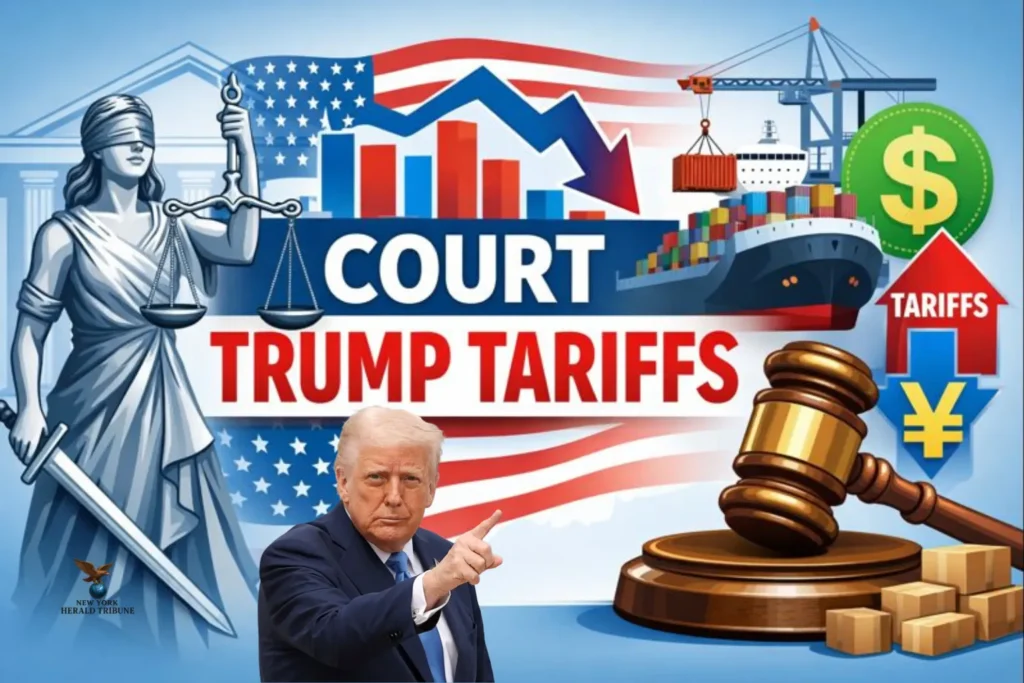
At the center of the dispute is whether a US president can unilaterally impose large-scale import tariffs under the banner of national security without direct approval from Congress. The issue, now widely referred to in legal and economic circles as the Court Trump tariffs case, goes far beyond trade policy. It has the potential to redefine the limits of presidential power in economic emergencies and reshape the future of international commerce.
The Supreme Court had earlier been expected to deliver its verdict on January 9, 2026. However, for the second time, the court has chosen to defer its decision without announcing a new hearing date. A similar delay occurred earlier in January, signaling that the justices remain deeply divided over the legal, economic, and constitutional implications of the case.
Trump’s Stark Warning: “America Could Be Ruined”
Donald Trump, who has consistently defended his tariff strategy, has publicly warned that an adverse ruling could have catastrophic consequences for the United States. According to Trump, if the Supreme Court overturns his tariffs, the federal government may be forced to refund hundreds of billions of dollars collected from importers and corporations over several years.
In Trump’s own words, such a ruling would “destroy the country economically” and undermine America’s negotiating strength on the global stage. He has repeatedly argued that tariffs were not merely a trade tool but a vital instrument of national defense, designed to protect domestic industries, reduce dependency on foreign nations, and strengthen the US economy.
These statements have intensified political pressure surrounding the Court Trump tariffs case, transforming it into a defining test of presidential authority.
What Happens If the Supreme Court Rules Against Trump?
Legal experts and economists have outlined a series of dramatic consequences if the Supreme Court ultimately rules that Trump exceeded his authority.
Possible Outcomes of an Anti-Trump Ruling
If the court invalidates the tariffs, the following developments are widely expected:
- The immediate removal of tariffs imposed under Trump’s emergency declarations
- Potential refund obligations running into hundreds of billions of dollars for US companies
- Significant relief for global exporters seeking access to the American market
- Major benefits for exporters from India, China, and European nations
- Lower prices for a wide range of consumer goods in the US
- A likely surge in stock markets due to reduced trade uncertainty
- Greater stability in global trade relations
Such a decision would also impose strict limits on the ability of future presidents to invoke emergency powers for economic policymaking.
What If the Court Sides With Trump?
On the other hand, a ruling in Trump’s favor would reinforce expansive presidential authority in trade matters.
Consequences of a Pro-Trump Verdict
If the Supreme Court upholds the tariffs:
- Trump-era tariffs would remain legally valid
- The US president would gain greater leverage over foreign governments
- Other nations may retaliate with counter-tariffs
- Global trade tensions could intensify
- Prices of imported goods may rise further
- Financial markets could experience continued volatility
Such a ruling would effectively grant the president the power to reshape global trade flows under the justification of national security, without congressional oversight.
The Origins of the Tariffs: National Security as Justification
In April 2025, Donald Trump announced sweeping tariffs on imports from dozens of countries, citing national security concerns. The tariffs were framed as a defensive response to what Trump described as an unsustainable trade deficit and excessive dependence on foreign manufacturing.
Tariffs, by definition, are taxes imposed on imported goods to make them more expensive than domestic products. The stated aim is to encourage local production, protect jobs, and strengthen national industries.
Trump claimed that these measures generated over $600 billion in revenue, funds he argued were instrumental in stabilizing the US economy and reducing reliance on foreign supply chains.
This economic strategy, however, sparked immediate backlash from businesses, economists, and state governments, eventually leading to the legal challenge now before the Supreme Court.
The Law at the Center of the Dispute: IEEPA Explained
The legal foundation for Trump’s tariffs rests on a nearly five-decade-old statute known as the International Emergency Economic Powers Act (IEEPA).
What Is the IEEPA?
Enacted in 1977, the IEEPA was designed to grant the president limited economic powers during genuine international emergencies, such as war, foreign aggression, or extraordinary external threats.
Under IEEPA, the president may:
- Regulate or block international financial transactions
- Freeze foreign assets
- Restrict imports and exports
- Impose economic sanctions
However, these powers are subject to strict conditions, including consultation with Congress and periodic reporting requirements.
Trump’s Unprecedented Use of IEEPA
Donald Trump became the first US president to use IEEPA explicitly as a legal basis for imposing broad import tariffs. Critics argue that the law was never intended to serve as a tool for routine trade policy or long-term economic restructuring.
This unprecedented application of IEEPA lies at the heart of the Court Trump tariffs controversy.
Supreme Court’s Role: Defining the Limits of Presidential Power
According to legal analysts, the Supreme Court’s decision will clarify whether a president can independently impose massive tariffs over extended periods or whether such actions require congressional approval.
If the court rules that IEEPA does not authorize such measures, it could permanently limit executive power in economic emergencies. Conversely, a ruling favoring Trump would significantly expand presidential authority.
This case is therefore not just about tariffs-it is about the constitutional balance of power between the executive branch and Congress.
Trade Deficit as a “National Emergency”
Trump justified his use of IEEPA by declaring the US trade deficit a national emergency. He argued that chronic trade imbalances weakened America’s industrial base and posed long-term security risks.
This interpretation has been fiercely contested. Opponents claim that trade deficits are a long-standing economic phenomenon, not an extraordinary emergency warranting unilateral executive action.
During hearings in November 2025, Supreme Court justices questioned whether a trade deficit qualifies as a foreign threat under the law’s original intent.
Legal Challenges From States and Small Businesses
Trump’s tariff announcement in April triggered lawsuits from small businesses and a coalition of 12 US states, including New York, California, Illinois, and Arizona.
The plaintiffs argued that:
- The president exceeded his legal authority
- Tariffs function as taxes, which fall under congressional jurisdiction
- IEEPA does not explicitly authorize tariffs
Lower courts agreed with these arguments, declaring the tariffs unlawful. Both the US Court of International Trade and the Federal Circuit ruled that IEEPA does not grant the president such expansive powers.
These rulings set the stage for Supreme Court intervention.
Judicial Skepticism at the Supreme Court
Despite the Supreme Court’s conservative majority, oral arguments revealed significant skepticism toward the Trump administration’s position.
Several justices noted that:
- The word “tariff” does not appear in IEEPA
- Congress has constitutional authority over taxation
- Allowing unilateral tariffs could set a dangerous precedent
The court also acknowledged a temporary allowance permitting Trump to impose a 15% tariff for up to 150 days, provided strong justification existed. However, long-term and large-scale tariffs remained legally questionable.
The Delay: Why the Court Is Taking Its Time
The postponement of the ruling has fueled speculation among legal experts. Some believe the justices are grappling with the far-reaching implications of either outcome. Others suggest the delay may benefit Trump by preserving the status quo.
Regardless, the absence of a decision has prolonged uncertainty for businesses, governments, and investors worldwide.
India and the Global Impact of Trump’s Tariffs
India has been among the most affected nations. The US imposed a cumulative 50% tariff on Indian goods, including a 25% penalty linked to India’s purchase of Russian crude oil.
These measures have:
- Reduced Indian exports to the US
- Increased costs for Indian manufacturers
- Complicated diplomatic negotiations
India is seeking to reduce the total tariff burden to 15% and eliminate the additional penalty entirely. Negotiations are ongoing, with hopes of progress in the coming months.
Also read: Credit Card Cap Trump Proposal Sparks Fierce Showdown Between White House and Wall Street
A Broader Global Trade Reckoning
The outcome of the Court Trump tariffs case will influence not only US trade policy but also global economic stability. A ruling against Trump could usher in a new era of predictability and multilateral cooperation. A ruling in his favor could embolden future leaders to weaponize trade policy under emergency powers.
Why This Case Matters More Than Ever
At its core, this case will define:
- The scope of presidential authority
- The role of Congress in economic policymaking
- The legal boundaries of national emergencies
- The future of global trade governance
It is a constitutional crossroads with consequences that will reverberate across markets, borders, and political systems for years to come.
Also read: Donald Trump Accused of Exploring Greenland Takeover Plan, Sparking NATO and Global Security Fears
Conclusion: A Decision That Will Shape the Future
As the Supreme Court continues to deliberate, the world watches closely. The ruling, whenever it arrives, will determine whether the United States reinforces constitutional checks and balances or expands executive power in unprecedented ways.
The Court Trump tariffs case is no longer just a legal dispute-it is a defining moment in the global economic order.