Washington, D.C.-President Donald Trump has reignited one of the most controversial economic promises of his political career, calling for a one-year cap of 10% on credit card interest rates, a move he says is aimed at protecting American families from what he describes as “exploitative” lending practices.
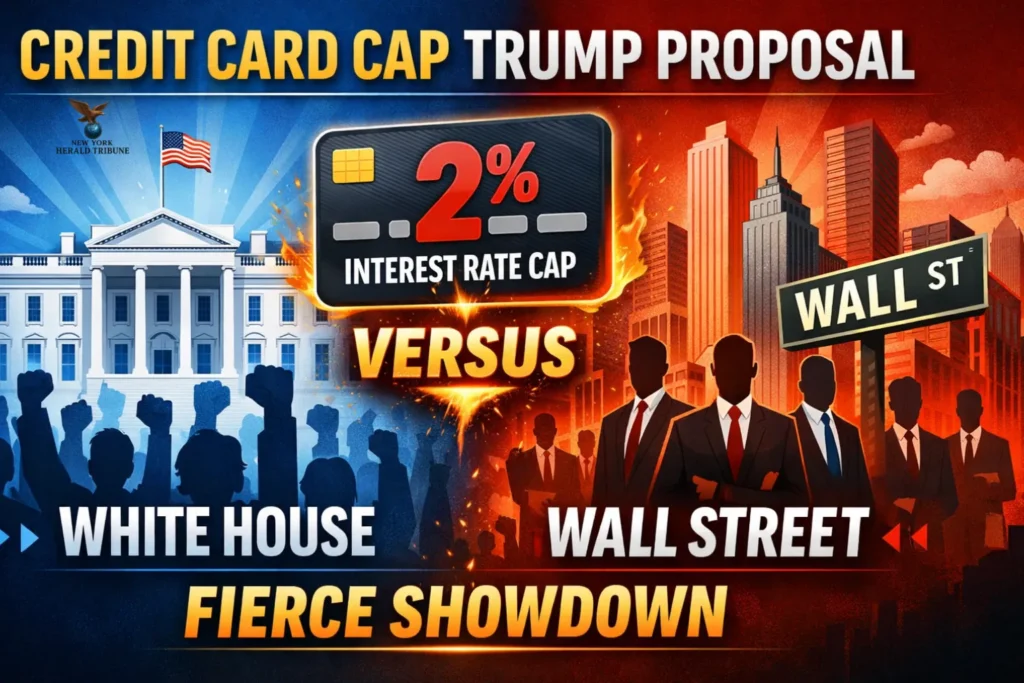
The proposal, widely referred to as the Credit card cap Trump plan, immediately sent shockwaves through the banking and financial services industry, setting up a high-stakes confrontation between the White House and some of its most powerful former allies on Wall Street.
While consumer advocates have welcomed the idea as long overdue relief for households struggling under record levels of debt, major banks and credit card issuers have issued strong warnings, arguing that such a cap could disrupt lending markets, reduce access to credit, and push borrowers toward more expensive and less regulated financial products.
A Campaign Promise Revisited
President Trump’s call for a 10% interest rate ceiling on credit cards is not new. It was first introduced as a campaign pledge during the 2024 presidential race, where Trump positioned himself as a defender of working-class Americans burdened by rising living costs, inflation, and high borrowing rates.
In a post shared on his Truth Social platform late Friday night, January 9, 2026, Trump reaffirmed that pledge, stating bluntly:
“We will no longer let the American public be ripped off by credit card companies charging interest rates of 20, 25, and even 30%.”
The president expressed hope that the cap could take effect by January 20, marking one year since he returned to office for his second term. However, he did not specify whether the cap would be imposed through executive authority or by new legislation passed by Congress.
That ambiguity has fueled intense speculation across Washington and financial markets alike.
How High Are Credit Card Interest Rates Today?
To understand the impact of the Credit card cap Trump proposal, it is important to examine the current landscape of consumer credit in the United States.
According to data from the Federal Reserve and independent financial tracking firms, average credit card interest rates currently range between 19.65% and 21.5%. Some subprime cards charge rates exceeding 29%, particularly for borrowers with weaker credit histories.
Although interest rates have eased slightly over the past year following reductions in the Federal Reserve’s benchmark rate, credit card APRs remain near historic highs, the highest levels recorded since regulators began tracking this data in the mid-1990s.
For millions of Americans carrying revolving balances, these rates translate into thousands of dollars in annual interest payments.
Potential Savings for Consumers
Independent researchers who analyzed Trump’s proposal when it was first unveiled during the campaign estimated that capping credit card interest at 10% could save Americans close to $100 billion annually in interest charges.
These savings would disproportionately benefit:
- Middle-income households
- Lower-income borrowers
- Seniors on fixed incomes
- Young Americans facing student loan and housing costs
Supporters argue that the policy could act as an immediate form of financial relief without requiring taxpayer spending.
“Interest rates on credit cards are among the most punitive in consumer finance,” said one economist familiar with the research. “A cap would dramatically shift the balance of power away from lenders and toward borrowers.”
Wall Street Pushback Was Immediate
Despite Trump’s populist framing, the response from the banking sector was swift and critical.
Major financial institutions-many of which donated heavily to Trump’s 2024 campaign and supported key elements of his second-term agenda — have warned that a mandated rate ceiling could destabilize the credit market.
In a joint statement, the American Bankers Association and allied industry groups said:
“If enacted, this cap would likely reduce access to credit for millions of consumers and push borrowers toward less regulated, more costly alternatives.”
Banks argue that credit card interest rates reflect risk, especially for borrowers with weaker credit profiles. A uniform cap, they claim, would make it unprofitable to lend to higher-risk consumers, potentially cutting off access to credit altogether.
A Complicated Relationship With Big Banks
The Credit card cap Trump proposal marks a notable shift in tone for an administration that has, until now, been widely viewed as friendly toward the financial industry.
Since returning to office, Trump has overseen:
- The approval of Capital One’s acquisition of Discover Financial, creating the largest credit card issuer in the country
- A sharp reduction in enforcement activity at the Consumer Financial Protection Bureau (CFPB)
- A broader rollback of financial regulations introduced after the 2008 crisis
Critics argue that these policies have emboldened banks to raise fees and interest rates, while consumer protections have weakened.
This apparent contradiction-deregulation on one hand, rate caps on the other-has led some observers to question whether the proposal will ultimately move forward.
Executive Order or Congressional Action?
One of the biggest unanswered questions surrounding the Credit card cap Trump plan is how it would be implemented.
The White House has not clarified whether the president believes he has the authority to impose a cap through executive action, or whether he will rely on Congress to pass legislation.
A White House spokesperson declined to comment on whether Trump has consulted with credit card companies or banking executives before making the announcement.
Legal experts note that while presidents have broad authority in some areas of economic policy, imposing a nationwide interest rate cap would likely face significant legal challenges unless enacted by Congress.
Republican Support Emerges
Despite opposition from Wall Street, Trump’s proposal has gained traction among certain lawmakers in both parties.
Senator Roger Marshall of Kansas, a Republican, said he spoke directly with Trump on Friday night and confirmed that the president is fully supportive of legislative efforts to enact the cap.
“This is about lowering costs for American families and reining in greedy credit card companies that have been ripping off hardworking Americans for far too long,” Marshall said.
According to the senator, draft legislation is already being discussed in both the House and the Senate.
Bipartisan Momentum Builds
Interestingly, the Credit card cap Trump proposal aligns with measures previously introduced by lawmakers across the political spectrum.
In February, Senator Bernie Sanders of Vermont and Senator Josh Hawley of Missouri unveiled a bipartisan bill that would cap credit card interest rates at 10% for five years.
Sanders argued that Trump’s renewed support could help build momentum for broader reform.
“For decades, credit card companies have made obscene profits by trapping working people in cycles of debt,” Sanders said at the time.
However, Sanders also criticized Trump earlier on Friday, accusing him of simultaneously deregulating large banks in ways that allowed them to charge higher fees.
House Lawmakers Enter the Debate
In the House of Representatives, similar proposals have emerged.
Representative Alexandria Ocasio-Cortez of New York, a frequent political critic of Trump, has long advocated for caps on consumer interest rates.
Meanwhile, Representative Anna Paulina Luna of Florida, a close Trump ally, has also voiced support for limiting credit card APRs.
The unlikely overlap between progressive Democrats and conservative Republicans underscores the political potency of the issue.
Impact on Credit Card Rewards and Benefits
While researchers suggest that the credit card industry would remain profitable under a 10% cap, they also acknowledge that consumers could see changes in perks.
Potential impacts include:
- Reduced cashback rewards
- Fewer airline miles and points programs
- Higher annual fees on some cards
- Stricter approval criteria
Banks may attempt to offset lost interest revenue through other charges or by scaling back incentives.
Consumer advocates argue that the trade-off is worth it, particularly for households paying thousands of dollars a year in interest alone.
The Broader Economic Context
Trump’s proposal comes at a time when American households are under increasing financial strain.
Despite easing inflation, many families continue to struggle with:
- Elevated housing costs
- Rising insurance premiums
- Student loan repayments
- Medical expenses
Credit card balances have reached record levels nationwide, making interest rates a growing political issue ahead of the 2026 midterm elections.
Political Calculations Behind the Move
Some analysts believe the Credit card cap Trump announcement is as much political as it is economic.
By taking on banks-traditionally viewed with suspicion by much of the electorate-Trump may be seeking to reinforce his populist credentials and appeal to working-class voters.
At the same time, the proposal risks alienating powerful donors and financial institutions that have historically supported Republican campaigns.
Whether Trump is willing to follow through in the face of intense lobbying pressure remains an open question.
Also read: Donald Trump Accused of Exploring Greenland Takeover Plan, Sparking NATO and Global Security Fears
What Happens Next?
For now, the Credit card cap Trump proposal remains an idea rather than enacted policy.
Key next steps include:
- Drafting formal legislation
- Clarifying the administration’s legal strategy
- Navigating committee hearings in Congress
- Facing likely opposition from the financial lobby
If passed, the measure would represent one of the most significant interventions in consumer credit markets in modern U.S. history.
Conclusion: A Defining Economic Battle
The push to cap credit card interest rates at 10% has set the stage for a defining economic and political battle of Trump’s second term.
Supporters see it as a long-overdue correction to a system they believe has exploited consumers for decades. Opponents warn of unintended consequences and market disruption.
As debate intensifies in Washington, millions of Americans watching their monthly statements may find themselves hoping that the Credit card cap Trump proposal becomes more than just another campaign promise-and instead, a turning point in the fight against runaway consumer debt.