New Delhi / Wellington:
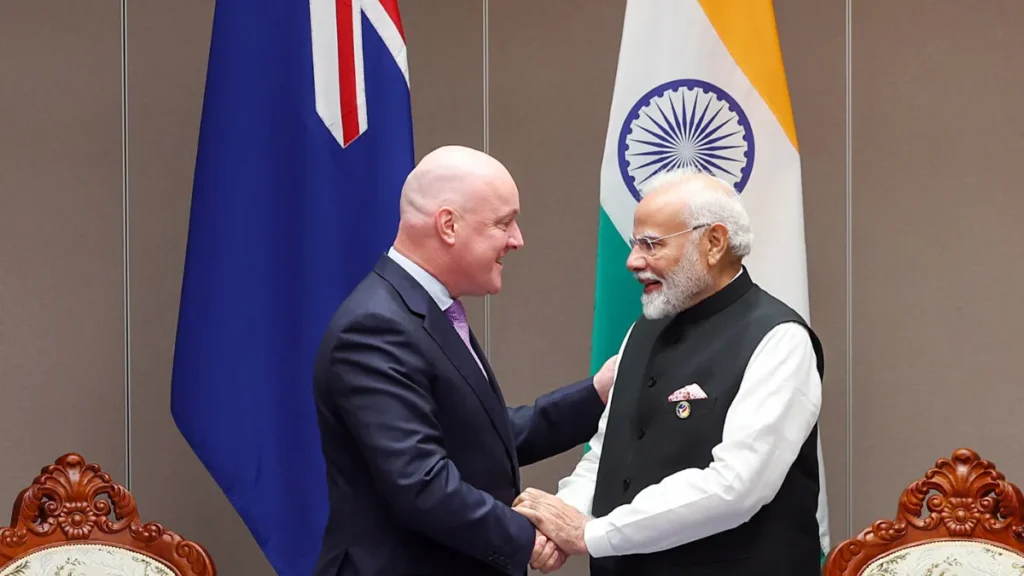
India New Zealand trade: India and New Zealand have taken a decisive step toward reshaping their economic relationship with the formal conclusion of a comprehensive and future-oriented Free Trade Agreement (FTA). Announced on Monday, the pact is being widely described as a turning point for India New Zealand trade, with far-reaching implications for commerce, investment, services, education, agriculture, and people-to-people ties across the Indo-Pacific region.
The agreement is one of the fastest FTAs India has ever concluded with a developed economy, underscoring the growing strategic trust between New Delhi and Wellington. It also aligns closely with India’s long-term national development roadmap, Viksit Bharat 2047, which envisions India as a developed, globally integrated economy by the centenary year of its independence.
With trade liberalisation, investment commitments, mobility provisions, and sector-specific cooperation at its core, the India–New Zealand FTA is designed not merely as a tariff-cutting arrangement, but as a modern economic partnership aimed at shared growth and resilience.
A Swiftly Concluded Agreement with Strategic Significance
Formal negotiations for the India–New Zealand Free Trade Agreement began on March 16, 2025, following a high-level meeting between India’s Union Minister for Commerce and Industry, Piyush Goyal, and New Zealand’s Minister for Trade and Investment, Todd McClay. What followed was an unusually rapid negotiation process by global trade standards.
Within a span of just nine months, the two sides successfully completed five full rounds of formal negotiations, supported by several in-person consultations and virtual intersessional discussions. Trade experts have noted that such speed reflects both political will and a high degree of complementarity between the two economies.
The conclusion of the FTA places New Zealand among a select group of developed nations with which India has successfully finalised a comprehensive trade agreement in recent years. It also signals India’s intent to deepen economic engagement in the Indo-Pacific, a region of growing geopolitical and commercial importance.
Zero-Duty Market Access: A Major Win for Indian Exports
One of the most significant features of the agreement is New Zealand’s decision to grant zero-duty market access on 100 per cent of its tariff lines. This means that all Indian goods exported to New Zealand will now enjoy duty-free entry, a move expected to substantially enhance India’s export competitiveness.
On its part, India has committed to tariff liberalisation on approximately 70 per cent of its tariff lines, which together account for nearly 95 per cent of current bilateral trade. This calibrated approach balances market openness with the need to protect domestic producers and sensitive sectors.
Importantly, India has excluded a range of sensitive agricultural and industrial products from tariff concessions. These include dairy, coffee, milk and milk products, sugar, spices, edible oils, rubber, and onions. By doing so, India has ensured that the agreement does not undermine the livelihoods of farmers or expose vulnerable domestic industries to sudden import surges.
This structure reflects a growing trend in India’s trade policy: pursuing ambitious trade liberalisation while safeguarding core economic and social interests.
Boost for Labour-Intensive Manufacturing and Exports
The India–New Zealand FTA is expected to provide a strong push to several of India’s labour-intensive sectors, which are critical for job creation and inclusive growth. Industries set to benefit include:
- Textiles and apparel
- Leather and footwear
- Marine and seafood products
- Gems and jewellery
- Handicrafts
- Engineering goods
- Automobiles and auto components
- Pharmaceuticals
- Processed and fresh agricultural products
With duty-free access to the New Zealand market, Indian exporters in these sectors are likely to gain improved price competitiveness and expanded market share. This is particularly relevant for small and medium-sized enterprises (SMEs), which form the backbone of India’s export ecosystem.
The agreement also strengthens India’s manufacturing ambitions by facilitating easier access to key industrial inputs from New Zealand. These include wooden logs, coking coal, and metal waste and scrap, which are essential for sectors such as steel, construction, furniture manufacturing, and energy.
By lowering input costs and ensuring supply chain stability, the FTA supports India’s broader “Make in India” and “Atmanirbhar Bharat” initiatives.
Services Trade: India Secures New Zealand’s Most Ambitious Offer
Services form a central pillar of India New Zealand trade, and the FTA delivers what officials describe as New Zealand’s most ambitious services offer in any of its trade agreements to date.
Under the pact, New Zealand has made binding commitments across 118 services sectors, including:
- Computer and IT-enabled services
- Professional and consultancy services
- Audio-visual and creative industries
- Telecommunications
- Construction and engineering services
- Tourism and travel-related services
- Education and training services
In addition, Most-Favoured Nation (MFN) commitments have been extended across around 139 sub-sectors, ensuring that Indian service providers receive treatment equal to or better than that accorded to competitors from other countries.
These provisions are expected to open new doors for Indian IT firms, consultants, architects, engineers, educators, and creative professionals, while also supporting high-skill employment and knowledge exchange.
Mobility and Education: Strengthening People-to-People Ties
A defining feature of the India–New Zealand FTA is its strong emphasis on mobility, education, and talent exchange. Recognising the importance of human capital, the agreement includes several forward-looking measures to enhance opportunities for students and professionals.
Expanded Post-Study Work Rights
Indian students studying in New Zealand will benefit significantly from enhanced post-study work provisions:
- Up to three years of post-study work rights for graduates of STEM bachelor’s and master’s programmes
- Up to four years of post-study work rights for doctoral (PhD) graduates
Crucially, these opportunities come without numerical caps, offering predictability and confidence to Indian students planning long-term academic and professional pathways in New Zealand.
New Employment and Holiday Visa Pathways
The FTA also introduces a Temporary Employment Entry visa pathway, allowing up to 5,000 Indian professionals to work in New Zealand at any given time. In addition, 1,000 Work and Holiday visas will be made available, further enhancing youth mobility and cultural exchange.
These measures are expected to deepen people-to-people ties, address skill shortages in New Zealand, and provide Indian professionals with valuable international exposure.
Agriculture: Productivity Partnerships and Farmer-Centric Growth
While safeguarding sensitive sectors, the agreement also creates new avenues for agricultural collaboration through the establishment of Agricultural Productivity Partnerships.
Dedicated Centres of Excellence will be set up for key products such as apples, kiwifruit, and honey. These centres will focus on:
- Productivity enhancement
- Technology transfer
- Research and innovation
- Quality improvement
- Value-chain development
The goal is to raise farmer incomes, improve crop quality, and promote sustainable agricultural practices. To protect Indian producers, market access for these products will be regulated through quotas and minimum import prices, ensuring that domestic markets are not disrupted.
This balanced approach demonstrates how trade agreements can support agricultural development without compromising food security or farmer welfare.
Investment Commitments: USD 20 Billion Pledge from New Zealand
One of the most striking announcements accompanying the FTA is New Zealand’s commitment to facilitate investments worth USD 20 billion in India over the next 15 years.
These investments are expected to flow into priority sectors such as:
- Manufacturing
- Infrastructure
- Services
- Innovation and technology
- Employment-intensive industries
The investment pledge aligns closely with India’s development priorities and is expected to generate significant employment, technology transfer, and value addition.
Indian companies, in turn, are likely to gain enhanced access not only to the New Zealand market but also to the wider Pacific Island economies, strengthening India’s commercial footprint in the region.
Pharmaceuticals and Medical Devices: Faster Regulatory Pathways
The FTA provides a major boost to India’s pharmaceutical and medical devices industries, which are already globally competitive.
Under the agreement, New Zealand will facilitate faster regulatory access by accepting Good Manufacturing Practice (GMP) and Good Clinical Practice (GCP) inspection reports from trusted regulators such as:
- The US Food and Drug Administration (US FDA)
- The European Medicines Agency (EMA)
- The UK Medicines and Healthcare products Regulatory Agency (MHRA)
This mutual recognition framework is expected to reduce compliance costs, shorten approval timelines, and accelerate the entry of Indian medicines and devices into the New Zealand market.
Given India’s role as a global supplier of affordable medicines, these provisions enhance the strategic and humanitarian dimensions of India New Zealand trade.
Protection of Geographical Indications and Cultural Products
The agreement also strengthens cooperation on Geographical Indications (GIs), with New Zealand committing to amend its laws to facilitate the registration of Indian products within defined timelines.
This move will benefit Indian wines, spirits, handicrafts, and region-specific agricultural goods, helping protect their authenticity and global reputation.
Beyond trade, the FTA promotes cooperation in areas such as:
- AYUSH and traditional medicine
- Culture and creative industries
- Fisheries and aquaculture
- Audio-visual tourism
- Forestry and horticulture
- Traditional knowledge systems
These initiatives underscore the comprehensive and people-centric nature of the partnership.
Addressing Non-Tariff Barriers and Improving Ease of Trade
Recognising that tariffs are only one part of the trade equation, the India–New Zealand FTA includes robust provisions to tackle non-tariff barriers.
Key measures include:
- Enhanced regulatory cooperation
- Greater transparency in trade rules
- Streamlined customs procedures
- Improved sanitary and phytosanitary (SPS) standards
- Stronger technical standards and conformity assessment mechanisms
Together, these steps are expected to reduce transaction costs, improve predictability, and make it easier for businesses—especially SMEs—to participate in bilateral trade.
Leadership Perspectives: Trade Built Around People
Speaking on the occasion, Commerce and Industry Minister Piyush Goyal described the agreement as being “about building trade around people and launching opportunities.”
He highlighted that the FTA would:
- Boost agricultural productivity
- Raise farmer incomes
- Open new global markets for Indian businesses
- Create learning and employment opportunities for Indian youth
Commerce Secretary Rajesh Agrawal termed the pact a “new-generation trade agreement” anchored in tariffs, productivity, investment, and talent. He emphasised that India’s strengths in labour-intensive manufacturing and services would drive export growth, while New Zealand would gain reliable access to one of the world’s largest and fastest-growing markets.
Read also: Visit of PM to Oman Strengthens Strategic, Economic and Cultural Partnership
Trade Numbers and Future Potential
Bilateral merchandise trade between India and New Zealand reached approximately USD 1.3 billion in 2024–25, while total trade in goods and services stood at around USD 2.4 billion. Services trade alone accounted for USD 1.24 billion, highlighting the growing importance of knowledge-based sectors.
Officials from both sides believe these figures represent only a fraction of the relationship’s true potential. By providing a stable, predictable, and transparent framework, the FTA is expected to unlock new growth avenues and significantly expand India New Zealand trade in the coming decade.
A Strategic Step Toward Viksit Bharat 2047
The India–New Zealand Free Trade Agreement is the third major trade pact concluded by India this year, reflecting a renewed push toward economic diplomacy and global integration.
More than a commercial arrangement, the agreement represents a strategic commitment to a people-centric, jobs-driven partnership. It strengthens India’s role in the Indo-Pacific, deepens ties with a trusted partner, and supports the long-term vision of Viksit Bharat 2047.
As the agreement moves toward implementation, businesses, students, farmers, and professionals on both sides are poised to benefit from a more open, collaborative, and future-ready economic relationship-one that firmly positions India New Zealand trade as a model for modern, inclusive global commerce.