Washington, D.C. NASA Artemis Rocket Launch: NASA has taken a major step forward in its ambitious return-to-the-Moon program, as engineers began moving the powerful Space Launch System (SLS) rocket and Orion spacecraft back to the launch pad in Florida. The move signals renewed momentum for the much-anticipated nasa artemis rocket launch, which could send astronauts around the Moon as early as April.
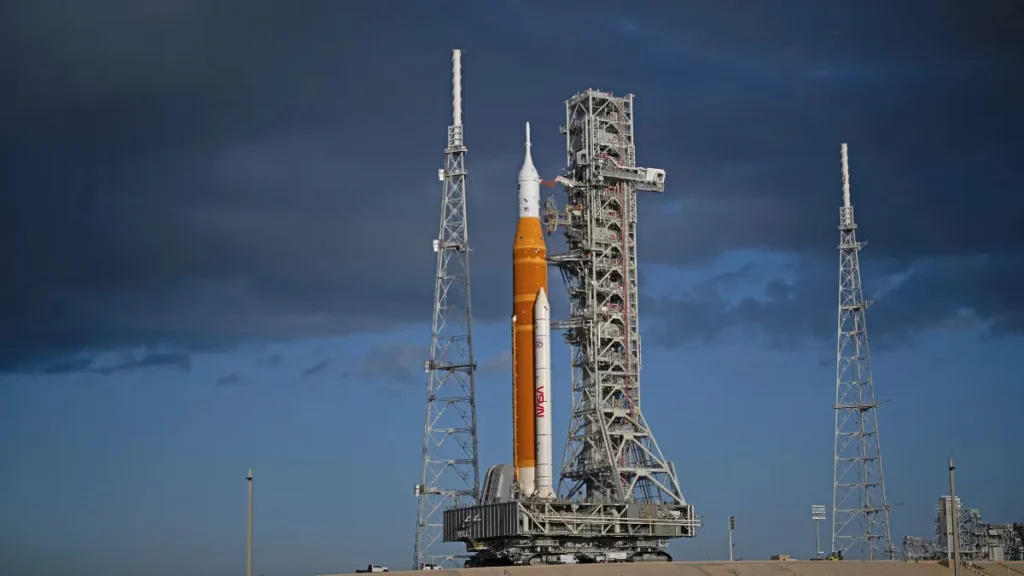
After weeks of technical inspections and repairs, the towering rocket-one of the most powerful ever built-is once again on the move at Kennedy Space Center. The rollout process, which began Thursday evening, is a slow and carefully coordinated operation that can take up to 12 hours to complete.
Massive Rocket Returns to Launch Pad
The giant orange-and-white SLS rocket, paired with NASA’s Orion crew capsule, is being transported from the Vehicle Assembly Building to Launch Pad 39B. The journey spans approximately four miles (6.5 kilometers), with the entire structure mounted on a specialized crawler-transporter that moves at a walking pace.
This relocation marks a critical milestone in preparations for the upcoming nasa artemis rocket launch, as teams get ready for final testing and countdown procedures. Once positioned at the pad, engineers will conduct a series of checks to ensure all systems are functioning properly before giving the green light for launch.
Artemis II Mission: A Historic Lunar Flyby
If all goes according to plan, the Artemis II mission will carry four astronauts-three from the United States and one from Canada-on a 10-day journey around the Moon. This mission will not land on the lunar surface but will serve as a crucial test flight for future crewed landings.
The upcoming nasa artemis rocket launch represents a historic milestone, as it will be the first time humans travel beyond low-Earth orbit since the Apollo era more than 50 years ago. The mission is widely seen as a stepping stone toward NASA’s long-term goal of establishing a sustainable human presence on the Moon.
Delays and Technical Challenges
Despite the excitement surrounding the mission, NASA’s Artemis program has faced multiple delays and technical hurdles. Most recently, engineers identified a problem with helium flow in the rocket system. As a result, the entire Artemis II stack-weighing an astonishing 11 million pounds-was rolled back into the Vehicle Assembly Building for further investigation.
Earlier issues had also complicated preparations for the nasa artemis rocket launch, including a liquid hydrogen leak that forced NASA to cut short a critical “wet dress rehearsal.” This rehearsal is designed to simulate the full launch countdown, including fueling the rocket, and is essential for ensuring mission readiness.
These setbacks ultimately pushed the launch timeline beyond March, prompting NASA to target a new window starting April 1. While delays have been frustrating, officials emphasize that safety remains the top priority.
April Launch Window in Focus
NASA is now aiming for its first launch opportunity on April 1, with additional backup dates available in the following days. Engineers remain cautiously optimistic that the issues have been resolved and that the rocket will be ready for liftoff.
The success of the upcoming nasa artemis rocket launch will depend on the results of final tests conducted at the launch pad. Any remaining technical concerns must be addressed before the mission receives final clearance.
Astronauts Prepare for the Journey
Meanwhile, the four-member Artemis II crew has entered quarantine in Houston as part of standard pre-launch protocols. This step is designed to minimize the risk of illness before the mission, ensuring that all astronauts are in peak condition for the historic journey.
The crew’s mission will involve traveling thousands of miles beyond Earth, orbiting the Moon, and returning safely-a complex operation that will test NASA’s deep-space capabilities.
A New Era of Lunar Exploration
The Artemis program represents NASA’s most ambitious effort since the Apollo missions, aiming not only to return humans to the Moon but also to pave the way for future exploration of Mars. The upcoming nasa artemis rocket launch is a crucial part of that vision, demonstrating the technologies and systems needed for long-duration space travel.
Originally announced during the administration of Donald Trump, the Artemis program has continued to evolve, with strong support from both government and international partners. The inclusion of a Canadian astronaut on Artemis II highlights the growing global collaboration in space exploration.
Also Read: BMW i3 Unveiled: A Stunning Electric Evolution of the Iconic 3 Series
Conclusion:
If the Artemis II mission is successful, it will set the stage for Artemis III, which aims to land astronauts on the Moon’s surface for the first time in decades. NASA hopes this will mark the beginning of a sustained human presence on the lunar surface, including the construction of a lunar base.
For now, all eyes are on Florida as the SLS rocket makes its slow journey back to the launch pad. The coming weeks will be critical as engineers complete final checks and prepare for what could be a defining moment in modern space exploration.
The world is watching closely as NASA moves one step closer to making history once again with the nasa artemis rocket launch-a mission that could usher in a new chapter in humanity’s quest to explore beyond Earth.