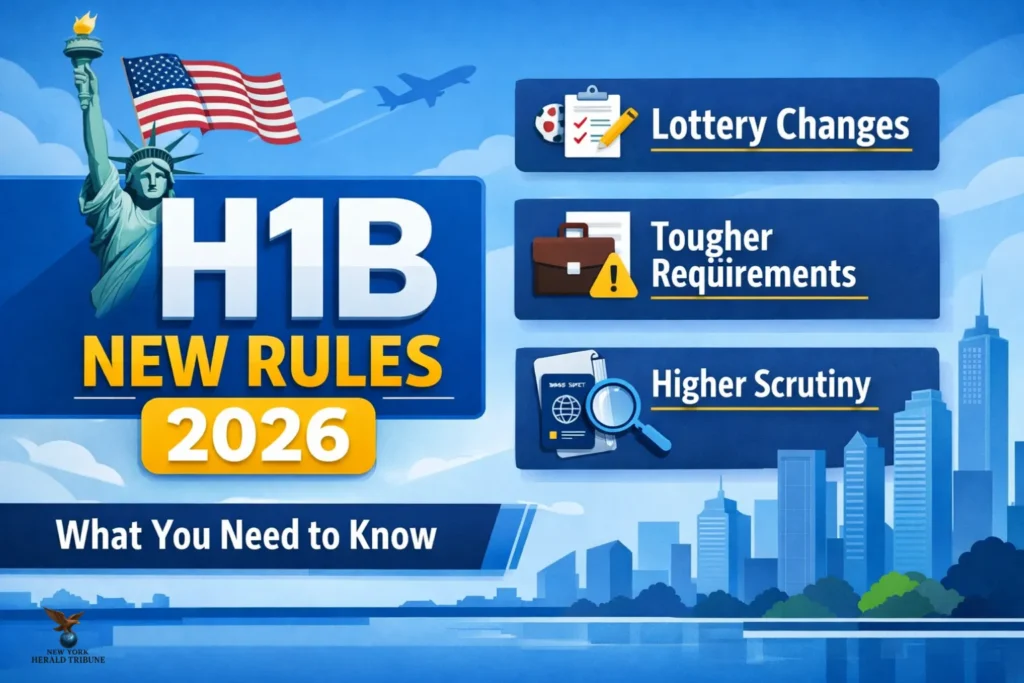
The H1B new rules 2026 have introduced significant changes that are creating uncertainty for thousands of Indian professionals and their families. What was once a predictable process for maintaining H1B status and traveling between India and the United States has now become complex and stressful. For many Gujaratis, in particular, these changes have disrupted plans for work, family reunions, and even marriages.
With the one-year anniversary of Donald Trump’s presidency on January 20, 2026, the U.S. administration has continued its “America First” policy, enforcing stricter immigration rules aimed at tightening oversight for foreign nationals. While these rules were designed to prevent fraudulent entries and protect American jobs, they have inadvertently affected highly skilled workers who have been contributing to the U.S. economy for years.
The Genesis of the H1B New Rules 2026
The latest changes were implemented in December 2025 and came into effect on December 15, 2025, extending stringent checks beyond student (F1) and visitor visas to include H1B and H4 visa holders. A major component of these rules is the mandatory social media verification. Previously, social media assessments were primarily applied to F1 students or visitors applying for U.S. visas. Now, any H1B or H4 visa applicant seeking renewal or stamping outside the U.S. must undergo social media screening.
The purpose, according to U.S. immigration authorities, is to prevent illegal or fraudulent entries. However, this has created major complications for professionals who are traveling back to India for personal or professional reasons, particularly during the end-of-year holiday period when many take leave from work.
How the Rules Are Affecting Indian Professionals
The impact of these rules has been most pronounced among Indians in the U.S., including Gujaratis. Many are now facing the uncertainty of whether they will be able to return to the U.S. after traveling abroad. Professionals are experiencing:
- Cancelled visa appointments due to pending social media verification
- Delays in visa stamping, pushing return dates to mid-2026
- Work disruptions, especially for roles that cannot be performed remotely
- Family complications, as dependent H4 visa holders may also be affected
Case Study 1: The Raj Shah Family
Raj Shah (name changed for privacy) was on an H1B visa in the U.S. with his wife and two children. The family traveled to India for the holiday season, expecting routine visa renewal. However, due to the new social media checks, their visa stamping date was canceled and rescheduled for June 2026.
The situation created multiple complications:
- Raj requested work-from-home approval from his company, but the company could only offer a six-month remote arrangement, leaving uncertainty for his H1B status.
- Without a valid H1B status, Raj’s wife and children could not return to the U.S., creating the risk of family separation.
- The youngest child, born in the U.S., could remain, but the rest of the family might have to stay in India until visa approval.
This scenario highlights how a single policy change can ripple across work, family, and residency planning.
Case Study 2: Nisarg and Niharika
Nisarg and Niharika (names changed) were scheduled to marry in January 2026. Both were H1B visa holders employed at well-paying U.S. companies, earning around $100,000 each. Niharika traveled to India early December to prepare for the wedding, while Nisarg planned to arrive later.
Unexpectedly, on December 9, 2025, they received an email stating that their visa appointments were canceled, pushing their stamping dates to June 2026. This meant:
- Niharika could not return to the U.S., putting her job and H1B status at risk.
- Nisarg had to cancel his travel plans and postpone the wedding, highlighting how visa delays are directly impacting personal lives.
- If work-from-home approval is not granted, both could risk losing their H1B status.
Expert Insights on the H1B New Rules 2026
Immigration experts Parthesh Thakker and Bhavin Thakker have emphasized the widespread effect of these rules on Indian professionals. According to them:
- Mandatory social media verification is now applied to H1B visa holders in addition to F1 students and visitor visas.
- The H1B visa process involves transitioning from F1 student visas to H1B work visas, sometimes spanning 10–20 years of stay in the U.S. Many applicants renew passports or visas without needing to leave the U.S., but international travel now requires a valid H1B stamp.
- Professionals with H1B visas who leave the U.S. must book appointments at their country’s U.S. embassy for stamping, which can take several months due to the social media review backlog.
They caution that Indian nationals are particularly affected, as India accounts for a large proportion of H1B visa holders globally. With new rules in place, thousands of appointments have been canceled simultaneously, forcing individuals to wait months before they can return.
Why the Holiday Season Exacerbates the Problem
End-of-year holidays, especially in December, are traditionally when U.S.-based professionals plan trips to India. Visa holders often schedule appointments for stamping, plan family visits, and align these trips with work breaks.
- This year, approximately 70,000 Indian H1B visa holders had appointments scheduled in December 2025.
- Following the implementation of social media checks, all these appointments were canceled, with new dates often pushed 4–6 months later.
- This has disrupted both professional commitments and personal plans, forcing many to remain in India until their visa is approved.
The Visa Stamping and H1B Process
Understanding how H1B visas work is critical to comprehending the impact of these rules:
- F1 Student Visa: Professionals often start in the U.S. on an F1 student visa.
- OPT (Optional Practical Training): Graduates may work in the U.S. under OPT, which still falls under the student visa category.
- H1B Selection: After OPT, they may transition to H1B status through lottery selection or employer sponsorship.
- Visa Stamping: Professionals must have their passport stamped with H1B approval if leaving the U.S. for any international travel.
- Green Card Wait: Many H1B holders stay in the U.S. for years, often without receiving a green card. Traveling back to the U.S. requires proper stamping to maintain status.
With the H1B new rules 2026, social media verification is now a mandatory part of the stamping process. If an applicant leaves the U.S. without a completed stamp, they risk being denied reentry.
Read also: Credit Card Cap Trump Proposal Sparks Fierce Showdown Between White House and Wall Street
Recommendations from Experts
Lawyers and immigration specialists are advising H1B visa holders to:
- Avoid international travel for the next 1–2 years unless absolutely necessary
- Seek work-from-home approvals if stranded abroad to maintain H1B status
- Plan visa stamping and appointments well in advance, considering potential delays
- Stay updated on U.S. embassy announcements regarding social media checks
Bhavin Thakker emphasized that applicants with November–January appointments have been pushed to June or July 2026 due to the mandatory social media assessment. This period is particularly challenging for those dependent on U.S. employment and residency.
Broader Implications for Families and Employers
The H1B new rules 2026 not only affect individuals but also extend to families and employers:
- Employers may lose key employees temporarily if remote work is not approved.
- Families face separation if dependent H4 visas cannot be renewed in India.
- Marriages, educational plans for children, and personal milestones are being disrupted.
For example, in the Raj Shah family case, one child remains in the U.S., while the rest of the family must stay in India, highlighting the emotional toll of these changes.