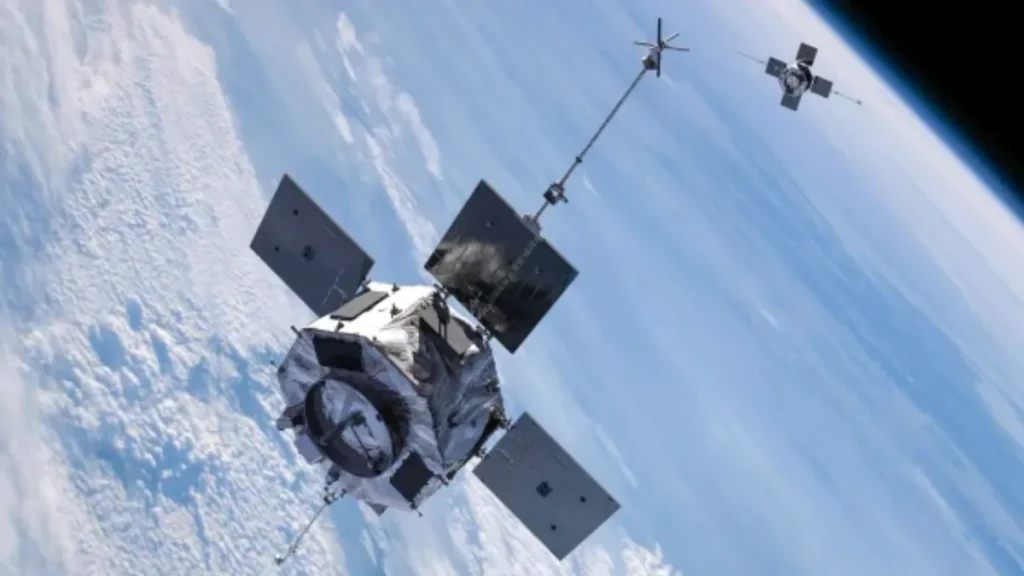
NASA Satellite Crash: A long-retired spacecraft launched by the NASA is expected to make an uncontrolled return to Earth, sparking renewed global discussion about the growing challenge of space debris and the potential dangers posed by aging satellites. The event—often described in media coverage as a possible “nasa satellite crash”—involves a scientific probe that once helped researchers better understand Earth’s radiation environment.
According to scientists and tracking agencies, the spacecraft could plunge back into Earth’s atmosphere earlier than originally predicted. While experts emphasize that most of the vehicle will likely burn up during the intense heat of reentry, a small number of components may survive and reach the ground.
The incident highlights both the successes of past scientific missions and the emerging concerns around orbital debris as the number of satellites orbiting Earth continues to grow rapidly. Although the probability of injury or damage is extremely low, space agencies are closely monitoring the situation as the spacecraft approaches its final descent.
This article explores the mission behind the spacecraft, the science it delivered, the circumstances leading to its premature return, and the broader implications of space debris management in an era of increasing space activity.
NASA Satellite Crash: Space Probe Expected to Reenter Earth’s Atmosphere
A scientific spacecraft developed and launched by NASA is predicted to reenter Earth’s atmosphere soon in what experts describe as an uncontrolled descent. The probe, weighing approximately 1,323 pounds (600 kilograms), is expected to encounter the upper atmosphere sometime around 7:45 p.m. Eastern Time on Tuesday, although scientists note there is an uncertainty window of roughly 24 hours on either side.
The object involved in the anticipated nasa satellite crash is known as Van Allen Probe A, a spacecraft launched more than a decade ago to study the powerful radiation zones surrounding Earth.
Tracking calculations provided by United States Space Force and NASA indicate that the spacecraft has gradually lost altitude due to atmospheric drag. As it descends further into the thicker layers of Earth’s atmosphere, friction will generate intense heat, causing most of the probe to disintegrate.
However, not every component is guaranteed to burn completely. Scientists say certain dense pieces—such as parts made of titanium or steel—could potentially survive reentry and reach the surface.
Even so, the odds of debris causing harm remain extremely small.
Assessing the Risk to People on the Ground
NASA scientists have calculated the probability that falling debris from the spacecraft could harm a person on Earth. According to the agency, the chance is roughly 1 in 4,200.
In statistical terms, this probability is very low. Experts emphasize that Earth’s surface is largely covered by oceans, deserts, forests, and uninhabited regions, meaning any surviving fragments are far more likely to land in remote areas than near populated locations.
Space debris specialist Darren McKnight, a senior technical fellow at the satellite tracking company LeoLabs, explained that the risk level is still considered manageable.
He noted that previous reentry events have involved probabilities as high as 1 in 1,000, yet none resulted in injuries.
From a global safety perspective, McKnight said the current risk profile does not represent an extraordinary threat to humanity. Even though headlines describing a nasa satellite crash may sound alarming, the actual danger to individuals is extremely limited.
Still, this particular scenario carries a slightly higher risk level compared with some earlier satellite reentries.
Comparing With Previous Spacecraft Reentries
One frequently cited comparison involves the uncontrolled descent of the Chinese space station Tiangong-1 in 2018.
When that station reentered the atmosphere, analysts estimated that the chance of debris striking a person anywhere on Earth was less than one in a trillion—an extraordinarily tiny probability.
Ultimately, fragments from Tiangong-1 burned up or fell harmlessly into the ocean, and no injuries were reported.
The current nasa satellite crash scenario carries somewhat higher risk estimates than that event, but experts stress that the difference does not significantly change the overall safety outlook.
Most satellite reentries end without incident, largely because the atmosphere acts as an effective shield that incinerates objects traveling at orbital speeds.
The Mission Behind the Van Allen Probes
The spacecraft at the center of this story—Van Allen Probe A—was launched in 2012 alongside its twin, Van Allen Probe B.
Together, the two spacecraft formed the Van Allen Probes Mission, an ambitious scientific effort aimed at studying Earth’s radiation belts.
These belts, often referred to as the Van Allen radiation belts, consist of zones filled with high-energy charged particles trapped by Earth’s magnetic field. They stretch across vast distances, ranging from about 400 miles to more than 58,000 miles above the planet.
The radiation belts are named after American physicist James Van Allen, who first discovered them in 1958 using data from early satellites.
Understanding these radiation regions is critical because they can affect both space technology and human spaceflight.
Why the Radiation Belts Matter
Earth’s radiation belts act as a natural protective barrier. They shield the planet from harmful cosmic radiation, powerful solar storms, and streams of charged particles known as the solar wind.
Without this protection, Earth’s environment—and the technology humans rely on—could face significant risks.
NASA scientists have long sought to understand how these belts behave during different space weather conditions. Changes in solar activity can cause the belts to expand, intensify, or even temporarily disappear.
The Van Allen Probes provided unprecedented insight into these processes.
During their mission, the spacecraft recorded valuable measurements of magnetic fields, charged particles, and radiation dynamics.
One of the most remarkable discoveries came when scientists detected a temporary third radiation belt, which forms during periods of intense solar activity. Before the mission, researchers believed Earth had only two such belts.
The discovery reshaped scientists’ understanding of near-Earth space.
Mission Success and Extended Operations
The Van Allen Probes were originally designed for a mission lasting about two years.
However, both spacecraft continued operating far beyond their planned lifespan. Thanks to careful management and the durability of their systems, they remained active for seven years, collecting a vast amount of data about Earth’s radiation environment.
The mission officially concluded in 2019, when the spacecraft gradually ran out of the fuel needed to maintain their orbits and perform scientific maneuvers.
Despite the end of active operations, the probes continued orbiting Earth for several years afterward.
Now, one of them is approaching its final return to Earth in what observers have described as a potential nasa satellite crash event.
Planning the Spacecraft’s End of Life
From the beginning of the mission, NASA engineers knew that the spacecraft would eventually have to be removed from orbit.
Rather than leaving them drifting indefinitely in space, mission planners decided the probes would ultimately reenter Earth’s atmosphere and burn up.
This strategy is commonly used for satellites operating in low-Earth orbit. By allowing atmospheric drag to slowly pull a spacecraft downward, agencies can ensure it eventually disintegrates in the upper atmosphere.
Before concluding the mission, NASA executed several maneuvers to prepare the spacecraft for its final phase.
These operations included:
- Releasing any remaining fuel
- Adjusting the spacecraft’s orbit
- Ensuring the vehicle would naturally descend due to atmospheric drag
The goal was to prevent the spacecraft from remaining in orbit for centuries, where it could pose a collision risk to other satellites.
Why the Reentry Is Happening Earlier Than Expected
When NASA originally calculated the spacecraft’s orbital decay timeline, scientists predicted it would not reenter Earth’s atmosphere until 2034.
However, new observations revealed that the spacecraft is descending much faster than anticipated.
The reason lies in the behavior of the Sun.
Solar activity follows an approximately 11-year cycle, during which the Sun alternates between quieter and more active periods. At the peak of this cycle—known as the solar maximum—the Sun releases stronger solar winds and radiation.
In 2024, researchers confirmed that the Sun had reached a particularly active phase.
These energetic solar events heat Earth’s upper atmosphere, causing it to expand slightly. As a result, satellites orbiting at relatively low altitudes experience increased atmospheric drag.
For the Van Allen Probe A, this drag accelerated orbital decay, bringing forward the timing of the anticipated nasa satellite crash by nearly a decade.
The Future of the Twin Spacecraft
The second spacecraft from the mission, Van Allen Probe B, remains in orbit for now.
However, scientists believe it may also reenter the atmosphere earlier than originally expected.
Current estimates suggest that Probe B could fall back to Earth sometime before 2030, although exact predictions will depend on future solar activity and atmospheric conditions.
Just like its twin, the spacecraft is expected to burn up during reentry, minimizing the likelihood of debris reaching the ground.
The Growing Challenge of Space Debris
The approaching nasa satellite crash event also highlights a broader issue facing the global space industry: the increasing amount of debris orbiting Earth.
Over the past two decades, the cost of launching satellites has dropped dramatically. Private companies, governments, and research institutions now send thousands of spacecraft into orbit each year.
While this expansion has enabled remarkable technological advances, it has also created a crowded orbital environment.
Dead satellites, rocket fragments, and tiny debris particles now travel around Earth at speeds exceeding 17,000 miles per hour.
Even a small object moving at such velocity can damage operational spacecraft.
Expert Warnings About Orbital Congestion
Space debris specialists have repeatedly warned that the growing number of objects in orbit increases the likelihood of collisions.
Marlon Sorge, an expert with the research organization The Aerospace Corporation, says awareness of the problem has increased significantly since the early 2010s.
When the Van Allen Probes were launched in 2012, the space industry was already discussing orbital debris, but the scale of the issue was smaller.
Today, with massive satellite constellations being deployed for internet connectivity and Earth observation, the stakes are higher than ever.
Modern spacecraft designs increasingly include features meant to reduce debris risks, such as ensuring satellites fully burn up during reentry.
If the Van Allen mission were designed today, Sorge suggests engineers might have taken additional steps to guarantee that no parts of the spacecraft survive atmospheric descent.
Real-World Examples of Falling Space Debris
Although rare, incidents involving space debris reaching the ground do occur.
In 2024, a piece of equipment released from the International Space Station unexpectedly survived reentry and crashed through the roof of a home in Florida.
Fortunately, no one was injured, but the event attracted international attention and underscored the unpredictable nature of orbital debris.
Fragments from rocket stages belonging to private space companies—including launches conducted by SpaceX and Blue Origin—have also been discovered on beaches and in rural areas around the world.
While these events are uncommon, they demonstrate that spacecraft materials can occasionally survive the extreme heat of atmospheric entry.
How Often Does Space Debris Reach Earth?
According to tracking specialists, objects returning from space are not as unusual as many people assume.
Expert Darren McKnight notes that debris reentries happen approximately once per week.
These events typically involve defunct rocket stages, satellites that have reached the end of their operational life, or payload components that gradually lose altitude.
In most cases, the objects burn up completely or fall into the ocean.
However, occasional surviving fragments can reach land, though injuries remain extraordinarily rare.
This reality means that while the phrase nasa satellite crash may capture public attention, it represents just one instance within a broader pattern of routine orbital decay events.
Managing the Future of Space Safety
As humanity becomes increasingly dependent on satellites—for navigation, weather forecasting, communication, and scientific research—the need for effective debris management has never been greater.
Space agencies worldwide are working on new strategies to reduce the risks associated with orbital congestion.
Some of these strategies include:
- Designing satellites that completely burn up during reentry
- Developing technologies to actively remove debris from orbit
- Establishing stricter international guidelines for spacecraft disposal
- Using “graveyard orbits” to move retired satellites away from active traffic
However, each approach comes with its own technical and financial challenges.
The Role of Graveyard Orbits
One disposal method used for some spacecraft involves relocating them to a graveyard orbit.
These are designated regions of space where inactive satellites can remain without interfering with operational spacecraft.
But experts caution that graveyard orbits are not a perfect solution.
Over time, objects in these regions can still collide with one another, producing clouds of debris that may spread into other orbital zones.
For the Van Allen Probes, placing them into such an orbit would have required additional fuel—fuel that scientists preferred to use for gathering more scientific data.
Ultimately, mission planners decided the most efficient approach was to allow the spacecraft to naturally reenter Earth’s atmosphere.
Conclusion: A Scientific Mission Reaches Its Final Chapter
The anticipated nasa satellite crash involving Van Allen Probe A marks the final stage of a mission that significantly advanced our understanding of Earth’s space environment.
Although the uncontrolled reentry has raised questions about safety and debris, experts stress that the likelihood of harm remains extremely small.
For scientists, the probe’s return to Earth represents not a failure but the natural conclusion of a successful mission that delivered years of valuable data.
At the same time, the event serves as a reminder that humanity’s growing presence in space requires careful planning, responsible engineering, and international cooperation.
As more satellites fill Earth’s orbit in the coming decades, managing the risks associated with space debris will remain one of the most important challenges facing the global space community.