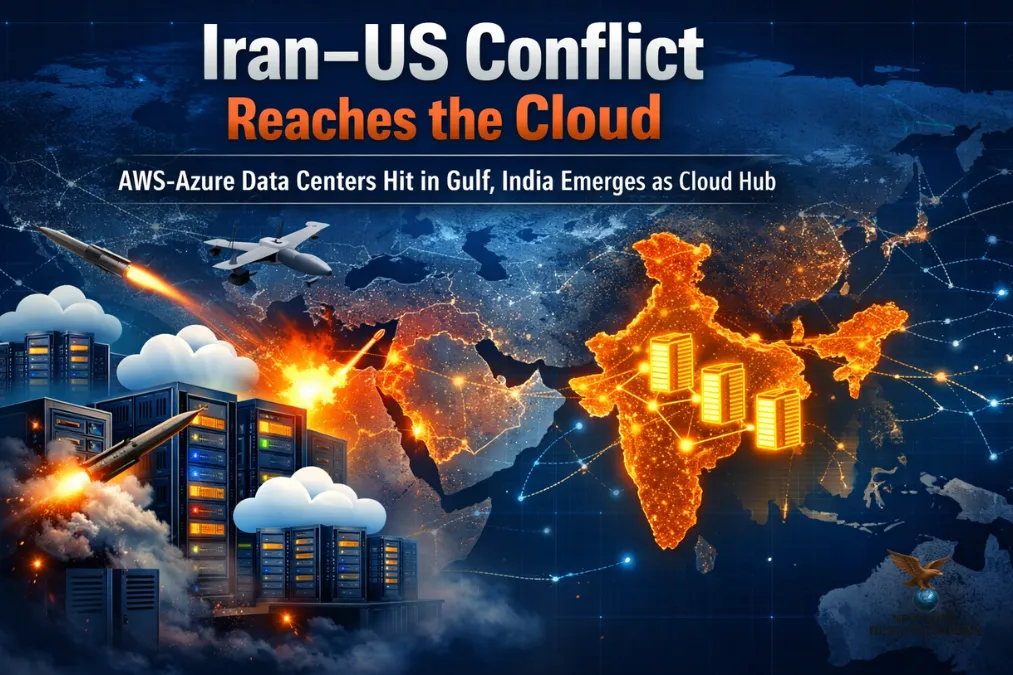
AWS-Azure: The escalating geopolitical tensions in West Asia have taken a dramatic new turn. What began as conflicts over oil, gas, and trade has now extended into the digital domain. Recent missile and drone attacks targeting major cloud infrastructure have demonstrated that data centers-once considered purely technological facilities-are increasingly being viewed as strategic assets in modern warfare.
In early March 2026, reported attacks on cloud data centers operated by global technology giants disrupted critical digital services across the Gulf region. The incidents involved facilities connected to AWS-Azure infrastructure located in the United Arab Emirates (UAE) and Bahrain. The disruption triggered widespread outages affecting banking systems, payment platforms, airport operations, and stock markets in parts of the Middle East.
While the geopolitical implications remain complex, the events have highlighted a crucial reality: digital infrastructure is now as strategically important as physical infrastructure. At the same time, the situation has opened a potential opportunity for countries like India to emerge as alternative global cloud hubs.
Digital Infrastructure Enters the Battlefield
Historically, geopolitical conflicts were limited to land, sea, or air. However, modern economies rely heavily on digital infrastructure, including cloud computing networks and data centers. As global data flows increase, these facilities have become vital components of national security and economic stability.
The recent incidents in the Gulf illustrate this shift. Reports suggest that missile and drone strikes were directed at facilities associated with hyperscale cloud providers, including infrastructure supporting AWS-Azure platforms.
These facilities host critical computing workloads that power everything from financial transactions and airline operations to government services. Any disruption to these systems can have immediate economic consequences.
The March 2026 incidents demonstrated how vulnerable digital infrastructure can be during geopolitical conflicts.
AWS-Azure Infrastructure Disruptions in the Gulf
According to early reports, cloud data centers located in the UAE and Bahrain experienced significant operational disruptions following the attacks. These facilities serve as regional hubs for global cloud providers such as Amazon Web Services and Microsoft Azure.
The disruptions affected several “availability zones”-specialized clusters of servers designed to ensure redundancy and uninterrupted service.
Industry analysts indicate that:
- Multiple availability zones in the UAE region experienced temporary outages.
- More than two dozen AWS services were reported as disrupted or degraded.
- Additional cloud services experienced performance issues across the region.
The technical consequences were significant. Businesses and government systems across the Gulf that depend on AWS-Azure infrastructure faced interruptions in their operations.
Ripple Effects Across Banking and Aviation
The disruption of cloud infrastructure quickly translated into real-world consequences.
Banks and financial institutions in the Gulf rely heavily on cloud platforms to process transactions and manage digital services. Payment gateways, mobile banking applications, and financial clearing systems were among the services impacted.
In addition, airport operations in major regional hubs-including cities such as Dubai and Kuwait-faced temporary disruptions. Airports depend on cloud-based platforms for ticketing systems, flight scheduling, passenger databases, and security monitoring.
Even regional stock exchanges reportedly experienced brief suspensions of trading activities as a precaution while technical teams worked to stabilize systems connected to AWS-Azure infrastructure.
These incidents served as a stark reminder of how deeply modern economies rely on digital platforms.
Why Azure’s Role Raises Strategic Concerns
While AWS provides cloud services primarily for commercial clients, Microsoft’s Azure platform has broader strategic applications.
Microsoft Azure supports a wide range of enterprise and government workloads globally. Some of its infrastructure is also used by defense organizations, including systems associated with NATO partners and the U.S. Department of Defense.
Because of this dual-use nature, disruptions to AWS-Azure cloud environments can have implications beyond commercial business operations. Experts note that attacks on such infrastructure could potentially impact communications networks, defense logistics systems, and other digital operations.
This growing interconnection between commercial cloud platforms and national security infrastructure explains why data centers are increasingly being viewed as strategic assets.
India Emerging as a Potential Global Cloud Hub
The instability in parts of West Asia has prompted many global technology companies to reassess their infrastructure strategies. To ensure reliability and redundancy, cloud providers are exploring alternative regions where workloads can be hosted safely.
India has emerged as one of the most promising destinations.
Several factors make the country attractive as a fallback or expansion hub for AWS-Azure cloud infrastructure.
1. Geopolitical Stability
Unlike several regions in West Asia, India is not directly involved in the ongoing conflict. This relative geopolitical stability makes it a safer location for mission-critical cloud infrastructure.
Companies seeking redundancy for their Middle Eastern operations may increasingly rely on Indian data centers.
2. Rapidly Expanding Data Center Capacity
India already hosts some of Asia’s fastest-growing hyperscale data center clusters.
Major technology hubs include:
- Mumbai
- Chennai
- Hyderabad
- Pune
- Kochi
Mumbai in particular has become one of Asia’s largest cloud infrastructure hubs, hosting numerous global data center facilities that support AWS-Azure services.
3. Massive Investment in Digital Infrastructure
India’s private sector is investing heavily in digital infrastructure.
Major industrial groups such as Reliance, Adani, Tata, and Larsen & Toubro have announced plans to expand their presence in the data center and cloud computing sectors.
Industry estimates suggest that total investments in India’s cloud infrastructure ecosystem could exceed $250 billion in the coming years.
Experts project that India’s total data center capacity may grow dramatically—from roughly 1.4 gigawatts today to nearly 10 gigawatts within the next five to seven years.
Economic Opportunities for India
If cloud workloads from the Middle East increasingly shift to India, the economic benefits could be substantial.
Potential advantages include:
- Billions of dollars in new foreign investment
- Rapid expansion of hyperscale data centers
- Growth in cloud computing infrastructure
- Creation of thousands of high-skill technology jobs
India’s large pool of IT professionals and its well-established technology sector also strengthen its position as a reliable host for global cloud platforms such as AWS-Azure.
The Future of Digital Security
The recent incidents in West Asia highlight a broader global challenge: the vulnerability of digital infrastructure in an era of geopolitical conflict.
As cloud computing becomes central to global commerce, financial systems, and government operations, protecting data centers will become a priority for both technology companies and national governments.
Cybersecurity, physical security, and geopolitical risk management will increasingly shape how companies design their global cloud networks.
Also Read: Iran War Oil Crisis Deepens: Iran Warns No Oil Will Leave Region as Trump Threatens Hormuz Takeover
A New “Digital Safe Haven”
The events of March 2026 may ultimately accelerate a shift in global cloud infrastructure.
Countries that offer political stability, strong cybersecurity capabilities, and advanced digital infrastructure could become the preferred locations for next-generation cloud hubs.
India appears well positioned to benefit from this transformation.
With its expanding data center ecosystem, robust IT talent pool, and growing investment in cloud infrastructure, India is steadily emerging as a potential “digital safe haven” for global technology platforms-including AWS-Azure.
As the world becomes more dependent on digital systems, the geography of data may become just as important as the geography of oil and trade. In that evolving landscape, India’s role in the global cloud economy is likely to grow significantly in the years ahead.