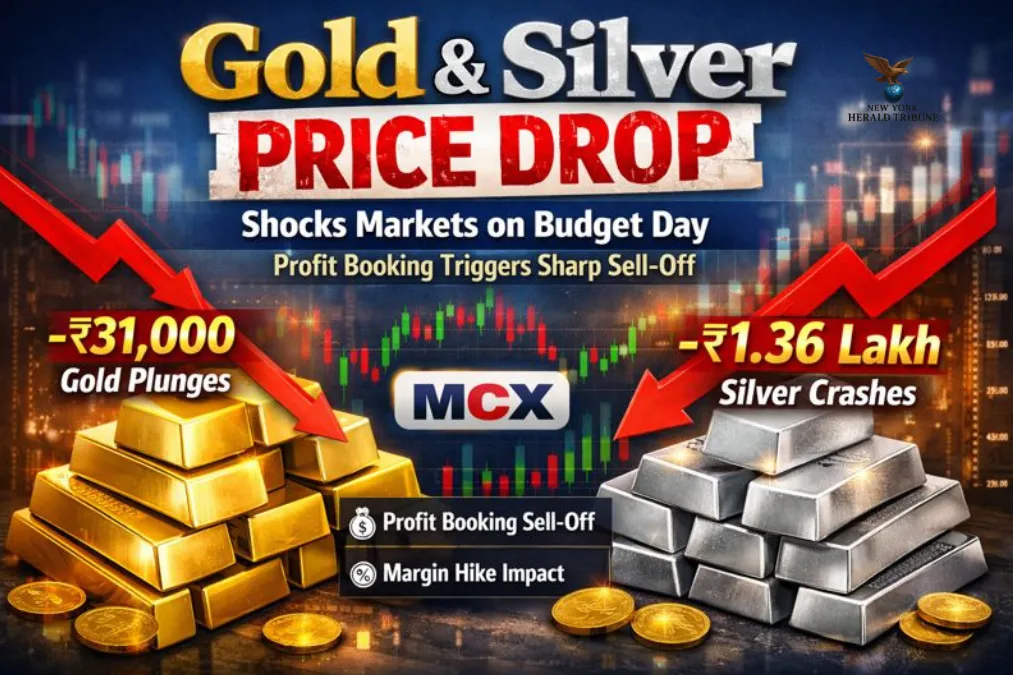
The gold and silver price drop witnessed on Budget Day sent shockwaves through India’s commodity markets, marking one of the steepest short-term corrections in recent history. Both precious metals, which had surged to record highs just days earlier, tumbled sharply amid aggressive profit booking, weaker physical demand, and increased margin requirements on global exchanges.
On Saturday morning, February 1, ahead of the Union Budget presentation, prices of gold and silver fell for the second consecutive trading session on the Multi Commodity Exchange (MCX). Silver recorded a dramatic intraday fall of nearly 9%, while gold declined by around 8%, wiping out a large portion of the gains accumulated during January’s historic rally.
Silver Leads the Fall with Massive Two-Day Correction
Silver prices bore the brunt of the sell-off. During early trade on MCX, silver futures plunged by ₹26,000 per kilogram, falling to ₹2,65,652 per kg. This marked one of the sharpest single-session drops in recent years.
Over just two trading days, silver prices have crashed by a staggering ₹1.36 lakh per kg, after touching an all-time high of ₹4.01 lakh per kg on January 29. The sudden reversal stunned investors, especially retail participants who had entered the market during the peak.
MCX Silver Price Movement (Last Two Sessions)
| Date | Price per kg (₹) | Change |
|---|---|---|
| Jan 29 | 4,01,000 (All-time high) | — |
| Jan 31 | 2,91,922 | −₹1.09 lakh |
| Feb 1 | 2,65,652 | −₹26,270 |
Gold Also Slides Sharply from Record Highs
Gold prices mirrored silver’s weakness, falling sharply after hitting historic levels earlier in the week. On MCX, gold futures declined by ₹12,000 per 10 grams during Saturday’s morning session, trading near ₹1.38 lakh per 10 grams.
In just two days, gold prices have dropped by nearly ₹31,000 per 10 grams, after reaching an all-time high of ₹1.69 lakh per 10 grams on January 29.
MCX Gold Price Trend
| Date | Price per 10 grams (₹) | Change |
|---|---|---|
| Jan 29 | 1,69,000 (Record high) | — |
| Jan 31 | 1,50,849 | −₹18,151 |
| Feb 1 | 1,38,000 | −₹12,849 |
Gold and silver exchange-traded funds (ETFs) also reflected the market stress, registering losses of up to 29%, further highlighting the scale of the correction.
Why Did Gold and Silver Prices Fall So Sharply?
Market experts point to a combination of profit booking, weaker physical demand, and regulatory margin hikes as the key reasons behind the sudden gold and silver price drop.
1. Aggressive Profit Booking After Record Highs
Gold and silver had rallied relentlessly in recent weeks, pushing prices to unprecedented levels. As soon as prices peaked, traders and institutional investors rushed to lock in profits, triggering heavy selling pressure across futures markets.
With prices stretched far above historical averages, even a minor trigger was enough to spark a sharp correction.
2. Weakening Physical and Industrial Demand
After prices surged to all-time highs, physical demand for gold jewellery slowed, while concerns also emerged around industrial silver demand, particularly from manufacturing and electronics sectors sensitive to price volatility.
This demand slowdown further weakened market sentiment.
Margin Hike Adds Pressure on Precious Metals
Another major factor behind the gold and silver price drop was the increase in margin requirements by global commodity exchanges.
According to SEBI-registered commodity expert Anuj Gupta, the Chicago Mercantile Exchange (CME) raised margins on precious metals after implementing similar changes for copper.
Revised Margin Requirements
| Metal | Earlier Margin | Revised Margin |
|---|---|---|
| Gold | 6% | 8% |
| Silver | 11% | 15% |
Margin refers to the amount traders must deposit as security when taking large positions. When margins are raised, traders are required to bring in additional capital. If they fail to do so, they are forced to sell their existing positions, leading to sharp price declines.
As multiple traders exited positions simultaneously, selling pressure intensified, accelerating the fall in gold and silver prices.
Bullion Market Also Sees Decline, But Less Severe
The physical bullion market also reflected the downward trend, though losses were relatively smaller compared to futures markets due to limited trading hours.
According to the India Bullion and Jewellers Association (IBJA):
- Silver prices fell by ₹40,638 per kg to ₹3,39,350 per kg
- Gold prices declined by ₹9,545 per 10 grams to ₹1,65,795 per 10 grams (24-carat)
IBJA Bullion Prices
| Metal | Latest Price | Daily Change |
|---|---|---|
| Gold (24-carat, 10g) | ₹1,65,795 | −₹9,545 |
| Silver (1 kg) | ₹3,39,350 | −₹40,638 |
Unlike MCX, the bullion market closes at 5:00 pm, while futures markets remain active until midnight. Continuous trading in futures markets allows prices to fluctuate rapidly, resulting in sharper movements.
Volatility Follows Historic Rally
The correction comes just days after silver created history by crossing the ₹4 lakh per kg mark for the first time ever. On Thursday, the silver contract expiring on March 5 surged to ₹4,20,048 per kg, before collapsing by more than ₹1.28 lakh the very next day.
By Sunday, Budget Day, silver had fallen another 9%, or over ₹27,500, highlighting the extreme volatility gripping precious metal markets.
Gold followed a similar trajectory. The April gold contract on MCX had touched a historic high of ₹1,93,096 per 10 grams, before sliding sharply by more than ₹42,000 in subsequent sessions.
Also read: Gold and Silver Prices Soar to Record Highs as Global Tensions and Fed Rate Cut Expectations Fuel Rally
What Should Buyers Keep in Mind Amid Falling Prices?
Despite the gold and silver price drop, experts advise buyers to remain cautious and informed.
Key Tips When Buying Gold
- Always Buy BIS-Hallmarked Gold
Purchase only Bureau of Indian Standards (BIS) certified gold with a unique alphanumeric hallmark to ensure purity and authenticity. - Cross-Check Prices Before Buying
Verify daily gold rates from multiple reliable sources such as IBJA. Remember, prices vary for 24-carat, 22-carat, and 18-carat gold, so ensure you’re paying the correct rate.
Also read: Bitcoin Slumps 30% from Record Highs in 2025, but Long-Term Outlook Remains Positive
Market Outlook: More Volatility Ahead
Analysts warn that precious metal markets may remain volatile in the near term as traders react to global interest rate cues, currency movements, and post-Budget policy signals. While long-term fundamentals for gold and silver remain intact, short-term price swings could continue as markets digest recent gains.
For now, the dramatic gold and silver price drop serves as a reminder that even traditionally “safe-haven” assets are not immune to sharp corrections after euphoric rallies.