Introduction: A Dangerous New Phase in US–Iran Relations
The already fragile relationship between the United States and Iran has entered one of its most dangerous phases in years. Fresh military movements, increasingly aggressive rhetoric, and direct threats exchanged between Washington and Tehran have sparked global concern over the possibility of a large-scale conflict in the Middle East.
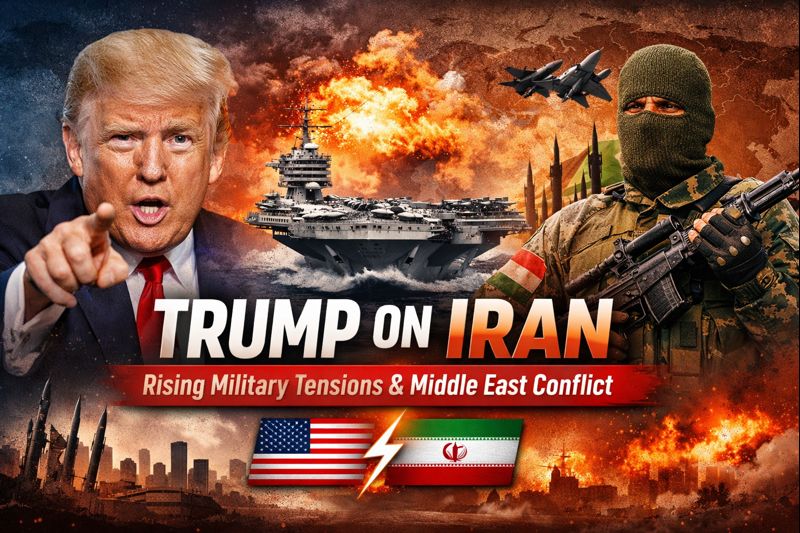
At the centre of this escalating crisis is former US President Donald Trump, whose latest statements and reported decisions have once again placed Iran at the forefront of American foreign policy debates. Trump on Iran has become a dominant headline worldwide as reports suggest the US is actively preparing military options that could fundamentally reshape the region’s security landscape.
According to senior American officials quoted by leading international media outlets, Trump has demanded “decisive” military plans against Iran—options designed not merely to deter but to deliver overwhelming impact. As US warships advance towards Iranian waters and fighter jets are positioned across the region, Tehran has responded with stark warnings of its own, declaring that American bases are already within missile range.
What follows is a comprehensive look at how this confrontation has unfolded, the military movements raising alarm, Iran’s counter-threats, Israel’s involvement, and the broader geopolitical consequences now looming over the Middle East.
Trump on Iran: Reports of Military Planning Spark Alarm
According to reporting by The Wall Street Journal, senior US officials revealed that Donald Trump has been actively considering military action against Iran. These officials stated that Trump has sought plans capable of delivering a “decisive” blow—an approach that suggests more than limited strikes or symbolic shows of force.
Both the Pentagon and the White House have reportedly begun working on a range of military scenarios. Among these options are plans that could directly target Iran’s governing structures, raising the prospect of regime change—an idea Trump has openly supported in recent remarks.
This development marks a significant escalation in Trump on Iran, shifting the narrative from sanctions and diplomatic pressure to overt military readiness.
USS Abraham Lincoln Heads Toward the Middle East
One of the most visible signs of escalating tensions is the rapid deployment of the USS Abraham Lincoln, one of the most powerful aircraft carriers in the US Navy.
President Trump confirmed that the warship is moving swiftly toward the Arabian Sea, placing multiple Iranian cities within striking distance. The arrival of the USS Abraham Lincoln in the Middle East has triggered intense speculation over whether the United States is preparing for sudden military action.
Strategic Positioning Raises Questions
The carrier strike group has reportedly entered the US Central Command (CENTCOM) operational zone, a critical region encompassing much of the Middle East. At the same time, a US C-37B military aircraft has landed at Ashgabat air base in Turkmenistan, north of Iran—another move interpreted as part of broader strategic preparations.
Previously deployed in the South China Sea, the USS Abraham Lincoln crossed the Malacca Strait on January 20 before entering the Indian Ocean. Its relocation underscores how rapidly Washington’s strategic priorities can shift when tensions rise.
USS Abraham Lincoln: Power and Capabilities
The USS Abraham Lincoln is far more than a symbolic show of force. It represents one of the most formidable military assets ever built.
Key Facts About USS Abraham Lincoln
- Built by: Newport News Shipbuilding
- Commissioned: 1989
- Cost: Approximately ₹57,000 crore (as of 2024 estimates)
- Length: 333 metres
- Width: 76.8 metres
- Displacement: Over 100,000 tonnes
- Speed: 56–60 km/h
Carrier Strike Group 3
The ship serves as the flagship of Carrier Strike Group 3, a powerful formation that includes destroyers, cruisers, and nuclear-powered submarines.
Advanced Capabilities
- Nuclear-powered propulsion, requiring refuelling only once every 25–30 years
- Capacity to carry 75–80 aircraft
- Equipped with 48–60 F/A-18 fighter jets
- Ability to launch attacks from air, sea, and land
- Strike range of up to 2,300 kilometres without refuelling
According to reports from Reuters, the carrier travelled at speeds exceeding 20 knots before disabling its Automatic Identification System (AIS), a move often used to conceal real-time location during sensitive operations. At that pace, it could reach Middle Eastern waters within hours.
Additional US Naval and Air Assets Deployed
The USS Abraham Lincoln is not operating alone. Several US destroyers and at least one nuclear submarine are reportedly accompanying the carrier, significantly increasing the strike group’s firepower.
Military analysts note that such formations are rarely deployed unless Washington seeks to send an unmistakable message—or prepare for active combat.
Fighter Jets Deployed in Jordan
Beyond naval power, the United States has also intensified its air presence in the region.
According to Reuters, the US Air Force has deployed at least 12 F-15 fighter jets to Jordan. American officials confirmed that additional aircraft are en route.
Between January 20 and January 22, US C-17 military transport planes reportedly made multiple trips to Jordan’s Muwaffaq Salti Air Base. These flights are believed to have delivered Patriot-3 missile defence systems, reinforcing the region’s air defence network.
Protecting Israel and US Bases
US officials indicated that the primary objective of these deployments is to shield Israel and American military installations from potential Iranian retaliation. Tehran has repeatedly warned that any US or Israeli attack would be met with a powerful response.
Diego Garcia: A Strategic Hub in the Indian Ocean
Another focal point of military activity is the US base at Diego Garcia in the Indian Ocean. Reports indicate a steady flow of cargo aircraft landing at the base, suggesting preparations for large-scale logistics operations.
Military experts believe Diego Garcia could serve as a critical staging ground for long-range air missions, logistical coordination, and troop deployments if hostilities escalate.
Iran Responds: “American Bases Are Within Our Range”
Iran has responded sharply to the growing US military presence.
Javed Akbari, a member of Iran’s Supreme Council, declared that all American military bases in the Middle East are within Iran’s missile range. He warned that Iranian missiles are awaiting orders to strike if provoked.
Another senior Iranian military official, General Ali Abdollahi Aliabadi, issued an even stronger warning. He stated that any US attack would result in Iranian strikes on American bases across the Middle East and strategic targets in Israel.
IRGC Warning: “Our Finger Is on the Trigger”
Mohammad Pakpour, commander of Iran’s Islamic Revolutionary Guard Corps (IRGC), reinforced the country’s readiness. In a written statement, Pakpour said Iran’s armed forces are more prepared than ever and fully capable of responding to any aggression.
“Our finger is on the trigger,” he warned—a phrase that has since been widely quoted across global media.
These statements underline how Trump on Iran has pushed both sides toward a potentially explosive standoff.
Israel Enters the Equation
Israel has also weighed in forcefully, further complicating the situation.
Israeli Minister Nir Barkat issued a stern warning to Tehran, stating that any future attack on Israel would be met with a response “seven times stronger” than before.
Speaking to international media in Davos, Barkat said Israel has already demonstrated its ability to strike Iranian targets and would respond with even greater force if provoked again.
He claimed previous Israeli actions had exposed Iran’s military vulnerabilities, suggesting that Tehran should not underestimate Israel’s capabilities.
Protests and Unrest Inside Iran
As external tensions rise, Iran is also grappling with significant internal unrest.
According to Reuters, an Iranian official confirmed that more than 5,000 people have died during nationwide protests, including around 500 security personnel. The protests began on December 28 over inflation and economic hardship before spreading across the country.
The US-based human rights group HRANA has reported 4,519 confirmed deaths, including 4,251 protesters, with investigations ongoing into an additional 9,049 cases.
The scale of unrest has intensified international scrutiny of Iran’s leadership and human rights record.
Trump on Iran: Open Support for Regime Change
Donald Trump has openly advocated for political change in Iran, a stance that has further inflamed tensions.
Last week, Trump told political allies that “the time has come to think about new leadership in Iran.” He urged Iranian citizens to continue protests and seize control of institutions—remarks that Tehran described as blatant interference.
Although Trump later claimed that executions of detainees had been temporarily halted, Iranian leaders accused him of encouraging violence and instability.
Iran’s Supreme Leader Responds
Iran’s Supreme Leader, Ayatollah Ali Khamenei, directly blamed Trump for escalating violence inside Iran. He accused the former US president of inciting unrest and being responsible for the deaths and suffering of Iranian civilians.
In response, Trump launched a scathing attack on Khamenei, accusing Iran’s leadership of ruling through fear and violence and holding them responsible for the country’s destruction.
This war of words has only deepened the crisis and hardened positions on both sides.
Global Reaction and Growing Fears
International observers fear that a single miscalculation could trigger a broader conflict involving multiple regional powers.
European leaders have urged restraint, warning that military confrontation could destabilise global energy markets, disrupt shipping routes, and ignite conflicts beyond the Middle East.
Markets have already shown signs of nervousness, with oil prices fluctuating amid fears of supply disruptions through the Strait of Hormuz.
What Comes Next?
The situation remains fluid and highly volatile. While no official declaration of war has been made, the scale of military deployments and the intensity of rhetoric suggest the risk of escalation is real.
Whether this crisis ends in diplomacy, limited military action, or a wider conflict will depend on decisions made in Washington, Tehran, and allied capitals in the coming days.
One thing is certain: Trump on Iran has once again pushed US–Iran relations to the brink, with consequences that could reshape the Middle East and reverberate across the world.
Conclusion:
As warships advance, missiles stand ready, and leaders trade threats, the world watches anxiously. The coming weeks may determine whether this standoff becomes another chapter of tense diplomacy-or the opening act of a far more dangerous conflict.