Macron Text Message Trump: A sharp diplomatic standoff has emerged between France and the United States after former US President Donald Trump threatened to impose a staggering 200% tariff on French wine and champagne, prompting a pointed and unusually candid response from French President Emmanuel Macron.
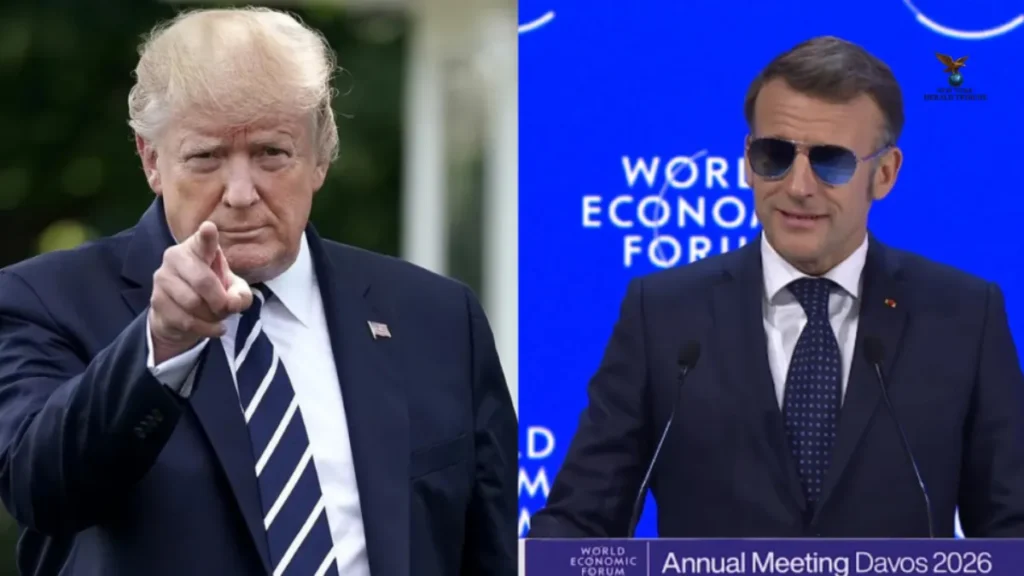
Speaking at the World Economic Forum (WEF) in Davos, Macron made it clear that France does not respond to intimidation, sending a strong message to Washington that diplomacy must be based on respect rather than coercion. The dispute has since escalated, fuelled by Trump’s public disclosure of a private message from Macron, widely referred to as the Macron text message trump, intensifying debate over trade, sovereignty, and global power politics.
“We Understand the Language of Respect, Not Bullying”: Macron’s Davos Warning
Addressing world leaders, CEOs, and policymakers in Davos, Emmanuel Macron responded directly-though without naming Trump-to the tariff threat that has rattled Europe’s wine industry.
“France believes in respect, not threats,” Macron said. “We understand the language of dignity, not bullying.”
The remarks followed Trump’s warning that French wine and champagne exports to the US could face a 200% import duty, a move that would devastate one of France’s most valuable cultural and economic sectors.
Macron’s comments drew applause across the conference hall, reflecting growing unease among European leaders about the use of economic pressure as a geopolitical weapon.
Greenland, Sovereignty, and Europe’s Red Line
Macron went beyond trade, linking the tariff threat to wider concerns over territorial pressure and sovereignty, particularly referencing recent tensions surrounding Greenland, an autonomous territory of Denmark.
He warned that threatening sanctions or economic punishment to gain leverage over another nation’s land or independence sets a dangerous precedent.
“It is unacceptable to use economic tools to pressure a country’s sovereignty,” Macron stated firmly. “Europe will not accept this under any circumstances.”
He added that a world where international law is ignored is inherently unstable-one where powerful nations act without restraint while smaller states are forced to endure injustice.
“This Should Be a Time of Peace”-A Bitter Irony
At one point during his speech, Macron remarked that the present era should be one of peace, stability, and trust. The audience reacted with laughter—not mockery, but recognition of the irony.
Macron acknowledged the contradiction himself.
“The reality,” he said, “is completely the opposite.”
He went on to describe a world growing more unstable by the day, marked by wars, economic volatility, and the erosion of democratic institutions. According to Macron, several countries are sliding away from democratic norms toward authoritarianism, while global security frameworks weaken.
France Stands With Denmark
Reinforcing Europe’s united stance, Macron confirmed that France had participated in military exercises in Greenland, clarifying that the move was not intended as a provocation.
“Our objective is not to threaten anyone,” he explained. “It is to stand by our European ally, Denmark.”
He emphasised that freedom and sovereignty are not outdated ideas, but lessons learned from the devastation of the Second World War—lessons Europe refuses to forget.
Trump’s 200% Tariff Threat Explained
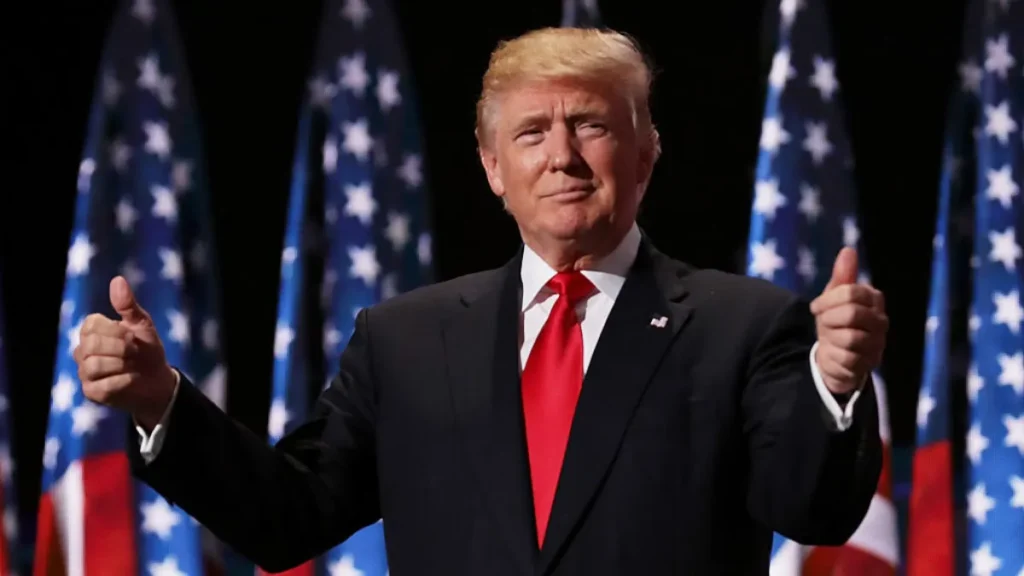
The dispute escalated after Donald Trump openly threatened to levy a 200% tariff on French wine and champagne, a measure that would effectively shut French producers out of the American market.
Trump issued the warning after France declined to participate in the Gaza Peace Board, a newly proposed international body aimed at managing governance and reconstruction in Gaza.
Expressing his frustration, Trump dismissed Macron’s political standing, suggesting that the French president’s leadership was nearing its end.
“If I decide to,” Trump said, “I will impose a 200% tariff on French wine and champagne. Then Macron will join the peace board himself.”
The Gaza Peace Board and the NCAG Initiative
Trump recently announced the formation of the National Committee for the Administration of Gaza (NCAG), tasked with overseeing governance and rebuilding efforts in the war-torn territory.
To supervise the initiative, Trump also unveiled a “Board of Peace”, inviting leaders from around 60 countries to participate. The board is designed to manage funding, security coordination, and political oversight for Gaza’s future administration.
India’s Prime Minister Narendra Modi, Russian President Vladimir Putin, and Pakistan’s Prime Minister Shehbaz Sharif are among those invited.
However, France’s refusal to join sparked Trump’s ire, triggering the tariff threat and subsequent diplomatic fallout.
Macron Text Message Trump: Private Message Goes Public
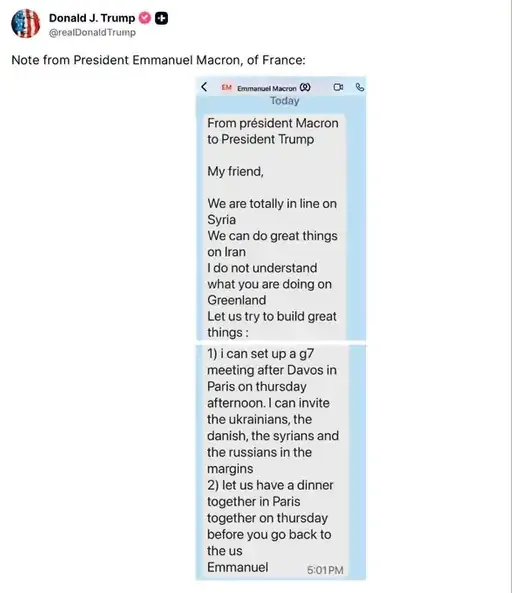
The controversy deepened when Trump leaked a screenshot of a private text message from Macron on social media—an unprecedented move between allied leaders.
In the message, Macron expressed agreement with Trump on Syria and Iran but questioned US actions regarding Greenland.
“We fully agree on Syria,” Macron wrote. “We can do much together on Iran. But I do not understand what you are doing in Greenland.”
The Macron text message trump also revealed Macron proposing a formal diplomatic meeting, suggesting a G7 summit in Paris that could include discussions on Ukraine, Denmark, Syria, and Russia. Macron even invited Trump to dinner in Paris before his return to the US.
France Mocks US Greenland Argument
Tensions rose further after France publicly mocked comments made by US Treasury Secretary Scott Bessent, who defended Trump’s Greenland stance by citing potential Russian threats.
Bessent argued that if Greenland were attacked, NATO would intervene, implying that pre-emptive US involvement was justified.
France’s Foreign Ministry responded sharply on its official social media account, comparing the logic to burning down a house simply because it might catch fire one day.
The post went viral across Europe, symbolising growing frustration with Washington’s aggressive rhetoric.
Why French Wine and Champagne Matter So Much
France is widely regarded as the world’s wine capital, producing some of the most celebrated wines globally.
French wine includes a vast range of red, white, rosé, and sparkling varieties, typically with alcohol levels between 11% and 15%. Quality depends on soil, climate, and grape variety.
France is the second-largest wine producer in the world, after Italy.
Global Wine Production (2025 Figures)
- Global production: ~23.2 billion litres
- France: ~3.59 billion litres
- Share of global output: ~15–16%
Champagne: Exclusively French
Champagne is a sparkling wine that can legally be produced only in the Champagne region of France. Any sparkling wine made elsewhere cannot be called champagne.
It is produced using a traditional method and is associated worldwide with celebration and luxury. As a result, 100% of the world’s champagne originates in France, making it especially vulnerable to punitive tariffs.
Israel’s Anger Over the Peace Board
Israel has reacted angrily to Trump’s Gaza initiative, claiming it was announced without consultation.
Prime Minister Benjamin Netanyahu’s office stated that the proposal contradicts Israeli government policy. Foreign Minister Gideon Sa’ar is expected to raise objections directly with US Secretary of State Marco Rubio.
According to media reports, Israel is particularly opposed to the inclusion of Turkey, which it views as supportive of Hamas. Turkish President Recep Tayyip Erdoğan has been one of Israel’s most vocal critics during the Gaza conflict.
Israeli National Security Minister Itamar Ben-Gvir has gone even further, arguing that Gaza does not need an administrative board but the complete elimination of Hamas and large-scale relocation.
Who Trump Invited to the Peace Board
The White House released a long list of countries invited to join the Peace Board, including:
- Russia
- Canada
- Turkey
- Egypt
- Argentina
- Paraguay
- Albania
- India
- Jordan
- Greece
- Cyprus
- Pakistan
- Hungary
Several leaders have already confirmed receiving invitations.
Controversy Over Alleged $1 Billion Membership Fee
A Bloomberg report claimed that countries seeking permanent membership on the Peace Board would need to contribute $1 billion in the first year.
According to the report, Trump would decide which countries receive permanent invitations, while standard membership would last three years.
The White House strongly denied the claim, calling it misleading.
“There is no mandatory membership fee,” the statement said. “Permanent membership is offered only to partners demonstrating deep commitment to peace, security, and prosperity.”
Ajay Banga Among Board Members
The White House also announced the initial members of the Peace Board, which includes Ajay Banga, President of the World Bank Group and an Indian-origin global financial leader.
Other members include Secretary of State Marco Rubio and Special Envoy Steve Witkoff.
A Transatlantic Relationship Under Strain
The Macron–Trump dispute underscores broader tensions between Europe and the US over trade, diplomacy, and global leadership. While the two sides remain allies, the episode highlights how quickly relationships can sour when economic power is used as leverage.
The public release of the Macron text message trump has raised concerns among diplomats about trust, confidentiality, and the future of private leader-to-leader communication.
What Comes Next?
Whether the tariff threat becomes reality remains unclear. However, the confrontation has already sent shockwaves through diplomatic and economic circles.
For France, the message is clear: sovereignty and respect are non-negotiable. For the United States, the episode has reopened debate about unilateralism and its global consequences.
As Macron warned in Davos, a world governed by intimidation rather than cooperation is a dangerous one—and Europe appears ready to push back.