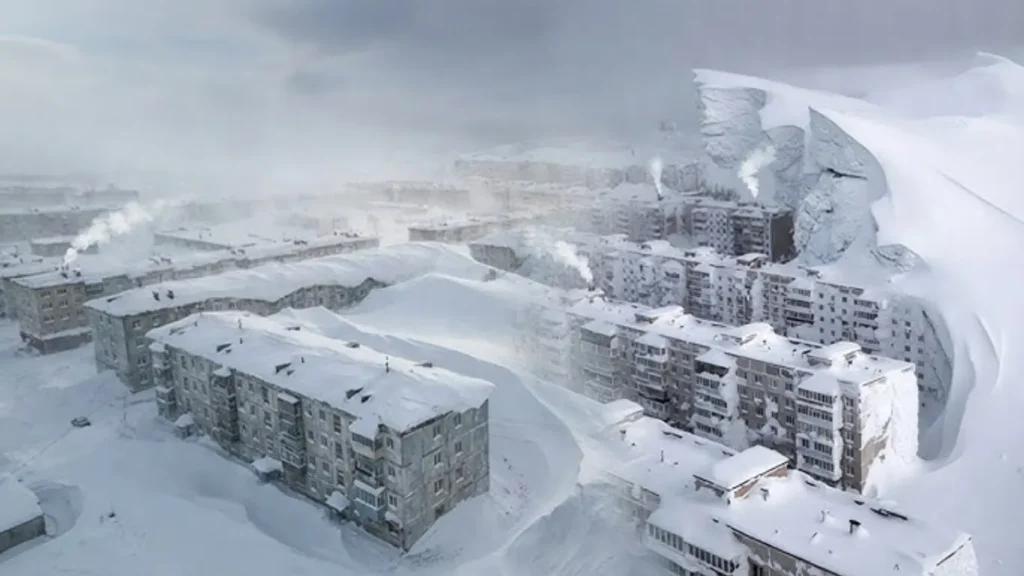
Russia snow: An extraordinary and devastating winter has pushed Russia’s far-eastern Kamchatka Peninsula into a state of emergency, as relentless snowfall and violent blizzards bury cities under mountains of ice in what officials and residents are calling the most severe winter disaster in three decades. Viral images and videos from the region show buildings swallowed up to their fourth floors, cars completely invisible beneath snowdrifts, and residents forced to dig tunnels just to exit their homes.
The unfolding Russia snow crisis has transformed daily life into a struggle for survival, with freezing temperatures, collapsing roofs, power outages, and blocked roads creating conditions rarely seen even in this notoriously cold part of the world.
A Winter Unlike Any Other in 30 Years
Kamchatka, known for its volcanoes and harsh climate, has experienced extreme winters before. However, this season has surpassed all expectations. According to local authorities and meteorological data, snowfall has reached up to 13 feet (approximately four metres) in several parts of the region, overwhelming infrastructure and emergency services.
Temperatures have plunged to –5.8°F (–21°C), accompanied by powerful Arctic winds that have sculpted snow into towering walls and deep, compacted drifts. Residents describe the landscape as unrecognisable, comparing neighbourhoods to frozen labyrinths rather than functioning cities.
Entire streets have disappeared under snowbanks so high that only the tops of streetlights and traffic signs remain visible. In some districts, snow has piled so high against apartment blocks that residents on the second and third floors can step directly onto snow from their windows.
Viral Videos Capture the Reality of Russia Snow Chaos
The severity of the situation has been amplified by viral footage circulating across social media platforms. One widely shared video shows children sliding down massive snow mounds, turning disaster into improvised skiing slopes. While the scene appears playful, it highlights how deeply snow has engulfed residential areas.
Other videos paint a far grimmer picture. Footage shows apartment buildings buried up to the fourth floor, their entrances completely sealed by ice. Vehicles are nowhere to be seen, their locations marked only by uneven snow formations. In some cases, residents have lost track of where their cars were parked altogether.
Drone footage reveals entire neighbourhoods transformed into a white wasteland, with rooftops barely visible above the snow. The visual evidence has shocked viewers worldwide, drawing attention to the scale of the Russia snow emergency unfolding thousands of miles from Moscow.
Cities Buried by a Relentless Blizzard
The capital of the Kamchatka region, Petropavlovsk-Kamchatsky, has been among the worst affected. A powerful and sustained snowstorm battered the city for days without pause, depositing layer upon layer of heavy snow faster than authorities could remove it.
According to reports published by The Moscow Times, at least two people have lost their lives after being struck by falling snow and ice from rooftops. These deaths marked a grim turning point, prompting city officials to take immediate action.
Following the first confirmed fatality, the city’s mayor declared a citywide state of emergency, allowing local authorities to mobilise additional resources, deploy emergency crews, and request federal assistance for snow removal and rescue operations.
Roof Collapses and Falling Ice Create Deadly Conditions
One of the most dangerous consequences of the unprecedented Russia snow accumulation has been the immense weight building roofs are being forced to bear. Continuous snowfall, combined with high winds, has caused snow to compact and harden, creating dense ice layers on rooftops.
Mayor Konstantin Belyayev publicly criticised several property management companies, accusing them of negligence for failing to clear snow from roofs in a timely manner. According to city officials, many companies delayed action, hoping the storm would pass, a decision that proved fatal.
As temperatures fluctuated and winds intensified, large slabs of snow and ice began to slide off roofs without warning. These sudden falls caused multiple injuries and at least two confirmed deaths, sparking anger and fear among residents.
Emergency services have since prioritised rooftop clearing operations, but persistent snowfall continues to complicate efforts.
Residents Forced to Dig Tunnels to Survive
In some of the most dramatic scenes of the crisis, residents have been forced to dig tunnels through snow to leave their buildings. Doorways, stairwells, and ground-floor windows are completely blocked in many apartment complexes.
Photographs show narrow snow corridors carved by hand, just wide enough for a person to pass through. These tunnels have become lifelines, allowing residents to reach grocery stores, medical facilities, or emergency shelters.
For elderly residents and those with mobility issues, the situation is even more dire. Many are effectively trapped inside their homes, dependent on rescue teams for basic necessities.
Rescue Teams Cut Through Ice to Reach the Elderly
Russia’s Ministry of Emergency Situations released official footage showing rescue workers battling chest-high snowdrifts to reach vulnerable residents. Armed with shovels and heavy equipment, teams have been clearing paths and delivering food, medicine, and heating supplies.
In several cases, rescuers were required to physically cut through compacted ice walls to access apartments where elderly residents had been isolated for days.
Authorities confirmed that emergency responders are working around the clock, but the scale of the Russia snow disaster has stretched resources thin. Additional personnel and machinery have been brought in from neighbouring regions to assist.
Schools Closed, Transport Halted, Power Under Pressure
The relentless snowstorm has effectively paralysed public life across Kamchatka. Schools have been closed indefinitely, with authorities citing dangerous conditions and inaccessible roads.
Public transportation has been suspended across large sections of the region. Buses, trams, and taxis are unable to operate as roads remain buried or dangerously icy. Airports have also experienced repeated delays and cancellations due to poor visibility and snow-covered runways.
The region’s power grid and supply chains are under significant strain. Heavy snow has damaged power lines in some areas, while blocked roads have slowed the delivery of fuel, food, and medical supplies.
Local officials have urged residents to conserve electricity and remain indoors whenever possible.
Everyday Life Frozen by Extreme Conditions
Beyond the immediate dangers, the Russia snow emergency has frozen daily life in Kamchatka. Slippery roads, abandoned vehicles, and obstructed sidewalks make even short trips hazardous.
Cars have become trapped under snowbanks so deep that recovery efforts may not begin until spring. In some residential zones, residents are using skis and snowboards as their primary means of transportation.
Businesses remain closed, and construction activity has come to a halt. For many residents, the focus has shifted entirely to survival: staying warm, securing food, and avoiding accidents.
Read also: Some Migrants to Face 20 Year Wait for Settled Status Under New UK Immigration Plans
Climate Questions Raised by Historic Snowfall
While Kamchatka is no stranger to harsh winters, the scale and intensity of this year’s snowfall have raised questions among scientists and climate experts. Some meteorologists suggest that changing atmospheric patterns may be contributing to more extreme and unpredictable weather events across Russia and the Arctic region.
Although no single snowfall can be directly attributed to climate change, experts note that such extreme events are becoming more frequent and severe globally.
The Russia snow crisis in Kamchatka is now being studied as a case example of how infrastructure and emergency planning must adapt to increasingly volatile winter conditions.
Authorities Continue Emergency Operations
As of now, the situation remains critical. Snow continues to fall intermittently, and weather forecasts offer little immediate relief. Emergency crews are prioritising roof clearing, road access, and aid delivery to isolated residents.
The regional government has pledged continued support and warned that recovery efforts may take weeks or even months. Officials are urging citizens to follow safety guidelines, avoid unnecessary travel, and report dangerous snow accumulations on buildings.
Despite the hardship, many residents have shown resilience and solidarity, helping neighbours clear snow and sharing supplies where possible.
Read also: Trump invited Putin to board of peace: Inside the Unexpected US Move on Gaza and the Global Reaction
A Region Waiting for Relief
Kamchatka’s battle against the worst snowfall in 30 years is far from over. What began as heavy winter weather has evolved into a full-scale Russia snow disaster, testing the limits of infrastructure, emergency response, and human endurance.
As towering snowdrifts continue to dominate the landscape and freezing temperatures show no sign of easing, the people of Kamchatka remain locked in a daily fight against nature’s extremes.
For now, survival depends on cooperation, resilience, and the hope that warmer days will eventually bring relief to a region buried beneath an ocean of snow.