Chaibasa, Jharkhand:
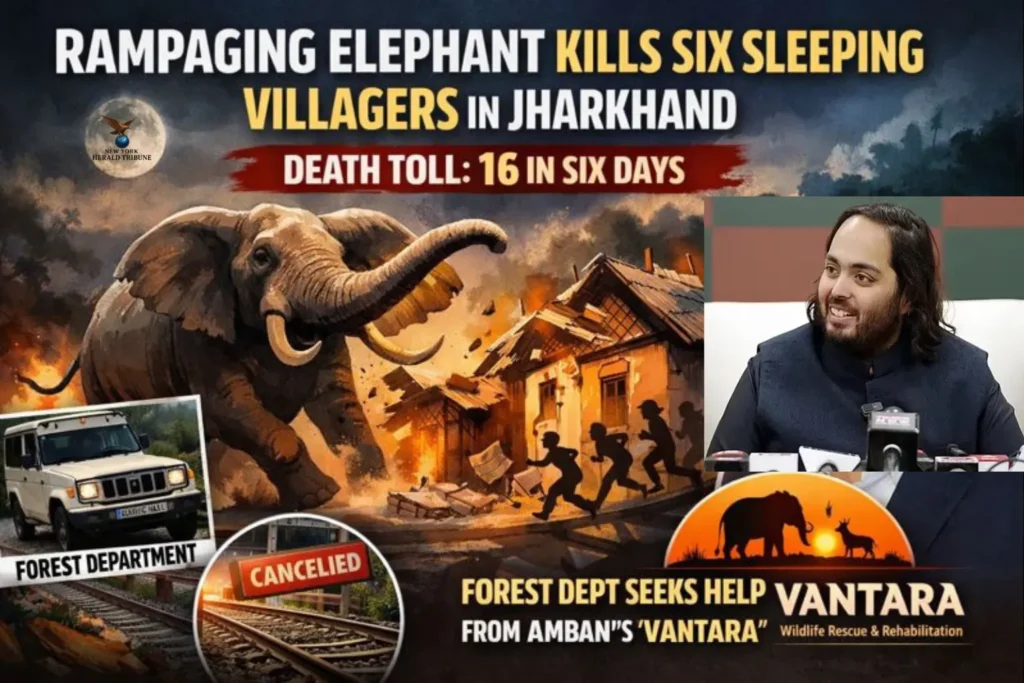
A wave of fear and grief has gripped parts of Jharkhand’s West Singhbhum district after a wild elephant went on a deadly rampage, crushing six people to death as they slept inside their home late Tuesday night. The horrific incident, reported from Bharbharia village under the Noamundi block of Chaibasa district, has pushed the total death toll linked to the same elephant to 16 within just six days, exposing the growing crisis of human–elephant conflict in eastern India.
Despite continuous efforts, the forest department has so far failed to capture or tranquilise the aggressive elephant, which has been rapidly changing its location and striking villages after nightfall. With the situation spiralling out of control, authorities have now sought assistance from ‘Vantara’, the wildlife conservation initiative backed by Anant Ambani, hoping that expert intervention and advanced resources can help avert further loss of life.
A Night of Horror: Six Members of One Family Killed While Asleep
According to officials and local residents, the deadly attack occurred around 10 pm on Tuesday in Bharbharia village, located within the Jethia Panchayat area. The victims were all members of a single family who were asleep inside their mud-and-brick house when the elephant suddenly stormed into the settlement.
Without warning, the massive animal rammed into the structure, tearing through walls and collapsing parts of the house. Before anyone could react, the elephant trampled six people to death. Those killed included Sanatan Meral, his wife Jonko Kui, their two children, and two other family members who were sleeping in the same dwelling.
In a small stroke of fortune amid the devastation, one child managed to escape the collapsing house and fled into the darkness, surviving the attack. However, two other occupants sustained serious injuries and are currently undergoing treatment at a nearby medical facility.
Villagers described scenes of chaos, screaming, and helplessness as the elephant continued its rampage before disappearing back into the forest. By the time forest officials and police arrived, the damage had already been done.
Sixteen Deaths in Six Days: An Escalating Crisis
The Bharbharia incident is not an isolated tragedy. Over the past six days, the same elephant is believed to have killed at least 16 people across different villages in the region. The attacks have followed a disturbing pattern: the animal remains hidden in forested areas during the day and ventures into villages after dark, targeting homes and attacking people while they sleep.
Local communities are living in constant fear, with many families abandoning their homes at night and seeking shelter in groups or safer locations. Farmers, daily wage workers, and tribal households—already among the most vulnerable—are bearing the brunt of the crisis.
“This elephant is no longer afraid of humans or houses,” said a local resident. “It comes straight into the village, breaks walls, and kills without any provocation.”
Forest Department Struggles to Track the Elephant
Chaibasa Divisional Forest Officer (DFO) Aditya Narayan acknowledged the seriousness of the situation and admitted that tracking the elephant has become a major challenge.
“The elephant is changing its location very rapidly,” the DFO said. “Our teams find it extremely difficult to maintain continuous surveillance. By the time we reach one area, it has already moved to another.”
Forest department personnel have been deployed across affected villages and forest corridors, patrolling day and night. Drones and other monitoring equipment are being used to track the elephant’s movement and issue alerts to villages that may be at risk.
However, officials concede that traditional methods have not been sufficient to contain the threat, prompting them to seek external expert assistance.
Help Sought from Anant Ambani’s ‘Vantara’
In a significant development, forest officials have formally requested help from ‘Vantara’, the wildlife conservation and rescue organisation supported by industrialist Anant Ambani. Known for its expertise in animal rescue, rehabilitation, and advanced veterinary care, Vantara has been involved in several high-profile wildlife conservation efforts across India.
Officials believe that Vantara’s specialised teams, equipment, and experience in handling large and aggressive animals could play a crucial role in safely tranquilising and relocating the elephant.
“A team from Vantara has been contacted, and further action will be decided once they arrive,” a senior forest official said. “Given the scale of danger, we need the best possible expertise to prevent more deaths.”
The involvement of Vantara underscores the growing reliance on private conservation initiatives to support overstretched government agencies in dealing with complex wildlife emergencies.
Railway Services Disrupted Due to Elephant Movement
The elephant’s movement has also impacted critical infrastructure in the region. According to a railway official, frequent elephant crossings along tracks have forced the South Eastern Railway to cancel six pairs of trains under the Chakradharpur division.
“These cancellations are a precautionary measure to prevent accidents involving elephants and trains,” the official said. “Safety of passengers and wildlife is our priority.”
Elephant-train collisions have been a recurring problem in Jharkhand and neighbouring states, often resulting in the deaths of animals and, occasionally, passengers. Authorities are now maintaining heightened vigilance along railway corridors passing through forested areas.
Night Attacker: Elephant Hides by Day, Strikes After Dark
Officials and wildlife experts say the elephant has adopted a clear pattern of behaviour. During daylight hours, it remains concealed deep within forested areas, making detection difficult. As soon as darkness falls, it moves towards nearby villages, attacking houses along its path.
“The elephant is targeting homes rather than fields,” an official explained. “It is attacking people while they are asleep, which makes the situation even more dangerous.”
Such behaviour suggests extreme aggression, possibly driven by biological or environmental factors, experts say.
Thermal Sensor Drones to Be Deployed for Night Surveillance
In response to the escalating threat, the forest department has decided to deploy thermal sensor-equipped drones for night-time monitoring. A specialised technical team reached the area on Wednesday evening to begin preparations.
“These drones can detect body heat even in dense forest or darkness,” an official said. “They will help us locate the elephant more accurately and alert villages in advance.”
Authorities hope that improved surveillance will allow rapid response teams to intervene before the elephant reaches populated areas.
Why Do Elephants Turn Aggressive? Experts Explain Three Key Reasons
According to Raja Ghosh, a wildlife researcher and expert associated with the Dalma forest region, there are three primary reasons why elephants become dangerously aggressive.
1. Musth in Male Elephants
Male elephants periodically enter a hormonal phase known as musth. During this time, testosterone levels can increase up to 60 times the normal level. A thick, pungent fluid called mad oozes from the elephant’s temporal glands near the temples. Elephants in musth are highly aggressive, unpredictable, and prone to attacking humans and other animals.
2. Social Isolation from the Herd
In some cases, male elephants are separated or driven away from their herd due to their behaviour. Isolation can make them irritable, stressed, and more likely to lash out violently.
3. Habitat Disruption and Human Encroachment
Rapid expansion of villages, mining activities, and infrastructure into traditional elephant corridors has severely disrupted their natural habitats. When elephants encounter human settlements along their migratory routes, they may react aggressively, especially if they feel threatened or confused.
“These factors often overlap,” Ghosh explained. “An isolated male in musth, navigating a fragmented habitat, is a recipe for disaster.”
Former Chief Minister Madhu Koda Visits Victims’ Families
Former Jharkhand Chief Minister Madhu Koda visited the families of the victims and expressed deep concern over the recurring elephant attacks. Speaking to the media, he criticised the administration for discontinuing earlier preventive measures.
“In the past, forest officials used to provide torches and firecrackers to village committees to scare away elephant herds,” Koda said. “That practice has stopped, and the consequences are visible today.”
Koda urged the state government to take immediate responsibility for the rehabilitation of children orphaned by elephant attacks. He demanded that the government ensure their education and long-term welfare.
“These children have lost their parents due to no fault of their own,” he said. “The state must step in and secure their future.”
Read also: Indonesia Seeks VANTARA’s Expertise to Tackle Deadly EEHV Threat to Sumatran Elephants
A Larger Problem: Human–Elephant Conflict in India
The tragedy in Chaibasa highlights a broader crisis unfolding across many parts of India. According to government data, hundreds of people and elephants die each year due to human–wildlife conflict, particularly involving elephants.
Jharkhand, Odisha, Chhattisgarh, and West Bengal are among the worst-affected states, where shrinking forests and expanding human activity have brought people and elephants into frequent and often fatal contact.
Conservationists argue that long-term solutions must include the protection of elephant corridors, better land-use planning, community awareness programmes, and rapid-response systems that can intervene before conflicts turn deadly.
Hope Rests on Expert Intervention
As fear continues to grip villages in West Singhbhum, residents are pinning their hopes on the combined efforts of the forest department, wildlife experts, and organisations like Vantara. Until the aggressive elephant is safely captured or relocated, the threat remains real and immediate.
For now, nights are sleepless, villages are on edge, and the tragedy serves as a stark reminder of the fragile balance between humans and wildlife in a rapidly changing landscape.