Washington / New Delhi:
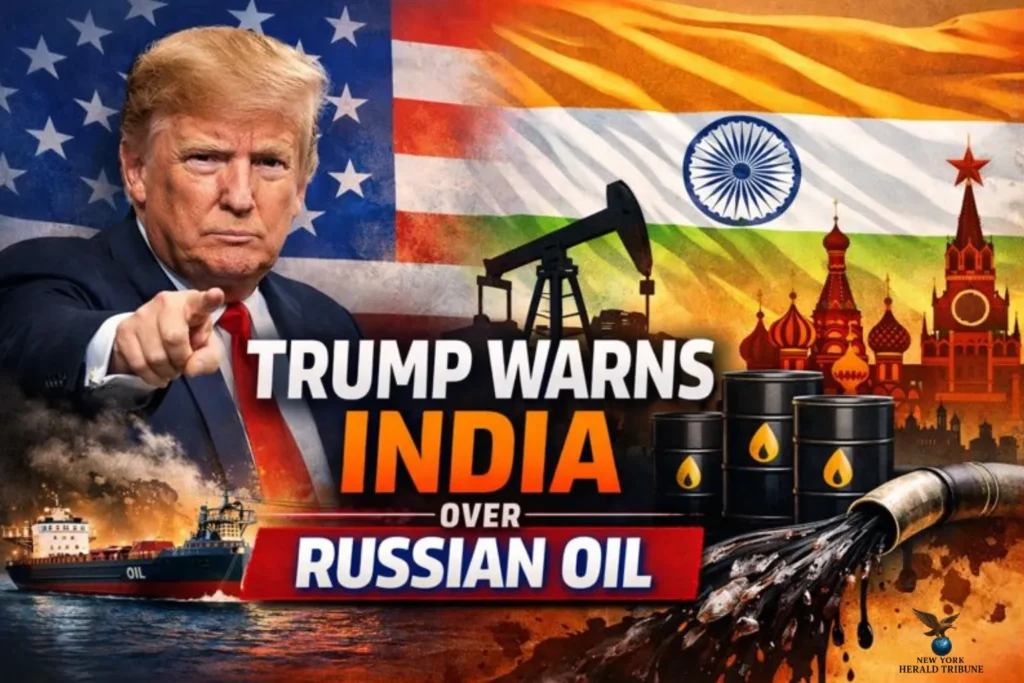
Trump warns india russian oil: US President Donald Trump has once again escalated pressure on India over its continued purchase of Russian crude oil, warning that Washington could impose significantly higher trade tariffs if New Delhi does not further reduce its energy ties with Moscow. The remarks underscore growing friction in US-India trade relations and highlight the increasingly complex role of energy politics in global diplomacy.
Speaking to reporters aboard Air Force One on Sunday, President Trump said punitive trade measures against India remain a serious option, explicitly linking future tariffs to India’s ongoing imports of discounted Russian oil. His comments reaffirm a long-standing stance he has taken since returning to office, in which economic leverage is used as a central tool of foreign policy.
“We could raise tariffs on India if they don’t help on the Russian oil issue,” Trump said, making it clear that the matter remains unresolved in Washington’s view.
The warning comes at a delicate moment for US-India relations, as officials from both countries attempt to revive stalled trade negotiations and preserve strategic cooperation amid broader geopolitical upheaval.
Trump’s Position: Energy, Trade, and Leverage
President Trump framed India’s energy decisions as closely tied to US expectations, suggesting that previous reductions in Russian oil purchases were driven largely by a desire to appease Washington rather than domestic policy considerations.
“They wanted to make me happy, basically,” Trump told reporters. “Prime Minister Modi’s a very good man. He’s a good guy. He knew I was not happy. It was important to make me happy. They do trade, and we can raise tariffs on them very quickly.”
The remarks are consistent with Trump’s transactional approach to diplomacy, where trade access and tariffs are frequently used to influence allies and competitors alike. His administration has repeatedly argued that countries buying Russian oil indirectly support Moscow’s military operations, particularly amid the ongoing war in Ukraine.
The phrase “Trump warns india russian oil” has increasingly dominated global headlines as Washington pushes major economies to isolate Russia economically.
Disputed Claims Over Indian Oil Imports
Trump claimed that India had significantly reduced its purchases of Russian crude in recent months, portraying this as evidence that US pressure was already producing results. However, official data from the Indian government presents a more complex picture.
According to figures cited by The Hindu, India’s imports of Russian oil actually climbed to a six-month high in November 2025. The data suggests that while India may have diversified some supply sources, Russian crude continues to play a central role in meeting the country’s massive energy demand.
Indian officials have consistently defended their energy policy, emphasizing that access to affordable fuel is essential for economic stability, inflation control, and national energy security.
India’s Energy Strategy: Economics Over Politics
India, the world’s third-largest oil importer, has maintained that its crude purchases are guided by market conditions rather than geopolitical alignment. Since Western sanctions limited Russia’s access to traditional buyers, Moscow has offered steep discounts on oil, making it an attractive option for price-sensitive economies like India.
New Delhi has repeatedly stated that it does not recognize unilateral sanctions imposed outside the United Nations framework and that its oil imports are fully compliant with international law.
Indian policymakers argue that abruptly cutting off Russian oil would raise fuel prices domestically, harm economic growth, and increase the burden on consumers. With inflation remaining a political concern, energy affordability continues to be a top priority for the Modi government.
Trade Talks Resume Amid Renewed Pressure
Trump’s latest warning arrives as US and Indian officials resume negotiations aimed at resolving a prolonged trade impasse. Talks have been strained since Trump’s earlier decision to impose sweeping tariffs on Indian exports, some reaching as high as 50 percent.
These measures affected a wide range of Indian goods, including steel, aluminum, textiles, and manufactured products, prompting retaliatory steps from New Delhi and souring trade ties between the two democracies.
A recent phone call between President Trump and Prime Minister Narendra Modi was intended to restore momentum in bilateral economic relations. According to both sides, the leaders acknowledged the importance of preserving cooperation despite unresolved disputes.
However, Trump’s renewed tariff threat suggests that progress remains fragile.
Role of US Lawmakers: Graham Pushes for Harsher Measures
Adding to the pressure, Republican Senator Lindsey Graham-a close ally of Trump-claimed that US sanctions and tariff threats had already forced India to cut back sharply on Russian oil imports.
Graham, who was traveling with Trump at the time, said he supports proposed legislation that would authorize tariffs of up to 500 percent on countries continuing to purchase Russian oil.
“If you are buying cheap Russian oil, you keep Putin’s war machine going,” Graham said. “The idea is to give the president the ability to make that a hard choice by tariffs.”
He credited Trump’s aggressive posture for what he described as a substantial decline in India’s Russian oil imports, though independent data does not fully support that claim.
Experts Warn India’s Balancing Act Is Risky
Trade analysts caution that India’s attempt to balance strategic autonomy with Western expectations may be becoming increasingly difficult to sustain.
Ajay Srivastava, founder of the Global Trade Research Initiative, told Reuters that New Delhi’s middle-ground strategy is losing effectiveness in the face of mounting US pressure.
According to Srivastava, India may soon be forced to clearly articulate its position rather than relying on diplomatic ambiguity.
He also warned that even a complete halt to Russian oil purchases might not shield India from future US trade demands.
“The pressure won’t necessarily stop with oil,” he said. “Once one concession is made, others may follow — on tariffs, market access, or regulatory issues.”
Broader Global Context: Energy Politics Resurface
The renewed focus on India’s oil imports comes as energy politics regain prominence worldwide. Recent US military actions against Venezuela — home to the world’s largest proven oil reserves-have once again disrupted global energy supply dynamics.
Despite holding more than 300 billion barrels of proven reserves, Venezuela’s oil production has been severely limited by years of US sanctions, mismanagement, and underinvestment. Output currently hovers around one million barrels per day, far below its potential.
These developments have tightened global supply and increased competition for alternative sources, further complicating India’s energy calculus.
The October Dispute: Conflicting Narratives
Tensions between Washington and New Delhi over Russian oil are not new. In October, a diplomatic dispute erupted after Trump publicly claimed that Prime Minister Modi had promised to stop importing Russian crude-an assertion that India firmly denied.
At the time, New Delhi clarified that while discussions were ongoing, no such commitment had been made. Indian officials reiterated that oil purchases were guided by national interest, not external pressure.
Trump, however, continued to insist that the call took place and warned that India would face “massive tariffs” if it failed to comply.
The episode exposed contrasting diplomatic styles: Trump’s public pressure versus India’s preference for quiet negotiation.
Strategic Partnership Under Strain
The repeated warnings raise questions about the future of the US-India strategic partnership, often described as a cornerstone of Indo-Pacific stability.
Both countries share concerns over China’s growing influence, cooperate on defense and technology, and maintain strong people-to-people ties. However, trade disputes and divergent energy policies threaten to undermine these gains.
While Washington views India as a critical counterbalance to Beijing, aggressive tariff threats risk alienating a key partner at a time of global uncertainty.
Economic Stakes for India
The economic implications of higher US tariffs could be significant for India. The United States remains one of India’s largest export markets, and punitive duties would impact manufacturing, employment, and foreign investment.
Industries such as pharmaceuticals, information technology services, textiles, and engineering goods could face renewed uncertainty if trade tensions escalate.
Indian businesses have already expressed concern over unpredictability in US trade policy, warning that prolonged disputes could deter long-term investment planning.
Trump’s Foreign Policy Playbook
Trump’s approach reflects a broader foreign policy philosophy centered on economic nationalism and direct leverage. Rather than relying on multilateral consensus, his administration has frequently pursued bilateral pressure tactics.
Supporters argue that this strategy forces faster concessions, while critics say it damages alliances and encourages retaliation.
The situation with India over Russian oil is a clear example of this divide, as Washington prioritizes geopolitical objectives while New Delhi emphasizes economic pragmatism.
What Comes Next?
As negotiations continue, both sides face difficult choices. India must decide whether to further diversify its energy imports or risk escalating trade penalties. The US, meanwhile, must balance its push against Russia with the strategic value of its partnership with India.
For now, the standoff remains unresolved, with energy purchases, trade tariffs, and diplomatic messaging tightly intertwined.
One thing is certain: as long as Russian oil remains a factor in global markets, the issue highlighted by “Trump warns india russian oil” will continue to shape headlines, diplomacy, and economic strategy on both sides of the Atlantic.
Also read: Unsealed US Indictment Details Sweeping Criminal Charges Against Nicolás Maduro and His Inner Circle
Conclusion
President Trump’s renewed warning underscores how energy, trade, and geopolitics have become inseparable in today’s global order. India’s response-whether through policy shifts, negotiation, or resistance-will have lasting implications not just for bilateral ties with the United States, but for its role on the world stage.
As global markets watch closely, the coming months will determine whether pragmatism or pressure ultimately prevails.