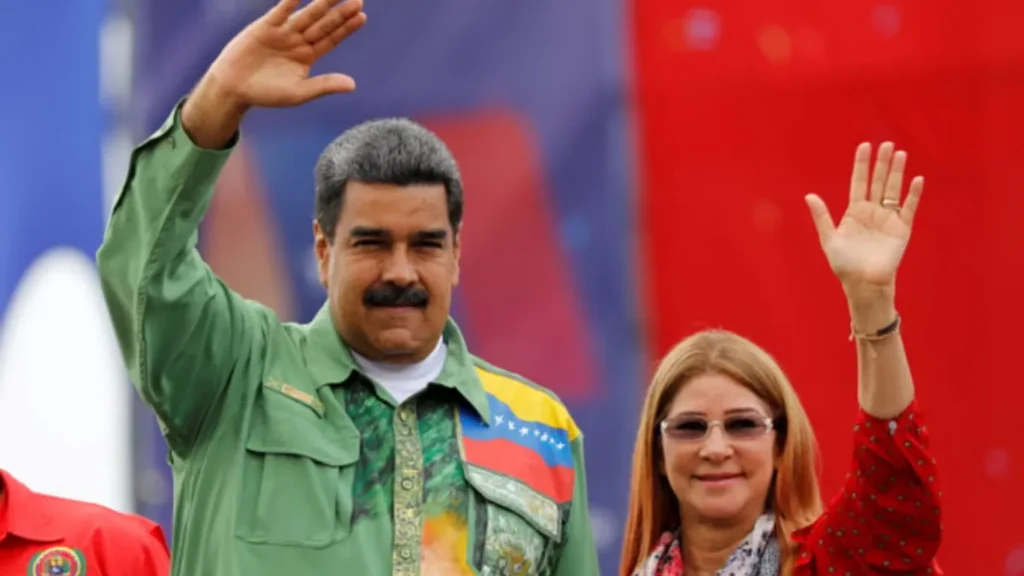
Nicolás Maduro: A newly unsealed indictment from the United States Department of Justice has laid out an extensive series of criminal allegations against captured Venezuelan President Nicolás Maduro, accusing him of presiding over what US authorities describe as a corrupt and illegitimate state apparatus deeply intertwined with international drug trafficking, organised crime, and narco-terrorism.
The indictment, filed in the Southern District of New York and revealed publicly on Saturday, portrays a Venezuelan government allegedly transformed into a criminal enterprise, with Nicolás Maduro, his wife Cilia Flores, and close family members at the centre of an operation that prosecutors say enabled the mass shipment of cocaine into the United States for years.
The dramatic arrest of Maduro and Flores during a US-backed military operation inside Venezuela earlier this weekend has set the stage for one of the most politically charged criminal prosecutions in modern American history. The case now moves to Manhattan federal court, where US prosecutors will attempt to hold a sitting—or recently deposed—foreign head of state criminally accountable under American law.
A Landmark Arrest With Global Consequences
The capture of Nicolás Maduro marks a turning point in long-simmering tensions between Washington and Caracas. For years, US authorities had accused the Venezuelan leader of evading justice while operating beyond the reach of American courts. His arrest, carried out in the early hours of Saturday, signals a decisive escalation.
US Attorney General Pam Bondi confirmed the development in a statement posted on social media, declaring that Maduro and his wife “will soon face the full force of American justice on American soil.” She described the indictment as the result of years of investigation into what prosecutors allege was a vast criminal conspiracy operating under the protection of the Venezuelan state.
Maduro and Flores are expected to remain in federal custody while pre-trial proceedings unfold. While officials have not confirmed the exact date of their first court appearance, legal experts say the case could span years and involve hundreds of witnesses, classified intelligence, and sensitive diplomatic considerations.
Charges That Mirror a Narco-State Allegation
According to the indictment, Nicolás Maduro faces four major federal charges:
- Narco-terrorism conspiracy
- Conspiracy to import cocaine into the United States
- Possession of machine guns and destructive devices
- Conspiracy to possess machine guns and destructive devices
The charges stem from allegations that Maduro collaborated with some of the world’s most notorious drug cartels and violent criminal organisations to facilitate the trafficking of massive quantities of cocaine through Venezuela and into the US.
The newly unsealed indictment expands upon an earlier case brought in 2020 during Donald Trump’s first presidency. While those earlier charges named Maduro alone, the updated filing adds his wife, Cilia Flores, his son, and three additional co-defendants, signalling a broader prosecution aimed at dismantling what authorities describe as a family-led criminal network.
Alleged Alliance With Global Drug Cartels
Central to the case is the claim that Nicolás Maduro knowingly partnered with violent transnational criminal groups, including Mexico’s Sinaloa cartel and the Venezuelan-based Tren de Aragua gang. Prosecutors allege these organisations operated with the direct cooperation and protection of Venezuelan state officials.
According to the indictment, cartel leaders paid bribes and shared profits with senior figures in Maduro’s government in exchange for safe passage, logistical assistance, and immunity from prosecution. These arrangements allegedly allowed cocaine shipments to move freely across Venezuelan territory, often using state-controlled infrastructure.
US investigators claim that by 2020 alone, as much as 250 tons of cocaine per year was being trafficked through Venezuela under this system. The drugs were allegedly transported using high-speed vessels, fishing boats, cargo ships, and aircraft departing from clandestine airstrips scattered across the country.
“This was not incidental corruption,” the indictment states. “It was systemic, intentional, and designed to enrich Nicolás Maduro, his family, and his closest allies.”
A Government Accused of Protecting Criminal Operations
Prosecutors allege that Maduro’s administration provided “law enforcement cover and logistical support” to criminal organisations, ensuring that traffickers could operate with near-total impunity. In return, cartel profits allegedly flowed directly to high-ranking officials, members of Maduro’s inner circle, and family members.
The indictment describes a vicious cycle in which drug profits funded political loyalty, corruption weakened institutions, and violence silenced opponents. US officials argue that this environment turned Venezuela into a key transit hub for narcotics destined for American cities.
“This narcotics-based corruption lined the pockets of Venezuelan officials and empowered violent narco-terrorists,” the indictment reads, adding that the consequences were felt far beyond Venezuela’s borders.
Allegations of Violence, Intimidation, and Murder
Beyond drug trafficking, the indictment accuses Nicolás Maduro and his wife of ordering acts of extreme violence to maintain control over their alleged criminal enterprise. These include kidnappings, physical assaults, and targeted killings against individuals accused of withholding drug proceeds or threatening the operation.
One specific allegation references the murder of a local drug boss in Caracas, allegedly carried out to send a message to others who might challenge the network. Prosecutors argue that such violence was not random but strategically deployed to enforce discipline and loyalty.
US authorities say these actions further demonstrate how deeply criminal activity had become embedded in the Venezuelan state under Maduro’s leadership.
Bribery Allegations Against Cilia Flores
Cilia Flores, long one of the most influential figures in Venezuelan politics, faces her own set of serious allegations. According to the indictment, she accepted hundreds of thousands of dollars in bribes as early as 2007 to broker meetings between major drug traffickers and senior Venezuelan anti-narcotics officials.
In one alleged scheme, Flores arranged an introduction between a large-scale trafficker and the head of Venezuela’s National Anti-Drug Office. The trafficker reportedly agreed to pay monthly bribes and additional fees for each cocaine-laden flight, ensuring safe passage through Venezuelan airspace.
Prosecutors allege that portions of these bribe payments were funneled directly to Flores, further implicating her in what they describe as institutionalised corruption.
The Nephews Case and Recorded Evidence
The indictment revisits a notorious earlier case involving two nephews of Cilia Flores, who were arrested in 2015 after recorded meetings with confidential US government sources. During those meetings, the nephews allegedly discussed plans to ship large quantities of cocaine from a Venezuelan airport using facilities reserved for presidential use.
According to prosecutors, the nephews openly referred to being “at war” with the United States and boasted of their access to government protection. They were later convicted and sentenced to 18 years in prison in 2017 for conspiring to traffic drugs into the US.
Their release in 2022 as part of a prisoner exchange involving seven detained Americans remains a controversial episode and is now cited by prosecutors as evidence of the far-reaching political implications of the case against Nicolás Maduro.
Military Operation Framed as Law Enforcement Action
US officials have emphasised that the operation that captured Maduro and his wife was conducted at the request of the Department of Justice. Speaking at a joint press conference, Secretary of State Marco Rubio and General Dan Caine, Chairman of the Joint Chiefs of Staff, described the raid as a law enforcement mission supported by military resources.
General Caine said the operation was carried out “at the request of the Justice Department,” while Rubio stressed that it fell within the scope of enforcing US criminal law rather than a traditional military intervention.
“This was the Department of War supporting the Department of Justice,” Rubio said, underscoring the administration’s effort to frame the arrest as a legal, not political, action.
A $50 Million Fugitive No More
For years, Nicolás Maduro was considered one of the world’s most high-profile fugitives from American justice, with a US reward of $50 million offered for information leading to his arrest. That designation, once symbolic, has now become concrete.
Rubio referred to Maduro as “a fugitive of American justice” whose capture sends a clear message about the reach of US law enforcement. He declined to comment on whether Congress was notified in advance, citing operational security concerns.
Read also: What Is Maduro Known For? A Complete and Clear Explanation
What Comes Next
Legal analysts say the prosecution of Nicolás Maduro will present unprecedented challenges. The case involves classified intelligence, foreign witnesses, and allegations that blur the line between criminal law and international politics.
Defence lawyers are expected to challenge US jurisdiction, question the legality of the arrest, and argue that the case represents political persecution. Prosecutors, meanwhile, appear determined to frame the trial as a straightforward criminal matter rooted in evidence gathered over more than a decade.
If convicted on all counts, Maduro could face life imprisonment.
A Trial That Could Redefine Accountability
Beyond the courtroom, the case has profound implications for international law, sovereignty, and the prosecution of alleged state-sponsored crime. Supporters of the indictment argue it represents a long-overdue effort to hold powerful leaders accountable. Critics warn it could deepen global divisions and set controversial precedents.
As Nicolás Maduro awaits trial in federal custody, the world will be watching closely. The outcome may not only determine the fate of a former president but also redefine how far international justice can reach when allegations of corruption and narcotics trafficking strike at the highest levels of power.