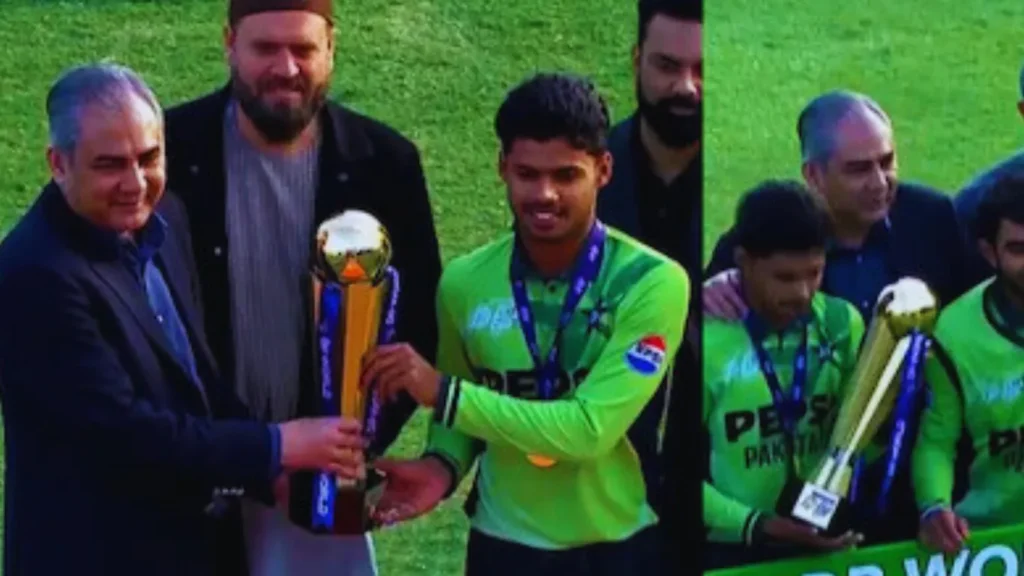
Asia Cup Trophy: Drama once again took center stage at an Asia Cup event as Asian Cricket Council (ACC) president Mohsin Naqvi became the focal point of controversy during the Under-19 Asia Cup trophy presentation ceremony. Pakistan emerged as champions after a dominant final victory, but the post-match scenes drew almost as much attention as the cricket itself, echoing tensions seen earlier this year during the senior men’s Asia Cup.
On Sunday, December 21, Mohsin Naqvi personally handed the U19 Asia Cup trophy to Pakistan and was seen celebrating alongside the winning team behind the “Champions” board. In contrast, the Indian Under-19 team, who finished as runners-up, did not step onto the main stage. Instead, Indian players quietly collected their medals off-stage from Mubashshir Usmani, an Associate Member Director at the International Cricket Council (ICC), near the presentation podium.
The unusual scenes immediately reignited discussions around the strained relationship between cricket administrators and teams from India and Pakistan, particularly in tournaments governed by the Asian Cricket Council.
ACC President Mohsin Naqvi handed over the trophy to Farhan Yousuf🔥❤
— usman (@Cricbyusman) December 21, 2025
– A dream for Suryakumar Yadav.😅🤫#INDvsPAK #U19AsiaCupfinal https://t.co/Pot8w2eO7Y
Echoes of Senior Asia Cup Controversy
This incident comes months after a major controversy during the senior men’s Asia Cup, where India and Pakistan were also finalists. On that occasion, India emerged victorious but reportedly declined to accept the Asia cup trophy from Mohsin Naqvi. Naqvi, who simultaneously serves as the chairman of the Pakistan Cricket Board (PCB) and Pakistan’s interior minister, had been under scrutiny for his political role and social media activity perceived as anti-India during the tournament.
India’s reported refusal to accept the trophy from Naqvi was widely interpreted as a symbolic political gesture, influenced by broader geopolitical tensions between the two nations. The situation escalated to the point where the trophy presentation ceremony was delayed by more than an hour. According to reports, Naqvi refused to allow any other ACC official to present the trophy to India and eventually left the venue, taking the Asia cup trophy with him to the ACC headquarters.
The Board of Control for Cricket in India (BCCI) was said to be angered by the handling of the situation and raised the issue at both ACC and ICC levels. Despite the passage of time, India is still reportedly yet to formally receive the trophy from that tournament, leaving a lingering administrative dispute.
Against this backdrop, Sunday’s U19 Asia Cup ceremony carried significant symbolic weight.
A Rare Scene at an ACC Event
While Pakistan’s victory in the Under-19 final may have reduced the likelihood of another standoff, observers noted that it remains highly unusual for the chairman or president of a continental cricket body to celebrate with one specific team during a trophy presentation. Mohsin Naqvi’s presence behind the Champions board with Pakistan’s players raised eyebrows, particularly given the events earlier in the year.
For India, the decision not to take the stage added another layer of intrigue. Although no official statement was issued immediately, the optics suggested a deliberate attempt to avoid an awkward or politically charged moment, choosing instead to complete the medal ceremony discreetly.
Pakistan’s Complete Dominance in the Final
On the field, however, there was little controversy about the outcome. Pakistan delivered a commanding performance to secure their second Under-19 Asia Cup title, comprehensively outplaying India in a one-sided final held in the One Day International (ODI) format.
Batting first, Pakistan posted a formidable total of 347 for eight, built on a sensational innings from Sameer Minhas. The young batter produced a magnificent 172, displaying maturity, power, and composure well beyond his years. His knock anchored Pakistan’s innings and demoralized the Indian bowling attack, which struggled to contain the flow of runs.
India’s bowlers found little assistance from the surface, and Pakistan capitalised fully, rotating the strike efficiently while also finding the boundary at regular intervals. By the end of the innings, the target looked daunting even by modern youth cricket standards.
Pace Battery Destroys India’s Chase
India’s chase began with a brief burst of optimism. The openers came out aggressively, racing to 49 for one within the first five overs, raising hopes of an early counterattack. However, that momentum evaporated almost instantly.
In the space of just two deliveries, India lost the crucial wickets of Aaron George and Vaibhav Suryavanshi, triggering a dramatic collapse. From that point onward, Pakistan’s pace trio took complete control of the match.
Ali Reza, Mohammad Sayyam, and Abdul Subhan exploited pace and bounce with ruthless efficiency, repeatedly beating the bat and forcing errors from the Indian batters. The Indian middle order offered little resistance as wickets fell in quick succession, turning the chase into a procession rather than a contest.
India were eventually bowled out for just 156 in 26.2 overs, handing Pakistan a massive 191-run victory-one of the most emphatic wins in Under-19 Asia Cup final history.
A Title Win Overshadowed by Ceremony Drama
Pakistan’s players celebrated a well-earned triumph, showcasing the strength of their youth development system and reaffirming their status as a powerhouse in junior cricket. For them, lifting the Asia cup trophy marked the culmination of a dominant tournament campaign.
Yet, despite the cricketing excellence on display, the post-match focus quickly shifted to the presentation ceremony and the broader implications for Asian cricket governance. Incidents like these raise questions about neutrality, protocol, and the role of administrators in maintaining the spirit of the game, especially at international youth events.
Conclusion
While both teams will move forward from this tournament, the scenes from the Under-19 Asia Cup final underscore how cricket in the subcontinent often extends beyond boundaries and scorecards. As long as geopolitical tensions continue to influence sporting interactions, moments like these are likely to recur.
For now, Pakistan walk away as deserving champions, proudly lifting the Asia cup trophy, while India are left to reflect on both a humbling on-field defeat and another chapter in an increasingly complex relationship with cricket’s governing bodies in the region.