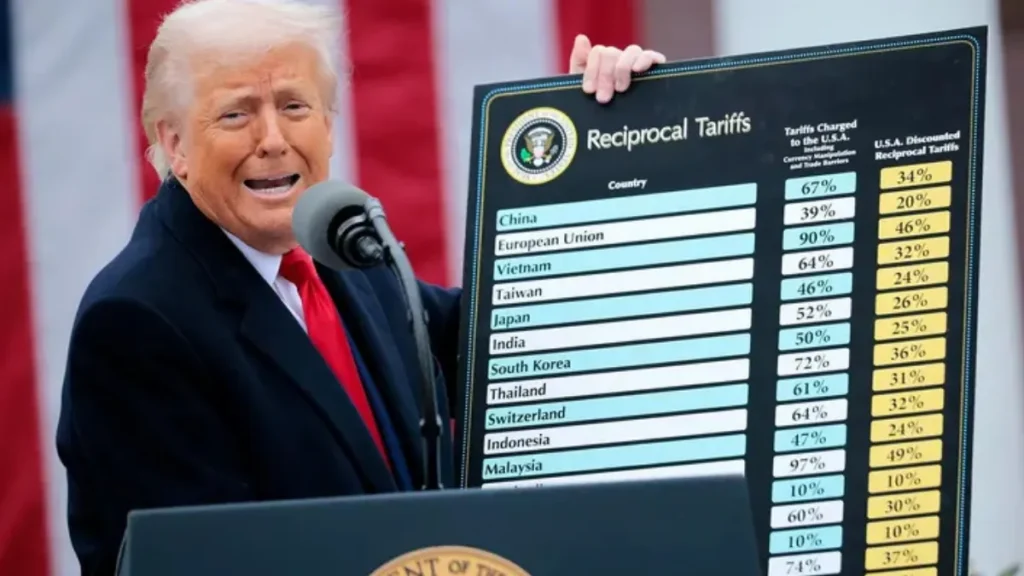
Trump Tariff Checks: Could millions of Americans soon receive a fresh round of stimulus payments — this time funded by tariffs rather than taxes?
That’s the question sweeping across the United States after former President Donald Trump announced plans for “Trump tariff checks”, promising $2,000 per person from what he called the “success of tariffs.”
In a November 9 Truth Social post, Trump said America’s booming trade revenue would be shared directly with citizens, calling it a “dividend” for hardworking Americans. The statement immediately triggered nationwide curiosity — and skepticism — about whether these payments could ever become reality.
This in-depth analysis breaks down what Trump actually said, what “Trump tariff checks” would mean, who might qualify, and whether the proposal has any chance of becoming law.
Trump’s Claim: America’s Tariff Success to Fund $2,000 Checks
On Truth Social, Trump declared confidently:
“People that are against Tariffs are FOOLS! We are now the Richest, Most Respected Country In the World, With Almost No Inflation, and A Record Stock Market Price. 401k’s are Highest EVER. We are taking in Trillions of Dollars and will soon begin paying down our ENORMOUS DEBT, $37 Trillion.”
He continued,
“A dividend of at least $2000 a person (not including high income people!) will be paid to everyone.”
The statement fueled immediate speculation: Was Trump serious about issuing Trump tariff checks? And if so, how would such payments work?
What Are “Trump Tariff Checks”?
The term “Trump tariff checks” refers to Trump’s idea of sending direct payments to American citizens, financed by the federal revenue collected from tariffs on imported goods — mainly Chinese products.
Trump’s trade policies have long emphasized tariffs as both a negotiation tool and a source of government income. The logic behind the checks is simple: if tariffs have made the U.S. “rich,” then ordinary Americans deserve a share of that wealth.
In essence, these payments would act as a national rebate, rewarding citizens for enduring higher consumer prices that tariffs sometimes cause.
However, while the idea sounds appealing, tariff revenues alone may not be enough to fund such large-scale payouts — and the process for distributing them would face serious political and financial obstacles.
Is the $2,000 Payment Real or Just a Promise?
As of now, no official government plan or legislation exists to issue $2,000 “tariff checks.”
Economic experts point out that such payments would require Congressional approval, as the executive branch cannot distribute funds without authorization.
The Hill and several financial outlets have noted that while Trump touts “trillions” in tariff revenue, much of it is already allocated toward federal programs and debt servicing.
That means unless Congress passes a new law specifically earmarking tariff funds for citizen payments, Trump tariff checks remain a campaign promise — not a confirmed policy.
Who Would Be Eligible for Trump Tariff Checks?
In his statement, Trump said the $2,000 payments would exclude high-income Americans, suggesting that eligibility could mirror previous stimulus programs that targeted middle- and lower-income families.
Although Trump didn’t define “high income,” experts estimate that thresholds could resemble past stimulus caps — around $75,000 for individuals or $150,000 for joint filers.
If implemented, families could also receive payments for dependents, but Trump’s post didn’t specify those details.
For now, eligibility for Trump tariff checks remains hypothetical, dependent entirely on future legislative action.
When Could the Payments Arrive?
Trump’s Truth Social post did not include any timeline or distribution details. There’s no indication that federal agencies such as the Treasury Department or IRS have been instructed to prepare payment systems.
Even if the plan gains traction, the rollout of Trump tariff checks could take months or even years.
The U.S. legislative process, budget approval, and IRS logistics all take significant time — and any new program would require full legal authorization.
In short, while the promise of $2,000 checks makes headlines, the path from proposal to payment is long and uncertain.
Earlier Attempts: The American Worker Rebate Act
This isn’t the first time the idea of using tariff revenue for public payments has surfaced.
In July 2025, Senator Josh Hawley (R-Missouri) proposed the American Worker Rebate Act, which aimed to give Americans $600 per adult and per child, or $2,400 for a family of four, funded entirely by tariff income.
Although the bill reflected the same logic as Trump tariff checks, it stalled in Congress and never advanced past the committee stage.
That earlier attempt highlights how difficult it can be to turn such populist ideas into policy.
The Economics Behind Tariff Revenue
Trump’s argument rests on the belief that tariffs generate huge profits for the United States.
In reality, tariffs are taxes on imported goods, often paid by American companies and passed down to consumers through higher prices.
According to economists, the federal government has collected tens of billions from tariffs, but not trillions, as Trump claims. While tariffs can increase revenue in the short term, they may also raise production costs and reduce trade volumes over time.
That raises a crucial question: Could “Trump tariff checks” end up recycling money that consumers already paid in higher prices?
Supporters vs. Critics: Two Economic Visions
Supporters of Trump tariff checks argue that tariffs have made America stronger, boosted domestic manufacturing, and leveled the playing field against China. They see the checks as a fair way to reward citizens for enduring the economic shifts that tariffs cause.
Critics, however, call it economic theater, warning that:
- Tariffs ultimately burden consumers, not foreign exporters.
- Revenue from tariffs is too small to fund nationwide checks.
- The proposal could increase inflation or add to national debt.
Still, the political appeal of the plan is undeniable. Many Americans — especially in working-class regions — welcome the idea of a government rebate that doesn’t come from borrowing or printing new money.
What About the “DOGE Dividend”?
Earlier in 2025, another Trump-aligned initiative known as the “DOGE dividend” gained online attention. It was rumored to provide payments funded by savings from federal cuts, but the plan was never formally approved.
Despite viral discussions, Congress never passed any DOGE-related legislation, and the proposal faded away.
That experience casts doubt on whether Trump tariff checks could face the same fate — big headlines, but no follow-through.
Public Reaction: Hope and Doubt Collide
Within hours of Trump’s announcement, the hashtag #TrumpTariffChecks trended across X (formerly Twitter) and TikTok.
Thousands of users expressed excitement, saying the idea could ease the cost of living crisis. Others dismissed it as a campaign promise designed to grab attention ahead of the 2026 elections.
For millions still recovering from inflation and housing costs, even the possibility of a $2,000 payment struck a chord.
Yet many economists caution that voters should separate political messaging from fiscal reality.
How Congress Could Make It Happen
If Trump or his allies were to turn this proposal into law, the process would require:
- A formal bill introduced in Congress defining payment amounts and eligibility.
- Budget allocation identifying which tariff revenues would fund the program.
- Senate and House approval, likely needing bipartisan support.
- Implementation by the Treasury and IRS for payment distribution.
Only after those steps could the first Trump tariff checks actually reach the public. Until then, the plan exists mainly as a political statement — a promise awaiting paperwork.
Impact on the National Debt
Trump also claimed that America would soon begin paying down its $37 trillion national debt, partly using tariff income.
Economists are divided on this assertion. While tariffs add some revenue, they are nowhere near sufficient to reduce such a massive debt on their own.
In fact, issuing Trump tariff checks could reduce available tariff funds, delaying any effort to pay down the deficit.
That trade-off highlights the tension between short-term political gain and long-term fiscal responsibility.
The Global Perspective
Internationally, Trump’s renewed focus on tariffs is being watched closely by global markets.
Countries like China, Mexico, and Canada — major U.S. trading partners — could see renewed trade tensions if the next administration reimposes or expands tariffs.
Economists in the UK and EU warn that such policies may trigger price hikes across global supply chains, affecting imports and consumer goods worldwide.
Thus, while Trump tariff checks might sound like an American-only issue, the ripple effects of tariff policy are undeniably global.
Also read: Donald Trump Promises $2,000 Tariff Dividend to Americans, Calls Critics “Fools”
Media and Market Reaction
Financial outlets and analysts have responded with cautious skepticism.
Wall Street economists warn that “tariff-funded” payments could disrupt market expectations, especially if investors view them as inflationary.
Meanwhile, political commentators note that the promise of Trump tariff checks serves as an effective campaign message — combining patriotism, populism, and economic optimism.
In essence, even if the payments never materialize, the idea reinforces Trump’s image as a leader who puts “America First” — literally returning money to its people.
Key Takeaways
- No official policy: “Trump tariff checks” are not yet legislated or confirmed.
- Funding challenge: Tariff revenues may not be large enough to support $2,000 per citizen.
- Eligibility unclear: Likely to exclude high-income earners.
- Political impact: The idea energizes Trump’s economic narrative.
- Economic impact: May clash with debt reduction and inflation control.
Also read: US Shutdown Crisis Deepens: America’s Air Travel in Chaos as Government Closure Enters Day 40
Conclusion: Reality or Political Strategy?
The concept of Trump tariff checks captures public imagination — a simple, patriotic promise to share America’s trade wealth with its citizens.
But behind the bold language lies a complex economic and political reality.
For now, there are no active plans, timelines, or laws confirming that Americans will receive $2,000 from tariff revenues.
Still, the phrase “Trump tariff checks” may continue to dominate campaign headlines, reflecting both hope and skepticism in a divided economy.
Whether it becomes a historic policy or just another viral talking point, one thing is clear: Trump’s promise has once again placed tariffs — and their impact on ordinary Americans — at the center of the national conversation.