Washington, D.C. Trump mamdani meeting What was expected to be the most heated political confrontation of the year turned into an unexpectedly cordial exchange as U.S. President Donald Trump welcomed New York City’s newly elected mayor, Zohran Mamdani, to the White House. The highly anticipated Trump mamdani meeting, originally hyped as a clash between ideological opposites, resulted instead in praise, shared laughs, and an overt commitment to work together on New York’s affordability crisis.
The two leaders had exchanged harsh criticism throughout the New York mayoral race. Trump labeled Mamdani a “communist,” while Mamdani, a self-identified Democratic socialist, called the president a “despot” in his victory address. Yet, inside the Oval Office, those political attacks faded quickly, as both men emphasized common priorities and mutual respect.
Whether this surprising political truce will endure once Mamdani formally assumes office on January 1 is uncertain. But for now, the tone was unmistakably warm. “I’ll be cheering for him,” Trump said with a smile as the meeting concluded.
From Political Enemies to Public Compliments
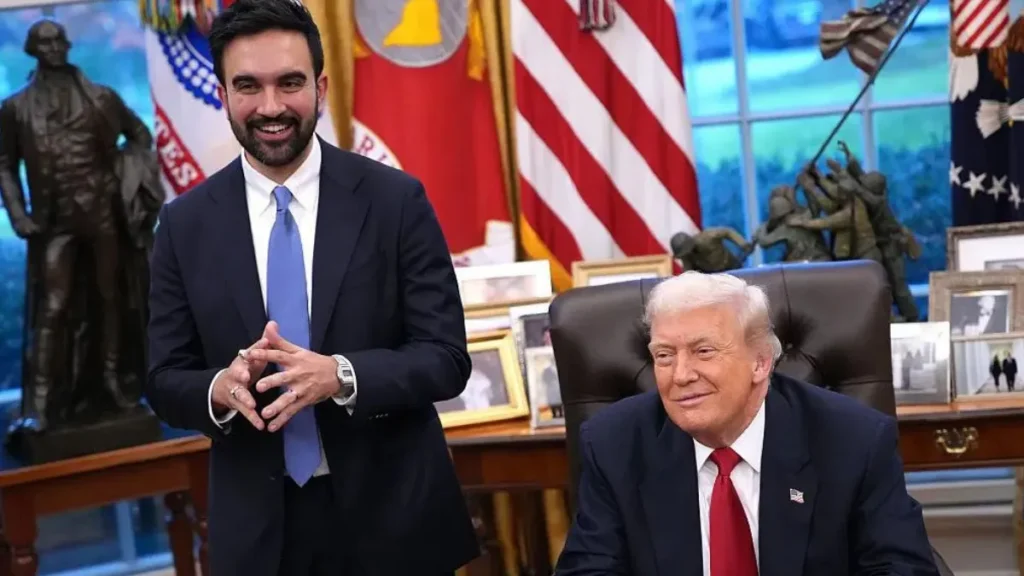
The shift in tone was visible immediately as the pair addressed reporters following a private Oval Office discussion. Mamdani stood calmly beside the Resolute Desk while Trump leaned back with a relaxed posture, signaling a level of comfort political watchers hadn’t expected.
Rather than criticize the mayor-elect, Trump praised him repeatedly. He told the room he believed Mamdani would be a “really great mayor,” and later added he was “confident that he can do a very good job.”
The president’s words were significant not only because of the election rhetoric that preceded them, but because Trump almost never extends such public warmth to political rivals. The Trump mamdani meeting demonstrated a rare moment when both men seemed eager to set aside disagreements and emphasize cooperation over conflict.
Deflecting the Harsh Labels
During the election, both camps traded some of the sharpest political labels in recent New York memory. Reporters didn’t hesitate to bring that up.
A journalist pressed Mamdani about once calling Trump a “despot.” Another reminded the president that he had attacked Mamdani as a “communist.”
Both leaders brushed off the reminders and instead redirected focus to affordability issues.
At one point, a correspondent went even further, citing remarks from one of Trump’s closest political allies — Republican Congresswoman Elise Stefanik — who had referred to Mamdani as a “jihadist.”
Trump shut the criticism down instantly.
“No, I don’t,” he responded when asked if he believed he was standing next to a “jihadist” in the Oval Office. With visible irritation toward the question, he added, “You say things sometimes in a campaign. She’s a very capable person.”
The brief exchange suggested that in the White House setting, Trump was determined to distance himself from the harshest rhetoric that surrounded the election. It also emphasized how committed both men were to maintaining a respectful tone during the Trump mamdani meeting.
us Bonding over Their Roots: Queens Boys Together
Surprisingly, one of the most authentic moments of the afternoon came through a shared sense of nostalgia. Though they represent drastically different political ideologies, Trump and Mamdani discovered strong common ground in their personal histories.
Both men are New Yorkers through and through — and more specifically, both come from Queens.
Trump grew up in Jamaica Estates, while Mamdani currently lives in Astoria. The shared “Queens connection” softened the tone of the meeting, and Mamdani later described their conversation as rooted in a “shared admiration and love” for the city.
The president spoke warmly about his hometown and said he hoped Mamdani would deliver the results New Yorkers need. “This city could be unbelievable — if he can be a spectacular success, I’ll be very happy,” Trump said, even joking that in another political lifetime, he might have liked to be mayor of New York himself.
United by a Common Mission: Tackling Affordability
More than anything else, Trump and Mamdani connected over the cost-of-living crisis — an issue both politicians have built major political momentum around.
Trump won re-election in 2024 by positioning himself as the candidate who understood inflation fatigue. Meanwhile, Mamdani ran a laser-focused local campaign promising to tackle New York’s extreme rents and housing shortages.
The mayor-elect emphasized rent freezes and broader housing reforms during his run, gaining support from voters feeling priced out of the city.
So it wasn’t surprising that throughout the Trump mamdani meeting, both men revisited the affordability theme repeatedly:
“We talked about how to deliver affordability to New Yorkers,” Mamdani told reporters.
Whenever asked about areas of disagreement — whether foreign policy, policing, or immigration — Mamdani kept redirecting the conversation to affordability issues. Trump backed him up, telling journalists that New Yorkers deserved relief and that Mamdani “gets it.”
Even on policies where critics assumed the two could never find harmony — immigration and policing — the discussion remained cooperative. Mamdani raised community concerns about federal enforcement operations, while Trump focused on crime statistics, with both ultimately agreeing that residents should feel safer.
Trump even surprised reporters by saying he would “feel safe” living in a Mamdani-run New York — a statement that stunned political strategists watching closely.
A Political Complication for Republicans?
The unexpected friendliness of the Trump mamdani meeting could create challenges for Republicans strategizing for the 2026 midterm elections. GOP operatives had reportedly planned to make Mamdani the national poster figure for “radical” Democratic politics, leveraging his democratic-socialist brand to energize conservative voters.
Leaked reports claimed that Republican campaign messaging was being built around portraying Mamdani as:
- Anti-police
- Anti-capitalist
- Anti-Israel
But Trump’s public praise for Mamdani — and dismissal of the harshest accusations — now risks undermining that strategy. If the Republican president himself does not treat Mamdani as a political threat, it may become harder to use him as a rallying symbol in congressional races.
Instead of describing Mamdani as dangerous, Trump suggested that he might surprise the critics on the right. It was another sign of the striking political pivot that defined this meeting.
Also read: Did Trump Sign the Bill? President Orders Release of Epstein Files, Turns Spotlight on Democrats
Where Does the Relationship Go from Here?
The political world remains divided on whether the goodwill from the Trump mamdani meeting is built to last. Some observers believe the two men share enough overlapping priorities — especially affordability and crime — to make future cooperation possible. Others predict the truce will dissolve once the realities of policy, public pressure and divided ideologies return.
It is also unclear how Trump supporters and Mamdani’s progressive base will respond to the public warmth each showed the other. Both leaders risk backlash if either group interprets the friendliness as political compromise.
For now, however, the body language, tone, and words from the Oval Office paint a clear picture: both Trump and Mamdani recognize that solving New York’s cost-of-living crisis is essential to their political success — and possibly their legacies.
Trump closed the meeting with unmistakable enthusiasm and optimism:
“I’ll be cheering for him,” he said. “New York deserves success.”
Whether this political alliance becomes a long-term partnership or a momentary pause in partisan fighting remains to be seen. But one thing is certain: the Trump mamdani meeting has already become one of the most intriguing and unexpected developments in American political storytelling in recent years.