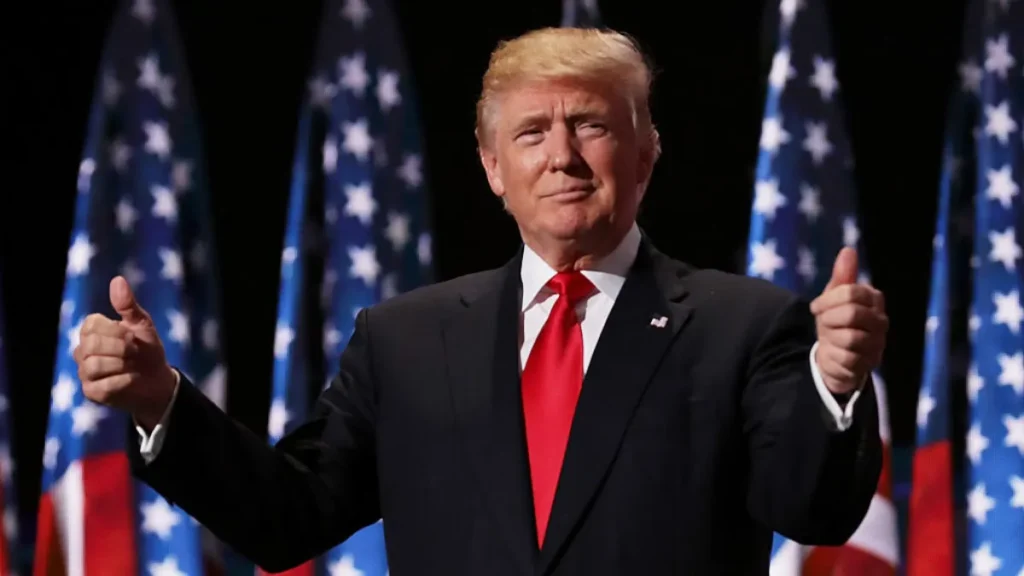
Trump h1b: The debate surrounding the H-1B visa programme has intensified once again after fresh comments from US President Donald Trump and a detailed clarification from the White House. As concerns grow regarding rising fees and scrutiny around the H-1B system, the administration has insisted that its policies aim to strike a balance between welcoming foreign investment and protecting local employment opportunities.
In recent days, President Trump—who returned to office on the back of renewed promises to prioritise American workers—spoke out in defence of the H-1B scheme. During his remarks, Trump acknowledged both his admiration for his conservative base and his MAGA supporters, while also recognising a practical reality: the United States continues to rely on foreign skilled workers in several high-tech and specialised industries. His comments have reignited the conversation over the future of the H-1B programme, popularly referred to in ongoing conversations as Trump h1b policies.
White House Issues Statement Amid H-1B Fee Controversy
Amid the uproar over proposed increases in H-1B visa fees, White House Press Secretary Karoline Leavitt delivered a significant statement highlighting the administration’s stance. She emphasised that President Trump remains committed to expanding foreign investment in the US while safeguarding employment for American citizens.
Leavitt explained that Trump’s approach reflects a broader strategy: the administration aims to strengthen domestic manufacturing, encourage multinational corporations to bring capital into the country, and ensure that such investments translate into jobs for American residents. Her comments came at a crucial time, as industries across the US express concern about the tightening of visa reviews and the potential for foreign workers to displace domestic labour.
‘Jobs Must Go to Americans First,’ Says White House
Addressing the concerns directly, Leavitt revealed that President Trump has instructed foreign companies operating in the United States to prioritise American workers. According to her, Trump’s message to global corporations is straightforward: if they wish to build and expand their businesses within America, they must commit to hiring US citizens for the majority of positions.
“President Trump does not support the displacement of American workers,” Leavitt told the media. “His priority is to ensure that American manufacturing runs better than ever before. This approach includes strategic tariff applications and negotiating trade deals around the world that ultimately benefit American industries.”
These remarks reflect the administration’s intensifying scrutiny of industries that rely heavily on foreign labour. As several labour groups and political figures raise concerns about the potential misuse of visa programmes, particularly in sectors such as technology and electronics, the White House is seeking to reassure the public that the core objective of the Trump h1b framework is to protect and uplift domestic job markets.
A Nuanced Approach to H-1B, Says White House
While the administration’s “America First” stance has dominated political headlines, Leavitt clarified that Trump’s approach to the H-1B visa programme is neither overly restrictive nor unrealistic. Instead, she described his stance as “nuanced and practical.”
Speaking about industries such as battery manufacturing, semiconductors, and clean-energy technology—sectors that have seen significant foreign investment—Leavitt stated that Trump wants American workers to benefit first. However, she noted that in rapidly advancing fields, specialised expertise from abroad can be essential, especially in the early stages of operations.
“If foreign companies are investing billions into American factories and bringing in experts to set up complex systems, the President wants those facilities operational as quickly as possible,” she said. “But ultimately, he wants American workers in those roles once the initial setup phase is complete.”
Her comments signal that while the administration supports foreign talent where absolutely necessary, it maintains a firm expectation that companies must train and transition roles to American employees as soon as feasible.
Also read: Meta Buried Evidence of Social Media Harm, US Court Documents Reveal
Trump Acknowledges the Need for Skilled Foreign Workers
Trump’s own statements in recent days further reinforce this balanced position. While speaking earlier this month, he reiterated his loyalty to his conservative base, acknowledging their concerns about immigration and the job market. Yet he also underlined a critical point: the US economy still requires skilled foreign workers, especially in areas where domestic expertise remains limited.
His defence of the H-1B programme came during the US-Saudi Investment Forum on 20 November, where he addressed criticism from within his supporter circle. Trump argued that industries making major technological investments cannot simply hire workers from unemployment lines and expect immediate proficiency in highly advanced fields.
Using the example of semiconductor production, Trump explained that companies cannot establish chip factories overnight without experienced professionals. “You can’t open a complex computer-chip plant and assume local workers will instantly be ready without proper training,” he told the audience. “Before foreign experts leave, American workers must be fully trained.”
This viewpoint reflects a dual-track strategy: support essential inflows of specialised talent while simultaneously upskilling American workers to take over those roles in the future. The administration has repeatedly highlighted that long-term self-reliance, not constant dependence on foreign expertise, is the goal of the Trump h1b approach.
A Policy Balancing Act
As the H-1B debate progresses, the White House is attempting to craft a policy that satisfies multiple stakeholders—corporations needing skilled talent, American workers concerned about job displacement, and political supporters advocating for stricter immigration controls.
The administration maintains that it is not eliminating opportunities for skilled foreign professionals but rather ensuring that American citizens receive the first claim to employment whenever possible. At the same time, foreign investment continues to be actively encouraged, provided it results in tangible benefits for US communities.
With industries undergoing rapid technological transformation, the future of the H-1B programme will remain a crucial topic in US economic and political discussions. As the Trump h1b policy direction continues to evolve, the balancing act between innovation, investment, and American jobs will shape the broader narrative in the months ahead.