Tensions in the Middle East have escalated sharply after Saudi Arabia launched a targeted airstrike on Yemen’s Mukalla port, citing intelligence that weapons and military equipment were being delivered to a separatist group backed by the United Arab Emirates (UAE). The development has exposed growing cracks between two long-time regional allies and plunged Yemen into a fresh political and security crisis.
According to Saudi officials, the airstrike was carried out in the early hours of Tuesday morning after surveillance confirmed the arrival of two ships at Mukalla port whose tracking systems had been deliberately switched off. Riyadh claims the vessels originated from the UAE’s Fujairah port and were transporting arms and military vehicles intended for the Southern Transitional Council (STC), a powerful separatist force operating in southern Yemen.
Saudi Arabia described the strike as a “limited and precise military operation” designed to prevent further destabilisation in Yemen. Officials said the attack was executed at night to minimise civilian casualties and was aimed exclusively at military targets.
Saudi Arabia’s Justification for the Mukalla Airstrike
Saudi Arabia has stated that the decision to strike Mukalla port was based on what it called “credible and time-sensitive intelligence.” According to Riyadh, the weapons shipment posed a serious threat to Yemen’s sovereignty and regional security, particularly because it was allegedly destined for the STC, a group seeking to divide the country.
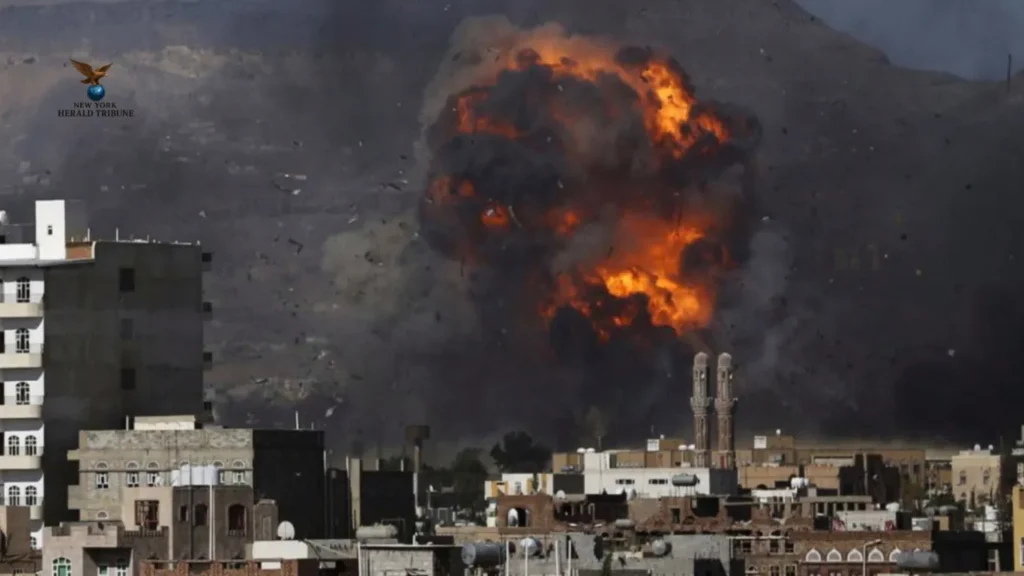
In an official statement, Saudi military sources claimed that unloading of arms and military vehicles had already begun at the port when the airstrike was launched. The Saudi Air Force reportedly destroyed several pieces of equipment and storage facilities linked to the shipment.
Saudi authorities later released video footage of the operation, showing what they described as precision strikes on military targets within the port area. The footage was intended to reinforce Saudi Arabia’s claim that the attack was carefully planned and avoided civilian infrastructure as much as possible.
Silence from the UAE Amid Rising Diplomatic Strain
As of now, the UAE has not issued any official response to Saudi Arabia’s allegations or the airstrike itself. However, the incident has significantly increased diplomatic tension between the two Gulf powers, who have been allies in Yemen’s long-running conflict for nearly a decade.
Saudi Arabia and the UAE have both been part of a military coalition fighting Iran-backed Houthi rebels since 2015. Despite their shared goal of countering the Houthis, the two countries have increasingly supported rival factions on the ground, leading to conflicting interests in Yemen’s south.
Analysts say the Mukalla airstrike highlights how far apart Saudi Arabia and the UAE have drifted in their Yemen strategies, even as they continue to present a united front against the Houthis.
Yemen Cancels Defence Agreement with UAE
The fallout from the airstrike was swift and dramatic inside Yemen. The Yemeni government announced the immediate cancellation of its defence agreement with the UAE, accusing Abu Dhabi of undermining Yemen’s unity and stability.
Rashad al-Alimi, head of Yemen’s Presidential Leadership Council, declared that all UAE military forces must leave Yemeni territory within 24 hours. The announcement marked one of the strongest rebukes of the UAE by Yemen’s internationally recognised government since the war began.
In addition, the Yemeni government imposed a comprehensive 72-hour air, land, and sea blockade in an attempt to regain control of the security situation. A nationwide state of emergency has also been declared for 90 days, granting authorities expanded powers to respond to internal threats.
Despite the escalation, Al-Alimi publicly praised Saudi Arabia for what he described as decisive action against separatist groups. He said the airstrike was “in the interest of Yemen’s sovereignty and regional stability.”
Who Are the Southern Transitional Council (STC)?
At the heart of the crisis is the Southern Transitional Council, a heavily armed separatist organisation that receives political and military backing from the UAE. The STC’s primary objective is to split Yemen into two independent states-North Yemen and South Yemen-and establish a separate government in the south.
Yemen was divided into two countries until 1990, when North and South Yemen were unified. However, separatist sentiment has remained strong in the south, particularly in areas that once formed South Yemen.
The STC has capitalised on Yemen’s prolonged instability to expand its influence. Over the past month, the group has launched a series of large-scale military operations, seizing control of key oil- and gas-rich regions such as Hadramout and Al-Mahra.
These advances forced Yemeni government forces and local tribal fighters to retreat from several strategic areas. Reports of violence, civilian displacement, and fatalities have increased sharply as a result.
By mid-December, the STC claimed control over multiple vital energy sites and announced a new military campaign in Abyan province. On December 15, STC fighters reportedly carried out a major assault in the mountainous areas of Abyan, further escalating tensions.
Saudi Warnings and the Road to Mukalla
Saudi Arabia had already signalled its displeasure with the STC’s actions weeks before the Mukalla airstrike. In response to the group’s expansion in Hadramout, Saudi jets conducted what were described as “warning strikes” in the Wadi Nahab area.
Saudi officials warned at the time that stronger action would follow if the STC did not halt its advances. The airstrike on Mukalla port is now widely seen as the next step in that warning campaign, underscoring Riyadh’s determination to prevent any unilateral changes to Yemen’s territorial integrity.
Why Saudi Arabia and the UAE Are at Odds Over Yemen
Saudi Arabia and the UAE initially worked closely together when Yemen’s civil war erupted. In 2014, Houthi rebels captured the capital, Sanaa, and forced the Saudi-backed government into exile. A Saudi-led military coalition was formed in 2015 to push back the Houthis, with the UAE as a key partner.
Over time, however, differences in strategic priorities became increasingly apparent. Experts say the UAE gradually pursued its own agenda in Yemen, focusing on securing ports, shipping lanes, and strategic coastal areas.
According to regional analysts, the UAE views control over maritime infrastructure as essential to its economic and geopolitical influence. Yemen’s ports, including Mukalla and Aden, are seen as critical assets in this strategy.
Professor Sultan Barakat of Hamad Bin Khalifa University in Qatar has argued that the UAE is less interested in developing Yemeni ports and more concerned with ensuring that Dubai’s Jebel Ali port remains the dominant logistics hub in the region. Controlling or influencing rival ports helps maintain the UAE’s commercial supremacy.
Yemen’s Civil War: A Brief Background
Yemen’s civil war began in 2014 when Houthi rebels overthrew the internationally recognised government. In 2015, Saudi Arabia launched a military intervention to counter the Houthis, whom it accuses of being backed by Iran.
The conflict has since become one of the world’s worst humanitarian crises. Hundreds of thousands of people have been killed directly or indirectly, and around 80% of Yemen’s population now depends on humanitarian assistance for survival.
While the war is often framed as a proxy conflict between Saudi Arabia and Iran, internal divisions have played a significant role. Yemen’s population is roughly 65% Sunni and 35% Shia, and sectarian tensions have long existed.
According to reports from the Carnegie Middle East Center, political unrest following the Arab Spring in 2011 intensified these divisions, eventually pushing the country into full-scale civil war.
By 2015, the situation had deteriorated to the point where the entire Yemeni government was forced into exile, while the Houthis gained control over large parts of the country.
What Comes Next?-Saudi Arabia Launches Airstrike on Yemen’s Mukalla Port
The Saudi airstrike on Mukalla port marks a dangerous turning point in Yemen’s already complex conflict. It not only raises the risk of direct confrontation between Saudi Arabia and the UAE but also threatens to further fragment Yemen at a time when peace efforts remain fragile.
With a 90-day state of emergency now in place, Yemen faces heightened uncertainty. Observers warn that continued rivalry between regional powers could deepen the humanitarian crisis and derail any prospects for long-term stability.
As Saudi Arabia launches airstrike on Yemen’s Mukalla port, the incident serves as a stark reminder that Yemen’s war is far from over-and that shifting alliances may shape its future just as much as battlefield developments.