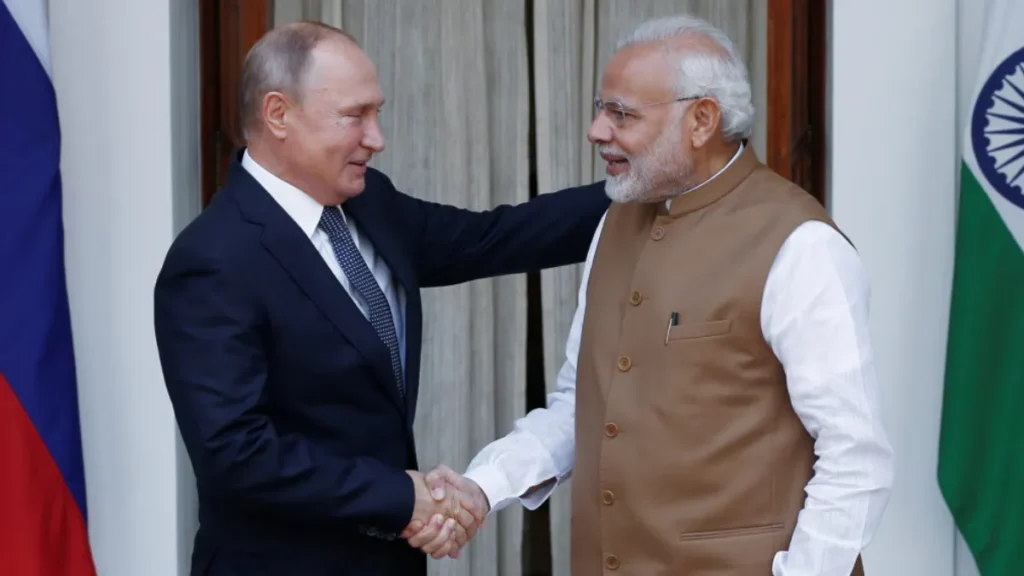
India russia deal-In a world where global supply chains are increasingly vulnerable to geopolitical tensions, shifting alliances, and maritime chokepoints, India and Russia have positioned themselves at the center of a historic transformation. During high-level meetings held in India on December 4 and 5, Prime Minister Narendra Modi and Russian President Vladimir Putin advanced what analysts are calling the most ambitious connectivity overhaul between the two nations in decades.
The two leaders didn’t simply reaffirm their decades-old diplomatic partnership; they rewrote its future. Through decisive negotiations and strategic commitments, India and Russia agreed to accelerate three major corridors that together promise to compress logistics by more than 16,000 kilometres and reduce transit durations by up to 40 days. The initiative-now widely referred to as the India russia deal-could reshape Eurasian trade and redefine how India interacts with global markets.
The three major connectivity projects pushed forward at the summit include:
- The International North-South Transport Corridor (INSTC)
- The Chennai–Vladivostok Maritime Corridor (CVMC)
- The Northern Sea Route (NSR)
If successfully executed, these routes will offer India unprecedented alternatives to the traditional Suez Canal-dominated maritime pathways. With Western economies still debating the future of their partnerships with Moscow, India and Russia are not waiting. They are building the future-in ink, steel, railways, shipping lanes, and Arctic icebreakers.
A Vision Beyond Diplomacy: Why These Corridors Matter
The Modi–Putin summit moved beyond ceremonial niceties and directly into the realm of economic transformation. Together, the three corridors will create a multi-directional transportation network that serves energy security, trade diversification, mineral supply stability, and geopolitical autonomy.
These projects dramatically shorten travel times between India’s manufacturing hubs and Russia’s resource-rich regions. While the West continues to lecture both nations about political alignments, New Delhi and Moscow are quietly drawing a new map of global commerce.
At the heart of the India russia deal is a shared belief that the shortest, safest, and most efficient routes will dictate the balance of economic power in the 21st century. And India is positioning itself to ensure that those routes run directly through its own ports, economic corridors, and industrial supply chains.
THE INTERNATIONAL NORTH-SOUTH TRANSPORT CORRIDOR (INSTC): INDIA’S FASTEST ROUTE TO RUSSIA
A 7,200-Kilometre Artery Redefining Eurasian Trade
Imagine a logistics route that cuts the journey from Mumbai or Nhava Sheva to St. Petersburg to just 23 to 25 days-nearly half the time required through the congested Suez Canal and volatile Red Sea. That is the promise of the INSTC.
The route is strategically elegant:
- Indian cargo ships travel to Iran’s Bandar Abbas or the Indian-built Chabahar Port.
- Goods proceed through Iran via roadways and railways.
- Cargo enters the Caspian Sea, crossing into Azerbaijan.
- From Azerbaijan, freight moves directly into Russia with logistical access extending to Armenia, Kazakhstan, Turkmenistan, and even Belarus.
To date, 13 nations have officially committed to the project.
One of the last missing infrastructural pieces-the crucial Rasht–Astara rail link in Iran-is now financed and actively under construction. Once completed, INSTC will offer uninterrupted connectivity from the Indian Ocean to the heart of Russia.
Operational Success Already Visible
Since March 2025, India has been using the corridor operationally. Cargo from Mundra Port in Gujarat has successfully been delivered to Central Asia via Bandar Abbas, proving that the project is not theoretical but functional.
A scholar at the Observer Research Foundation explained that INSTC could become a “game changer,” expanding India’s presence across Eurasia, strengthening rare-earth supply security, and counterbalancing China’s Belt and Road influence.
This is particularly crucial because, in 2025, India signed a pivotal strategic partnership with Central Asian nations centered on rare earths and critical minerals, marking India’s intent to decrease dependence on Chinese mineral supply chains.
Record-Breaking Eastern Arm Movement
Just in November 2025, a landmark event occurred:
A full cargo consignment moving through the eastern arm of INSTC reached Central Asia in record time.
On November 8, a freight train originating near Moscow travelled through Kazakhstan and Turkmenistan, entered Iran, and covered the final 900 km to Tehran’s Aprin dry port in just 12 days-establishing proof of concept for high-speed Eurasian freight via this route.
Strong Push from Modi and Putin
During the December 5 summit, Modi and Putin issued a clear directive: their respective teams must enhance the corridor’s stability and operational efficiency.
Their joint statement emphasized the need to:
- Expand logistics links
- Enhance infrastructure capacity
- Improve overall corridor performance
- Hold regular bilateral Arctic and transport-related consultations
Putin highlighted the immense opportunities these corridors bring, while Modi assured businesses that India is committed to accelerating progress.
The strategic undertone was unmistakable: this India russia deal is designed to outpace rival connectivity ideas before they even leave the drawing board.
THE FALTERING WESTERN ALTERNATIVE: INDIA–MIDDLE EAST–EUROPE ECONOMIC CORRIDOR (IMEC)
Announced with enthusiasm at the 2023 G20 Summit, the India–Middle East–Europe Economic Corridor was meant to become a mega-route connecting India to Europe via the UAE, Saudi Arabia, Jordan, Israel, Greece, and Italy.
However, geopolitical conflicts have frozen it in place:
- The Gaza war
- Houthi attacks on Red Sea shipping
- Tensions across West Asia
- The shutdown of planning mechanisms
What was envisioned as India’s strategic link to Europe is now, as observers put it, a “PowerPoint dream.”
In contrast, the INSTC is physically moving cargo today. India and Russia see this as a race-and they intend to win.
THE CHENNAI–VLADIVOSTOK MARITIME CORRIDOR (CVMC): A BLUE-WATER REVOLUTION
If INSTC is India’s Eurasian artery, the Chennai–Vladivostok Maritime Corridor is its Pacific lifeline.
A 10,370-km Shortcut with Massive Economic Potential
The CVMC cuts nearly 8,000 kilometres off existing maritime routes and slashes travel times significantly. First introduced in 2019, it struggled with logistical delays and global instability-until now.
At the 2025 India–Russia Summit, the project roared back to life. New MoUs were signed to:
- Establish regular liner shipping services
- Create reliable insurance and maritime risk frameworks
- Facilitate cooperation between Indian and Russian shipping companies
The corridor is particularly vital because it directly links India with Russia’s mineral-heavy far-eastern regions. Key resources India can access more rapidly include:
- Diamonds and gems from the Sakha Republic
- Timber
- Liquefied Natural Gas (LNG)
For Russia, the corridor provides a dependable “warm-water” connection to one of the world’s largest consumer markets-India’s 1.4 billion people.
This maritime path is expected to become one of the flagship achievements of the India russia deal, especially as Russia shifts trade eastward in response to Western sanctions.
THE NORTHERN SEA ROUTE (NSR): INDIA’S ARCTIC ENTRY GATE
The most geopolitically significant component of the India russia deal is the Northern Sea Route-a shipping corridor that runs along Russia’s Arctic coastline, stretching from Murmansk in the northwest to Vladivostok in the east.
A 40% Shorter Path to Europe
The NSR is up to 40 percent shorter than the traditional Suez Canal route. For India, this means:
- Faster access to European and Russian markets
- Reduced freight costs
- Shorter energy supply routes
- Bypassing piracy-prone areas and conflict zones
When combined with INSTC and CVMC, the NSR effectively gives India an all-season, multipolar logistics architecture-one that no Red Sea crisis, Malacca Strait blockage, or Suez congestion can disrupt.
Unprecedented Icebreaker Access for India
During the summit, India secured a remarkable agreement:
Priority icebreaker escort and guaranteed access to Russian Arctic ports for Indian ships.
This gives India something few countries possess-a reliable Arctic entry point for:
- LNG
- Crude oil
- Rare metals
- Future Arctic resources as ice recedes
This element alone elevates the India russia deal from a connectivity pact to a long-term energy security framework.
THE ECONOMIC IMPACT: TOWARD $100 BILLION TRADE FASTER THAN EXPECTED
India–Russia bilateral trade exceeded $65 billion in 2024–25, primarily due to discounted Russian energy imports.
The declared joint target:
$100 billion in trade by 2030.
However, Prime Minister Modi stated at the India Russia Business Forum that he expects this milestone to arrive much sooner, saying:
“As per my conversations with President Putin, and the potential we see, I don’t think we’ll have to wait until 2030 to achieve the target of $100 billion bilateral trade. We are moving forward with determination to achieve that goal ahead of schedule.”
Modi instructed Commerce Minister Piyush Goyal to eliminate all bottlenecks in the bilateral trade system. He emphasized that the 2030 Economic Cooperation Programme will create balanced, diversified, and sustainable trade with Russia.
For India, this means:
- Long-term access to critical minerals
- Greater energy security
- Opportunities for Indian companies in Russian markets
For Russia, Indian demand provides a crucial alternative to European markets, which have drastically shrunk due to political tensions and sanctions.
GEOPOLITICS: A QUIET BUT POWERFUL REBUKE TO WESTERN PRESSURE
While many Western capitals attempt diplomacy based on warnings and restrictions, India and Russia have adopted a pragmatic approach rooted in sovereignty and mutual benefit.
Far from Cold War nostalgia, the India russia deal is built on:
- Practical cooperation
- Shared strategic interests
- Complementary economic strengths
- Trust developed over decades
Modi described Russia as India’s “Pole Star”-a constant partner offering reliability in a turbulent global environment.
These corridors ensure India is not beholden to any single chokepoint or geopolitical power. Instead, they give the country its widest-ever set of connectivity choices.
A NEW FUTURE FOR SUPPLY CHAINS
The message emerging from New Delhi is unmistakably clear:
In a world where supply chains are frequently disrupted, the nations that control the shortest, safest trade routes will shape the future of global commerce.
With the INSTC, CVMC, and NSR advancing rapidly, India and Russia have drawn that future map-and have already begun navigating it.
This India russia deal is more than an agreement. It is a strategic declaration that the 21st century’s economic arteries will run through corridors built not by Western powers, but through robust Eurasian partnerships anchored in mutual trust.