Growing US Pressure on Pakistan: A major political storm has erupted between Washington and Islamabad after 44 members of the United States Congress formally urged the US Secretary of State, Marco Rubio, to impose immediate sanctions on Pakistan’s Prime Minister Shehbaz Sharif and the country’s powerful Army Chief General Asim Munir.
The letter, signed by Democratic Congresswoman Pramila Jayapal and Congressman Greg Casar, alleges that Pakistan is rapidly sliding into military-backed authoritarianism, sparking the loudest international call yet for human-rights accountability inside the nuclear-armed nation.
In the global media, the question circulating widely is:
Pakistani PM-Army Chief banned? Will the US actually sanction Pakistan’s top leadership?
The congressional letter accuses Pakistan’s military establishment of engineering a climate of intimidation, silencing journalists, and suppressing democratic freedoms—while warning that the situation has crossed a dangerous threshold.
US Lawmakers Accuse Pakistan Army of Running the Government
The 44 lawmakers assert that Pakistan is no longer functioning as a genuine democracy. The letter claims that the army, not the civilian government, is directly controlling state affairs. This allegation represents one of the boldest public statements against Pakistan’s military from the US political system.
According to the letter:
- Basic civil liberties in Pakistan are being systematically crushed.
- Voices of dissent—including journalists, activists, and political opponents—are being targeted.
- Even Pakistani-origin US citizens living overseas are facing intimidation when they criticize the Pakistani government or military.
The lawmakers argue that such actions violate international norms and directly threaten US citizens’ rights to free expression, making it a matter of American national interest.
Journalists Face Kidnappings, Threats, and Forced Exile
One of the most troubling allegations involves the targeting of Pakistani journalists, especially those reporting on military corruption. The letter mentions several specific incidents to support these claims.
Case 1: Journalist Ahmad Noorani
Ahmad Noorani, a journalist living in Virginia, became the target of severe retaliation after publishing reports on alleged corruption within Pakistan’s military ranks. Shortly after his reporting:
- Both of his brothers, who still lived in Pakistan,
- Were reportedly kidnapped and kept in captivity for over a month.
The US lawmakers stated that this was a deliberate attempt to silence Noorani by targeting his family. They argue that foreign-based journalists, particularly those who are US citizens, should not have to fear threats originating from another state’s military establishment.
Case 2: Musician Salman Ahmad’s Relative Kidnapped
The letter also highlights the abduction of a close relative of globally known musician Salman Ahmad. According to the congressional account, the family member was only released after direct intervention from US authorities.
These incidents, the lawmakers argue, are indicative of a larger pattern: Pakistan’s security establishment uses abduction and intimidation as tools against dissent—inside and outside the country.
Opposition Leaders, Women, Minorities, and Baloch Citizens Being Targeted
The congressional letter expresses alarm at the deteriorating human-rights conditions across Pakistan. It states that:
- Opposition leaders are being jailed without formal charges.
- Ordinary citizens face arrest for social media posts perceived as anti-government or anti-military.
- Journalists are routinely harassed, abducted, or forced to flee the country.
- Women and religious minorities face growing persecution.
- The most severe abuses reportedly occur in Balochistan, a region with a long history of tensions with the Pakistani military.
The US lawmakers warn that Pakistan’s internal repression has reached a point where silence is no longer an option.
Controversy Over Pakistan’s 2024 General Elections
A significant part of the letter focuses on Pakistan’s 2024 general elections, which were widely criticized both internationally and domestically.
The lawmakers cite findings from:
- The Pattan Report, produced by an independent Pakistani organization
- The US State Department, which also expressed “deep concerns”
- Multiple international observers who documented irregularities
According to the letter:
- The 2024 elections were marred by massive vote manipulation.
- The results did not reflect the will of the Pakistani people.
- A “puppet government” has been installed, one that is outwardly civilian but controlled from behind the scenes by the military leadership.
The lawmakers insist that the election irregularities demand a full and transparent investigation, without interference from the same authorities accused of manipulating the results.
Supreme Court Under Pressure? Civilian Cases Sent to Military Courts
Another alarming issue highlighted in the letter is the decision of Pakistan’s Supreme Court allowing civilian cases to be tried in military courts.
According to the US lawmakers, this development:
- Places Pakistan’s judiciary under military influence
- Eliminates independent judicial oversight
- Allows military officials to escape accountability for abuses
- Violates democratic principles and international law
The lawmakers warn that such legal changes reflect deepening authoritarian control, further justifying sanctions under US law.
What Sanctions Could the US Impose?
The central issue attracting global attention is whether the US might actually impose sanctions, leading many analysts to discuss:
“Pakistani PM-Army Chief banned?”
The congressional letter outlines three major categories of penalties that could be applied under current US legislation.
1. Visa Restrictions (Travel Bans)
The US can prohibit entry for:
- Prime Minister Shehbaz Sharif
- Army Chief Asim Munir
- Senior Pakistani officials involved in human-rights abuses
- Their immediate family members
If imposed, these individuals would be barred from traveling to the United States, which would be a major diplomatic blow.
Visa bans are typically applied under:
- The Global Magnitsky Act
- Other US human-rights enforcement frameworks
These restrictions are commonly used against officials from countries accused of political repression.
2. Asset Freezes and Financial Restrictions
Under US and international banking systems, sanctions could lead to:
- Frozen bank accounts
- Blocked property or investments
- Restrictions on international financial transactions
- Limitations on dollar-denominated trade
Any assets held in the US—or in US-aligned financial networks—could be seized or frozen. The Global Magnitsky Act specifically targets individuals who:
- Commit serious human-rights abuses
- Engage in corruption
- Use violence or intimidation against civilians
Such sanctions would severely limit Pakistan’s top leadership’s international mobility and financial access.
3. Broader Diplomatic and Economic Pressure
If the US officially declares that Pakistan’s government is violating democratic norms:
- Military-to-military cooperation could be reevaluated
- Security aid may be cut
- International organizations (IMF, World Bank) may be influenced to demand political reforms
- Pakistan’s global image could face serious damage
Given Pakistan’s dependence on international financial institutions, such pressure could have significant long-term consequences.
Asim Munir’s Recent White House Visits Add Tension
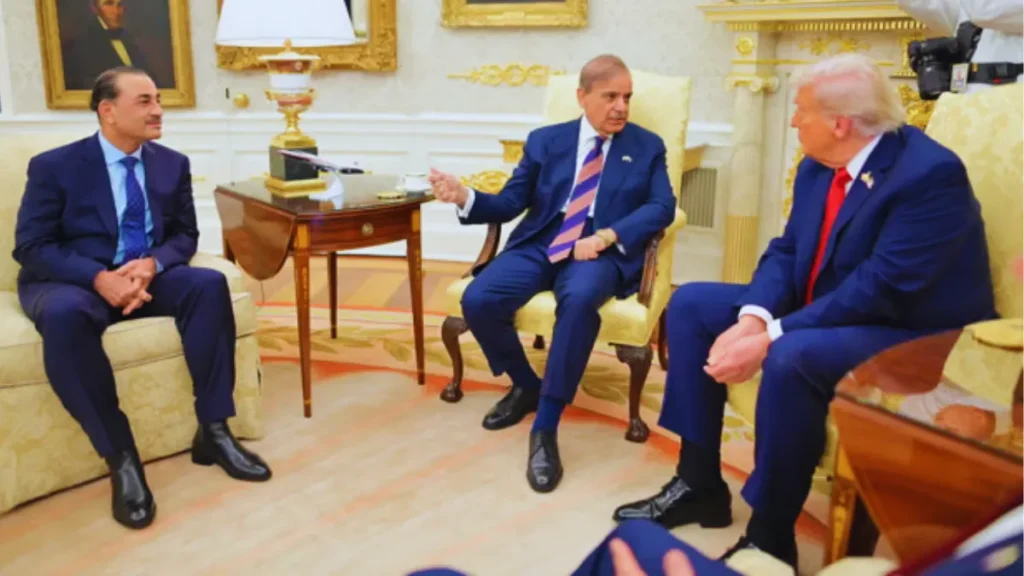
General Asim Munir’s recent Washington visits have become another focal point of controversy. In 2025, Munir met US President Donald Trump twice:
June 18 Meeting
- Trump hosted Munir for a private lunch at the White House.
- The meeting took place behind closed doors.
- Pakistani-American protesters gathered outside, calling Munir a “dictator” and “murderer.”
September Meeting
Later in September, both:
- Prime Minister Shehbaz Sharif
- Army Chief Asim Munir
met Trump again in a lengthy 1 hour and 20-minute session at the White House.
Protesters again questioned why the US government was engaging with Pakistani officials accused of human-rights violations.
Why the US Congress Is Taking an Unusually Strong Stand
Political analysts believe that several factors have pushed American lawmakers to act:
1. Rising Threats Against US Citizens of Pakistani Origin
When Pakistan-based actors allegedly target relatives of US citizens, the issue becomes a direct national-security concern.
2. Strategic Instability in a Nuclear-Armed Nation
A military takeover—or military control disguised as civilian rule—is seen as destabilizing for South Asia.
3. US Domestic Politics and Human Rights Concerns
Members of Congress, especially within the Democratic Party, have begun prioritizing human-rights accountability in foreign policy.
4. Pakistan’s Worsening International Reputation
Widespread reports of censorship, election manipulation, judicial interference, and forced disappearances have damaged Pakistan’s global standing.
5. Growing Activism Among Pakistani-Americans
The Pakistani diaspora in the US has become increasingly vocal, urging lawmakers to recognize human-rights abuses.
How Likely Are US Sanctions Against Pakistan’s Leadership?
Experts remain divided.
Possible Indicators That Sanctions May Happen
- A large bipartisan group signed the letter—44 lawmakers is significant.
- The Biden administration and State Department have previously expressed concerns about Pakistan’s democracy.
- The Global Magnitsky Act has been applied broadly in other countries.
- There is increasing political pressure from Pakistani-American citizens.
Reasons Sanctions May Be Delayed
- Pakistan remains geopolitically important to the US.
- Washington may avoid destabilizing a nuclear-armed nation.
- Diplomatic channels between the Pentagon and Pakistan’s military remain active.
- Trump’s interactions with Munir may complicate congressional pressure.
While sanctions are not guaranteed, analysts say this is the closest Pakistan’s top leadership has come to facing US penalties in decades.
The global debate continues to center around the main question:
Could we soon see “Pakistani PM-Army Chief banned?” under US law?
Also read: UAE Not Issuing Visas to Pakistanis: Rising Rejections Spark Major Concerns Among Travelers
Conclusion: A Diplomatic Crisis That Could Reshape US-Pakistan Relations
The letter from 44 US lawmakers marks a turning point in Washington’s approach to Pakistan:
- It publicly accuses Pakistan’s military of authoritarian control
- It calls for sanctions on sitting national leaders
- It highlights widespread human-rights abuses
- It demands accountability for election interference
Whether or not the US imposes sanctions, the impact is already visible. The Pakistani government and military elite are facing unprecedented scrutiny, and the international spotlight is now firmly on Islamabad’s domestic policies.
If Washington moves ahead with visa bans or financial sanctions, it could profoundly reshape Pakistan’s political landscape—and redefine US-Pakistan relations for years to come.
For now, the world continues to watch how far the US government is willing to go, and whether the bold question will become reality: