Trump US India Trade Deal: In a significant development that could reshape the economic relationship between the world’s two largest democracies, the United States has announced a reduction in reciprocal tariffs imposed on Indian goods. The move follows high-level talks between US President Donald Trump and Indian Prime Minister Narendra Modi and is being widely described as a breakthrough moment in the evolving Trump US India trade deal.
According to official statements and social media disclosures from President Trump, the United States has reduced a previously imposed 25 percent reciprocal tariff on Indian imports to 18 percent. While India still faces an additional levy linked to energy purchases from Russia, the overall tariff burden has now dropped from 50 percent to 43 percent, offering partial relief to Indian exporters and signaling renewed momentum in bilateral trade negotiations.
The announcement comes after months of economic tension, multiple tariff actions by Washington, and increasing diplomatic engagement between New Delhi and Washington over trade imbalances, energy security, and the global fallout from the Russia-Ukraine war.
US Slashes Reciprocal Tariffs on India: What Has Changed?
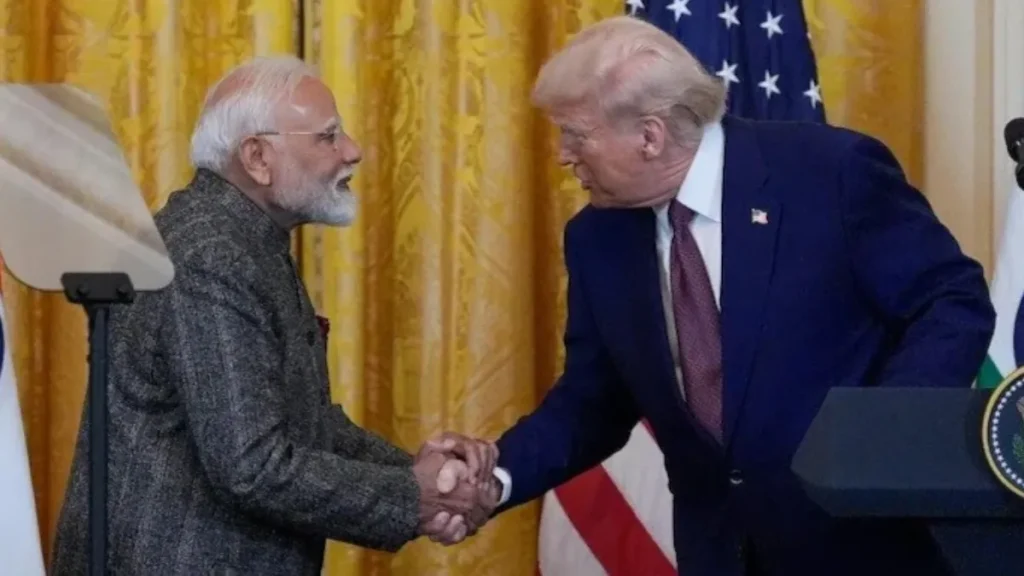
President Trump confirmed that the United States has decided to lower the reciprocal tariff imposed on India from 25 percent to 18 percent. The decision, he said, was taken following direct discussions with Prime Minister Modi and as part of a broader understanding between the two governments to move forward on trade and strategic cooperation.
Despite the reduction, Indian exports to the US will still face a combined tariff of 43 percent, as a separate 25 percent levy related to India’s continued purchase of Russian oil remains in place for now. US officials have not yet issued a formal clarification on whether this additional surcharge will be withdrawn in the near future.
The tariff reduction is being viewed as a confidence-building step under the broader Trump US India trade deal, indicating Washington’s willingness to recalibrate its stance amid constructive dialogue.
Background: How Tariffs on India Reached 50 Percent
The current tariff situation has its roots in two separate decisions taken by the US administration in August 2025.
- August 1, 2025: The United States imposed a 25 percent reciprocal tariff on Indian goods, citing concerns over trade imbalance and market access barriers faced by American companies in India.
- August 27, 2025: A further 25 percent surcharge was added after Washington accused India of indirectly supporting Russia’s economy by continuing to purchase crude oil amid the Ukraine conflict.
Together, these measures pushed the total tariff burden on Indian exports to a steep 50 percent, triggering concerns among exporters, policymakers, and global investors.
The latest reduction brings the cumulative rate down to 43 percent, marking the first rollback since the tariffs were imposed.
Trump Says Modi Will Reduce Russian Oil Imports
In a detailed post on his social media platform, Truth Social, President Trump described his recent conversation with Prime Minister Modi as “an honour” and emphasized the personal rapport between the two leaders.
Trump stated that Modi had expressed readiness to significantly reduce India’s purchases of Russian oil and instead increase imports from the United States. According to Trump, the Indian leader also indicated openness to sourcing energy from Venezuela if necessary.
Trump linked this potential shift in India’s energy strategy to broader global efforts to end the Russia-Ukraine war, arguing that reducing Moscow’s oil revenue would help weaken its ability to sustain the conflict.
While the Indian government has not issued a detailed public statement confirming these commitments, officials in New Delhi have acknowledged that energy diversification remains an ongoing priority.
Trade Agreement Announced “With Immediate Effect”
President Trump further claimed that, following Modi’s request and in recognition of their friendship, the United States and India had reached an immediate trade understanding.
Under this arrangement:
- The US will reduce the reciprocal tariff on India from 25 percent to 18 percent.
- India will begin working toward eliminating tariffs and non-tariff barriers on American goods.
- New Delhi will expand its “Buy American” commitments across multiple sectors.
This announcement forms the core of what Trump has described as the Trump US India trade deal, though formal documentation and legal frameworks are still awaited.
India’s Commitment to Buy More from the US
One of the most striking elements of Trump’s statement was the scale of India’s proposed purchases from the United States.
According to Trump, India has committed to buying more than $500 billion worth of American goods, including:
- Energy products such as crude oil and LNG
- Advanced technology and industrial equipment
- Agricultural commodities
- Coal and other raw materials
If realized, such a massive procurement programme would significantly alter the trade balance between the two countries and strengthen the US export sector.
Trade analysts note that achieving this figure would require long-term contracts, infrastructure investments, and sustained political alignment.
Strategic Implications for US-India Relations
The tariff cut and proposed trade expansion underline the strategic importance of US-India ties at a time of global uncertainty.
Both countries have increasingly aligned on:
- Countering China’s economic influence
- Securing supply chains
- Strengthening defence and technology cooperation
- Maintaining stability in the Indo-Pacific region
The Trump US India trade deal is being viewed not merely as a commercial agreement, but as part of a broader geopolitical partnership.
Trump Shares India Gate Image, Praises Indian Architecture
Alongside policy announcements, President Trump shared two India-related images on Truth Social.
One post featured a photograph of India Gate, New Delhi’s iconic war memorial. Trump praised the monument, calling it “beautiful” and describing it as a grand triumphal arch.
In a characteristically personal remark, Trump added that the United States would soon have an even more impressive gate of its own.
Trump’s ‘Arc de Trump’ Project in Washington
Trump’s reference was linked to his long-standing plan to construct a massive ceremonial gateway in Washington, DC, tentatively named the ‘Arc de Trump’.
According to US media reports and comments from White House officials:
- The structure would serve as a monumental entrance to the capital from Virginia.
- The design is inspired by Paris’s Arc de Triomphe.
- Trump personally contributed to the concept and design discussions.
Although the project has not yet begun, Trump has frequently cited it as a symbol of American pride and legacy.
Modi and Trump: A High-Frequency Diplomatic Relationship
The latest conversation between Modi and Trump is part of an unusually frequent pattern of direct engagement.
Since Trump returned to office, the two leaders have spoken seven times within 13 months, reflecting the priority both sides place on the relationship.
Timeline of Key Calls:
- January 27, 2025: Modi congratulates Trump on assuming office
- April 22, 2025: Trump calls Modi after a terrorist attack in Pahalgam
- June 17, 2025: Trump extends an invitation to Modi
- September 17, 2025: Birthday greetings
- October 21, 2025: Diwali wishes
- December 11, 2025: Strategic and economic discussion
- Latest call: Focused on trade, energy, and Ukraine
Indian officials have consistently described these conversations as warm, constructive, and forward-looking.
Trade, Technology, and Defence at the Core
Beyond tariffs, discussions between the two leaders have covered a wide array of sectors, including:
- Advanced and critical technologies
- Defence manufacturing and joint production
- Energy security
- Cybersecurity and digital infrastructure
Both governments have emphasized that future cooperation will be driven by tangible outcomes rather than symbolic gestures.
Economic Impact on Indian Exporters
The reduction of tariffs from 25 percent to 18 percent is expected to offer partial relief to Indian exporters, particularly in sectors such as:
- Pharmaceuticals
- Engineering goods
- Textiles
- Automotive components
However, industry leaders caution that the remaining tariff burden remains high and continues to affect competitiveness in the US market.
What Happens to the Extra 25 Percent Tariff?
A major unanswered question remains the fate of the additional 25 percent surcharge imposed over Russian oil imports.
While Trump has suggested that India will move away from Russian energy supplies, no official confirmation has been issued regarding the immediate withdrawal of this penalty.
Experts believe that any further reduction will depend on:
- Verified changes in India’s oil import patterns
- Progress on broader trade commitments
- Alignment on geopolitical issues
Global Reactions to the Trump US India Trade Deal
International observers are closely watching the development, as it could influence:
- Global energy markets
- Supply chain realignments
- Diplomatic dynamics surrounding the Ukraine war
European and Asian markets responded cautiously, with analysts awaiting clearer policy signals.
A Turning Point or Temporary Truce?
While the tariff cut marks a positive step, analysts warn against viewing it as a final settlement.
Much depends on:
- Formal agreements being signed
- Implementation of tariff and non-tariff barrier reductions
- Long-term political continuity in both countries
Still, the announcement has injected fresh optimism into discussions surrounding the Trump US India trade deal.
Also read: Gold and Silver Price Drop Shocks Markets on Budget Day as Profit Booking Triggers Sharp Sell-Off
Conclusion: A New Chapter in US-India Economic Ties
The decision by the United States to reduce tariffs on Indian goods, combined with ambitious trade and energy commitments, signals a renewed push to strengthen bilateral ties.
For India, the move offers economic breathing room and greater access to the world’s largest consumer market. For the United States, it promises expanded exports, strategic alignment, and influence in a rapidly changing global order.
As negotiations continue and details emerge, the Trump US India trade deal may well become one of the most consequential economic partnerships of the decade.