Ahmedabad/Gandhinagar, January 12, 2026
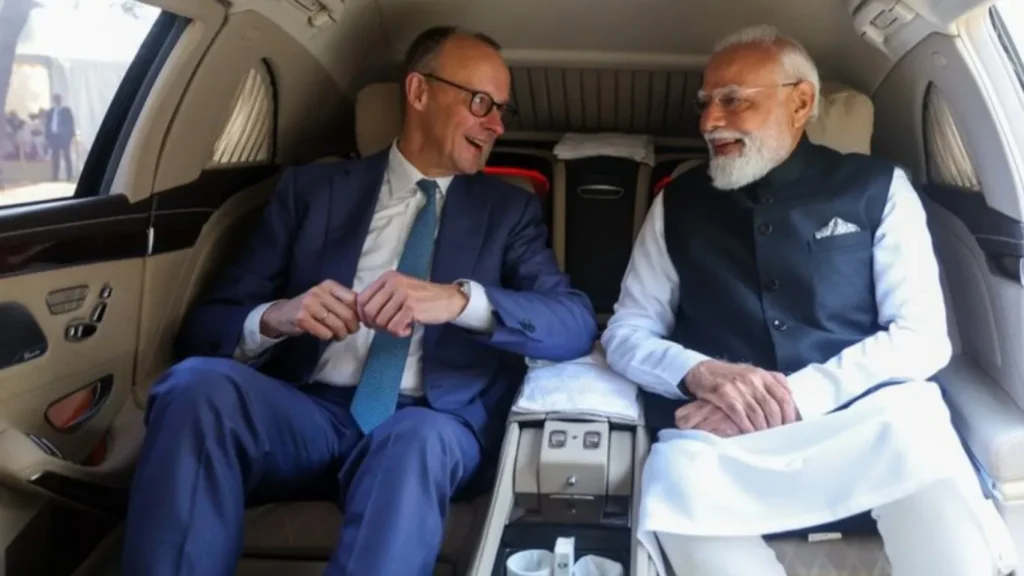
German Chancellor in India: The visit of the German chancellor in India marked a defining moment in India–Germany relations, as Prime Minister Narendra Modi and German Chancellor Friedrich Merz reaffirmed their commitment to deepening strategic cooperation across trade, energy, defence, education, climate action, and global security. The high-profile engagement culminated in the announcement that bilateral trade between India and Germany has crossed the $50 billion mark, a historic milestone reflecting growing economic trust between the two nations.
The German Chancellor’s three-day India visit concluded on Monday in Gujarat, where diplomacy blended seamlessly with cultural symbolism, public engagement, and forward-looking policy decisions. From a reflective visit to Sabarmati Gandhi Ashram to vibrant participation in the International Kite Festival, the visit showcased not just statecraft, but also people-to-people warmth.
A Symbolic Beginning at Sabarmati Gandhi Ashram
The final day of the German chancellor in India began with a deeply symbolic visit to the Sabarmati Gandhi Ashram in Ahmedabad. Prime Minister Narendra Modi personally welcomed Chancellor Merz at the historic site on the banks of the Sabarmati River.
Both leaders paid floral tributes to Mahatma Gandhi’s statue, followed by a quiet walk through Hriday Kunj, Gandhi’s modest residence. The visit underscored the shared respect for Gandhian values of truth, non-violence, self-reliance, and moral leadership-principles that continue to resonate globally amid geopolitical uncertainty.
Chancellor Merz appeared visibly moved by the simplicity and moral depth of the Ashram. Writing in the visitors’ book, he reflected on how Gandhi’s belief in freedom and human dignity continues to inspire societies across the world, including Germany.
From Philosophy to Festivity: International Kite Festival
After the Ashram visit, Prime Minister Modi and the German Chancellor proceeded to the International Kite Festival on the Sabarmati Riverfront. Gujarat Chief Minister Bhupendra Patel welcomed the leaders as thousands of spectators gathered to witness the unique blend of diplomacy and celebration.
In a rare and striking visual, Modi and Merz rode through the festival grounds in an open jeep, waving to crowds and interacting with kite flyers from across India and abroad. Together, they flew a special kite symbolising India–Germany friendship, drawing applause from onlookers.
Prime Minister Modi took time to explain the history of kite-making in Gujarat, detailing how traditional kites are crafted, the cultural significance of Uttarayan, and how the festival has become a global platform for cultural exchange. The German Chancellor listened attentively, asking questions and engaging warmly with participants.
Showcasing Ahmedabad’s Heritage and Urban Legacy
As part of the cultural programme, the German chancellor in India was also taken through the heritage pols of Ahmedabad, a UNESCO World Heritage City. Prime Minister Modi explained the unique urban design of pol houses—closely-knit communities that reflect centuries of social harmony, climate-responsive architecture, and collective living.
The visit offered the German delegation insight into India’s urban heritage, sustainability practices rooted in tradition, and the importance of preserving living heritage alongside modern development.
High-Level Bilateral Talks at Mahatma Mandir, Gandhinagar
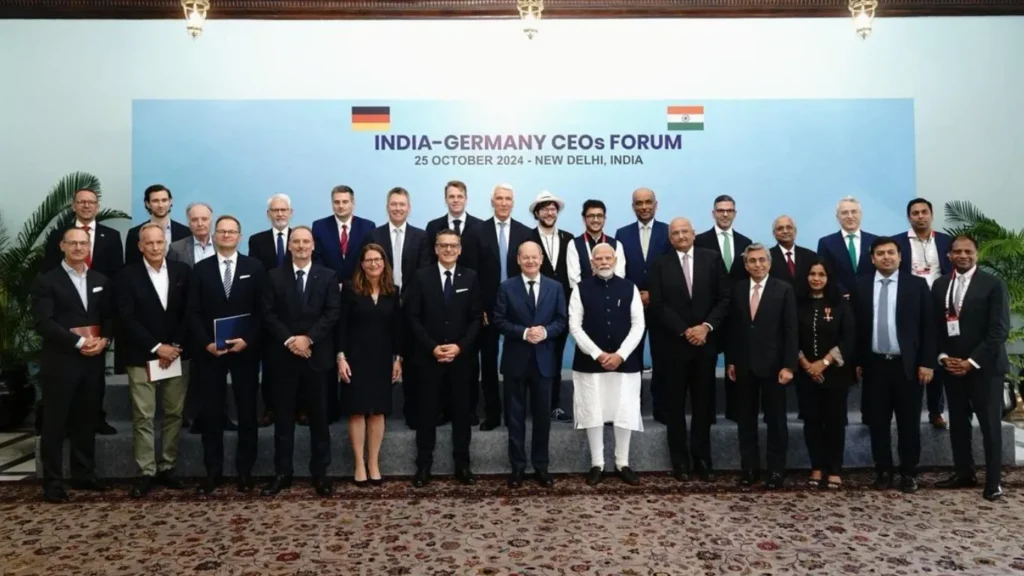
The core diplomatic engagement of the visit took place at Mahatma Mandir in Gandhinagar, where Prime Minister Modi and Chancellor Merz held extensive bilateral talks. The discussions covered a wide range of strategic, economic, and geopolitical issues.
Following the meeting, both leaders addressed a joint press conference, outlining the outcomes and future direction of India–Germany relations.
“A Sweet Welcome”: PM Modi’s Message to Chancellor Merz
Opening the press conference, Prime Minister Modi welcomed the German Chancellor with a distinctly Gujarati sentiment.
“In Gujarat, we say, ‘Aavkaro Mitho Aapjo Re’—welcome someone with warmth and affection. With this spirit, I extend my heartfelt welcome to Chancellor Merz in India,” the Prime Minister said.
He emphasised that India is fully committed to strengthening its friendship and partnership with Germany, describing the relationship as one rooted in trust, shared democratic values, and mutual respect.
75 Years of Diplomatic Relations, 25 Years of Strategic Partnership
The German chancellor in India visit coincides with a historic phase in bilateral ties. Prime Minister Modi highlighted that:
- India and Germany completed 25 years of strategic partnership last year
- 2026 marks 75 years of diplomatic relations between the two nations
“These milestones are not merely markers of time,” Modi said. “They represent shared ambitions, deep trust, and continuously expanding cooperation.”
Bilateral Trade Crosses $50 Billion: A Historic Milestone
One of the most significant announcements of the visit was confirmation that India–Germany bilateral trade has exceeded $50 billion, reaching its highest level ever.
Prime Minister Modi noted that:
- Over 2,000 German companies operate in India
- German investments span manufacturing, engineering, automotive, clean energy, and technology
- The growing trade relationship reflects Germany’s long-term confidence in India’s economy and reform trajectory
The achievement positions Germany among India’s most important European economic partners and reinforces India’s role as a global growth engine.
India–Germany Centre of Excellence Announced
To further strengthen cooperation in technology and sustainability, both leaders announced the establishment of an India–Germany Centre of Excellence.
The Centre will serve as a joint platform for:
- Knowledge sharing
- Technology transfer
- Innovation and research collaboration
Priority areas include:
- Renewable energy
- Climate action
- Urban development
- Urban mobility
- Clean technologies
Prime Minister Modi said the initiative would translate shared climate ambitions into practical, scalable solutions.
Renewable Energy and Green Hydrogen Cooperation
Energy transition emerged as a major pillar of discussions during the German chancellor in India visit.
Both nations acknowledged their aligned priorities in:
- Renewable energy deployment
- Green hydrogen development
- Climate-resilient infrastructure
Several memorandums of understanding (MoUs) were signed to accelerate cooperation, including joint mega-projects in green hydrogen, which leaders described as potential game-changers for future energy security.
Defence and Security: Roadmap for Co-Development and Co-Production
Defence cooperation featured prominently in bilateral talks. Prime Minister Modi confirmed that India and Germany will work on a roadmap to enhance collaboration between defence industries.
Key focus areas include:
- Co-development of defence technologies
- Co-production initiatives
- Secure and resilient supply chains
- Simplifying defence trade processes
Modi thanked Chancellor Merz for Germany’s support in easing regulatory pathways for defence collaboration, calling it a reflection of growing mutual trust.
Global Skills Partnership and Healthcare Mobility
One of the most people-centric outcomes of the visit was the announcement of a Joint Declaration of Intent on Global Skills Partnership.
The agreement aims to:
- Enhance migration and mobility frameworks
- Support skill development
- Facilitate easier movement of professionals, especially in healthcare
Prime Minister Modi highlighted the contribution of Indian youth to Germany’s economy and said the agreement would make the exchange of healthcare professionals significantly smoother.
Visa-Free Transit for Indian Citizens
In a major goodwill gesture, Germany announced visa-free transit for Indian citizens, a move warmly welcomed by the Indian side.
Prime Minister Modi thanked Chancellor Merz, stating that the decision would:
- Strengthen people-to-people ties
- Promote academic, business, and cultural exchanges
- Deepen mutual understanding between societies
Education and University Collaboration
The German chancellor in India visit also reinforced academic cooperation. Prime Minister Modi invited German universities to establish campuses in India, aligning with India’s vision to internationalise higher education.
A comprehensive roadmap on higher education cooperation was unveiled, aimed at:
- Joint research programmes
- Student exchanges
- Faculty collaboration
- Innovation partnerships
Cultural and Maritime Heritage Cooperation
Germany also joined India’s National Maritime Heritage Complex project at Lothal, Gujarat, through collaboration with a German maritime museum.
Leaders described the partnership as a historic step linking the maritime histories of both nations and fostering cultural diplomacy.
Additionally, cooperation in traditional medicine, particularly Ayurveda, was strengthened through new agreements involving Gujarat Ayurveda University and German institutions.
United Against Terrorism
On global security, both leaders unequivocally condemned terrorism.
“We are united in the belief that terrorism is a grave threat to humanity,” Prime Minister Modi said. “India and Germany will continue to fight it together with full determination.”
The two sides also discussed:
- Indo-Pacific cooperation
- Ukraine and Gaza conflicts
- Peaceful resolution of disputes
- Strengthening global institutions
Reforming Global Governance: UN Security Council
India and Germany reaffirmed their commitment to reforming global institutions, particularly the United Nations Security Council.
Through the G4 framework, both nations pledged to continue joint efforts to make global governance more representative, effective, and reflective of contemporary realities.
Chancellor Merz’s Reflections on India Visit
German Chancellor Friedrich Merz described his India visit as deeply meaningful. He praised India’s civilisational depth, democratic resilience, and global role.
At the Gandhi Ashram, he said Gandhi’s teachings remain profoundly relevant in today’s world, and that India and Germany are connected by shared human values.
A Visit That Blended Diplomacy, Culture, and Vision
The German chancellor in India visit stood out not merely for policy announcements, but for its unique blend of symbolism, warmth, and strategic clarity.
From flying kites together to discussing green hydrogen, from paying homage to Gandhi to planning future defence cooperation, the visit reflected a partnership that is both deeply rooted and forward-looking.
As India and Germany step into the next phase of their relationship—marked by economic strength, innovation, and shared global responsibility—the visit of Chancellor Friedrich Merz will be remembered as a milestone that strengthened a vital bridge between Asia and Europe.