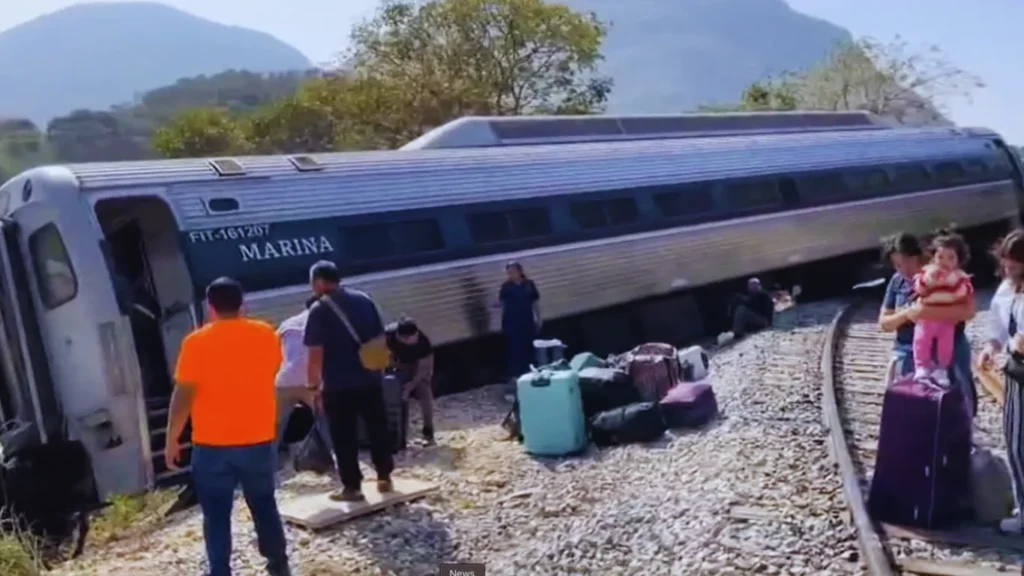
Mexico train crash: A deadly railway accident in southern Mexico has left at least 13 people dead and nearly 100 others injured after a passenger train derailed and its engine overturned in the state of Oaxaca. The incident has once again raised serious questions about rail safety and infrastructure in the region, particularly on newly developed strategic transport routes.
According to official information released by Mexican authorities, the train was carrying around 250 passengers at the time of the accident, including nine crew members. Several coaches reportedly flipped off the tracks after the derailment, while the locomotive itself overturned, causing extensive damage and triggering a large-scale emergency response.
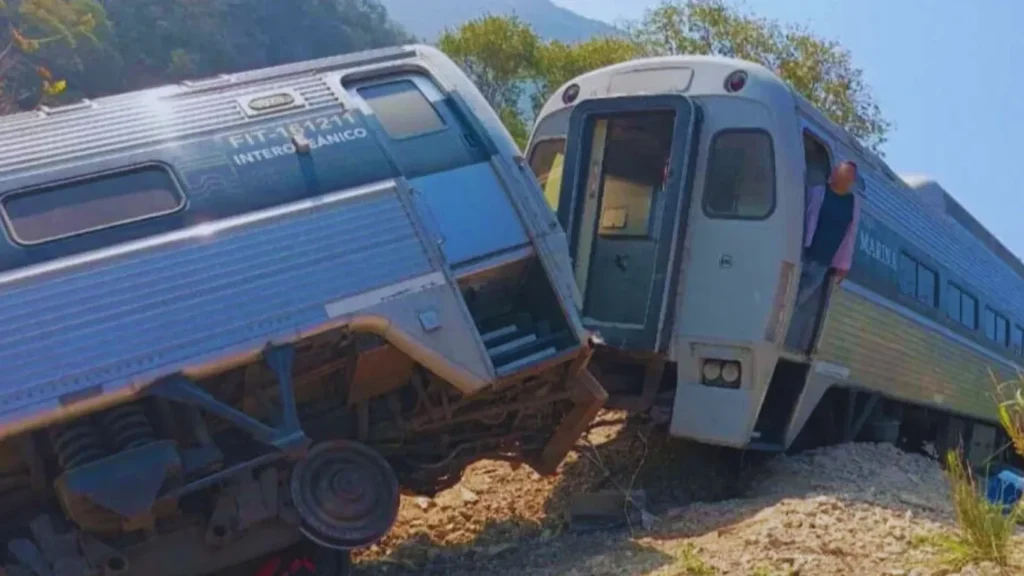
Accident occurred on a sharp curve between towns-Mexico train crash
The tragedy occurred on a curved section of track between the towns of Chivela and Nizanda in Oaxaca’s Isthmus of Tehuantepec region. Preliminary reports suggest that the train lost stability while navigating the bend, though the exact cause of the derailment has not yet been officially confirmed.
Rescue teams rushed to the remote site shortly after the accident, working through difficult terrain to reach injured passengers trapped inside overturned coaches. Emergency responders, medical personnel, and security forces coordinated efforts to evacuate survivors and provide urgent medical care.
Heavy casualties reported
Authorities confirmed that 13 people lost their lives in the accident, while 98 passengers sustained injuries of varying severity. Of those injured, at least 36 were admitted to nearby hospitals for treatment. Five victims remain in critical condition, according to statements from senior government officials.
Mexican President Claudia Sheinbaum addressed the tragedy on social media platform X, expressing condolences to the families of the victims. She confirmed that senior federal officials had been dispatched to the accident site to oversee rescue operations and ensure that affected families receive immediate assistance.
“The injured are being treated, and we are closely monitoring those in serious condition,” the president said. “Support is being provided to the families of those who lost their lives.”
Train operated under Mexican Navy oversight
The train involved in the accident was operating on a recently developed interoceanic railway corridor designed to connect the Gulf of Mexico with the Pacific Ocean. The railway line is overseen and managed by the Mexican Navy, which has been tasked with ensuring security and operations along this strategic route.
Officials from the Navy confirmed that the train was conducting a regular service when the derailment occurred. An internal review is underway alongside a broader federal investigation to determine whether mechanical failure, track conditions, speed, or human error played a role.
Government agencies mobilized for rescue and relief
Oaxaca Governor Salomón Jara stated that multiple government agencies were deployed to the crash site within hours of the incident. In a public update, he said emergency services, civil protection teams, and health authorities were working together to assist the injured and support rescue efforts.
“The priority has been to save lives and provide medical care,” the governor said, adding that shelters and transportation assistance were arranged for uninjured passengers stranded after the accident.
The Mexican Attorney General’s Office, led by Ernestina Godoy Ramos, confirmed that a formal investigation has been launched. Officials are collecting evidence from the scene, reviewing operational data, and interviewing crew members and survivors.
Strategic rail corridor under scrutiny
The interoceanic rail service, inaugurated in 2023 by former President Andrés Manuel López Obrador, was launched as a key component of Mexico’s infrastructure development plan for the country’s south. The project aims to transform the Isthmus of Tehuantepec into a major logistics and trade corridor linking the Atlantic and Pacific oceans.
The route spans approximately 290 kilometres, connecting the Pacific port of Salina Cruz with ports along the Atlantic side. It was designed to boost economic development, improve passenger connectivity, and provide an alternative trade route to the Panama Canal.
However, the deadly derailment has now cast a shadow over the ambitious project. Safety experts and opposition figures have called for a thorough review of rail operations, maintenance standards, and emergency preparedness on the line.
Survivors recount moments of terror
Passengers who survived the accident described moments of panic as the train suddenly shook before several coaches toppled. Some reported hearing loud screeching sounds moments before the derailment, while others said the train appeared to be moving at speed as it entered the curve.
Emergency responders had to cut through twisted metal to reach some victims, highlighting the severity of the impact. Medical teams continue to monitor patients, and psychological support services have been offered to survivors and families.
Read also: Trump Putin Tensions Intensify as Venezuela Crisis Pushes U.S. Toward Confrontation
Rail services disrupted, operations suspended
Rail services on the affected section of the line have been temporarily suspended as investigators examine the tracks and damaged train components. Authorities have not provided a timeline for when operations will resume, stating that safety assessments must be completed first.
The Mexican Navy and transport authorities have assured the public that all necessary steps will be taken to prevent a similar tragedy in the future. Maintenance records, safety protocols, and crew training procedures are expected to be reviewed as part of the investigation.
National mourning and calls for accountability
As news of the disaster spread, messages of condolence poured in from across Mexico. The incident has sparked national mourning and renewed debate over infrastructure readiness and passenger safety on newly launched transport routes.
While rescue operations have concluded, the long process of investigation and accountability has only begun. For now, the country mourns the lives lost in a tragic event that has shaken confidence in a flagship transport project.
The train derails in Mexico, engine overturns incident stands as one of the deadliest rail accidents in recent years, underscoring the urgent need for rigorous safety oversight as Mexico continues to expand its rail network.