New Delhi-WHO Global Summit: is set to witness a landmark moment in the global healthcare dialogue as Prime Minister Narendra Modi prepares to address the closing ceremony of the Second WHO Global Summit on Traditional Medicine on December 19, 2025. The high-profile event will take place at Bharat Mandapam in the national capital, bringing together world leaders, health experts, policymakers, scientists, and practitioners to shape the future of traditional and integrative healthcare systems.
The Prime Minister’s participation underscores India’s growing role as a global leader in advancing traditional medicine through scientific validation, digital innovation, and international cooperation. During the closing ceremony, PM Modi will also launch several major initiatives aimed at strengthening the Ayush ecosystem and enhancing its global credibility and accessibility.
Strengthening Global Health Through Traditional Medicine
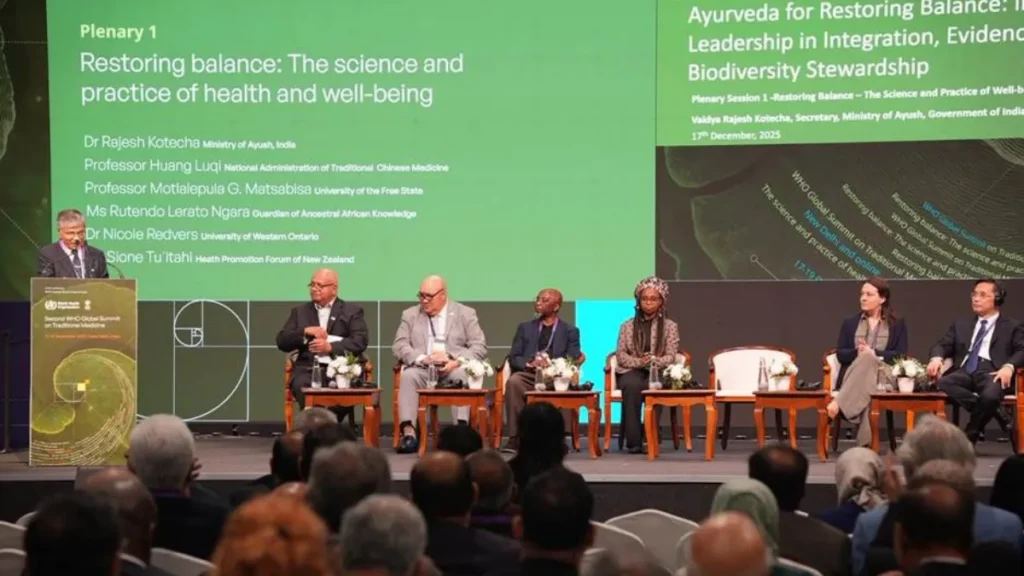
The Second WHO Global Summit on Traditional Medicine is being jointly organised by the World Health Organization (WHO) and the Ministry of Ayush, Government of India. Held from December 17 to 19, 2025, the summit revolves around the theme “Restoring balance: The science and practice of health and well-being.” This theme reflects a growing global consensus on the need to integrate evidence-based traditional medicine with modern healthcare to build more resilient, inclusive, and people-centred health systems.
Over three days, the summit has hosted in-depth discussions among global leaders, health policymakers, scientists, Indigenous knowledge holders, traditional medicine practitioners, and civil society representatives. The deliberations have focused on ensuring equitable access to traditional medicine, strengthening scientific research, setting global standards, and promoting sustainability in healthcare practices.
PM Modi to Launch My Ayush Integrated Services Portal
A key highlight of the closing ceremony will be the launch of the My Ayush Integrated Services Portal (MAISP) by Prime Minister Modi. The portal is envisioned as a comprehensive digital gateway for the Ayush sector, bringing together services, information, and resources related to Ayurveda, Yoga, Naturopathy, Unani, Siddha, and Homoeopathy on a single platform.
The My Ayush Integrated Services Portal aims to improve transparency, accessibility, and efficiency within the Ayush ecosystem. By leveraging digital technology, the portal will support practitioners, researchers, institutions, and citizens, while also strengthening data-driven policymaking and service delivery. This initiative aligns with India’s broader digital health vision and reinforces the country’s commitment to modernising traditional medicine without compromising its core principles.
Ayush Mark to Set Global Quality Standards
In another significant move, the Prime Minister will unveil the Ayush Mark, a quality certification designed to serve as a global benchmark for Ayush products and services. The Ayush Mark is expected to enhance international trust by ensuring adherence to stringent quality, safety, and efficacy standards.
As global demand for traditional and alternative medicine continues to rise, the Ayush Mark will play a critical role in positioning Indian Ayush products competitively in international markets, including the UK and the US. It will also help protect consumers by promoting authenticity and discouraging substandard or misleading products.
Key Publications and Commemorative Stamp Release
During the ceremony, PM Modi will release several important publications that highlight India’s leadership in traditional medicine. These include a WHO technical report on training in Yoga, which is expected to provide global guidance on standardised, evidence-based Yoga education and practice.
The Prime Minister will also release a book titled “From Roots to Global Reach: 11 Years of Transformation in Ayush,” documenting the significant progress made in the Ayush sector over the past decade. The publication captures India’s journey in revitalising traditional medicine through policy reforms, research, infrastructure development, and international engagement.
Adding a symbolic touch to the occasion, a commemorative postal stamp on Ashwagandha will also be unveiled. Ashwagandha, one of India’s most renowned medicinal plants, represents the global recognition of India’s traditional medicinal heritage and its relevance in modern wellness practices.
Honouring Excellence in Yoga Promotion
The Prime Minister will also felicitate the recipients of the Prime Minister’s Awards for Outstanding Contribution to the Promotion and Development of Yoga for the years 2021 to 2025. These awards recognise individuals and institutions that have demonstrated sustained dedication to promoting Yoga both in India and internationally.
The awards reaffirm Yoga’s enduring value as a holistic practice that promotes physical health, mental well-being, balance, and harmony. They also highlight India’s leadership in taking Yoga from its ancient roots to a global stage, benefiting millions worldwide.
Read also: Visit of PM to Oman Strengthens Strategic, Economic and Cultural Partnership
Exploring the Traditional Medicine Discovery Space
As part of his visit, PM Modi will tour the Traditional Medicine Discovery Space, an exhibition showcasing the depth, diversity, and contemporary relevance of traditional medicine knowledge systems from India and around the world. The exhibition highlights how ancient practices are being integrated with modern science to address current and future healthcare challenges.
The Discovery Space serves as a powerful reminder that traditional medicine is not just about heritage, but also about innovation, sustainability, and inclusive health solutions.
India’s Vision for a Balanced and Inclusive Health Future
Prime Minister Modi has consistently advocated for the mainstreaming of traditional medicine and Indian Knowledge Systems through rigorous research, standardisation, and global collaboration. His address at the closing ceremony of the WHO Global Summit is expected to reinforce India’s commitment to building health systems that are preventive, sustainable, and accessible to all.
The summit has positioned India as a thought leader in shaping a science-based, evidence-driven, and people-centric global traditional medicine agenda. As the world seeks solutions to rising healthcare costs, lifestyle diseases, and mental health challenges, the integration of traditional medicine offers a promising path forward.
The Second WHO Global Summit on Traditional Medicine marks a decisive step towards restoring balance in global healthcare-bridging ancient wisdom with modern science for the well-being of present and future generations.