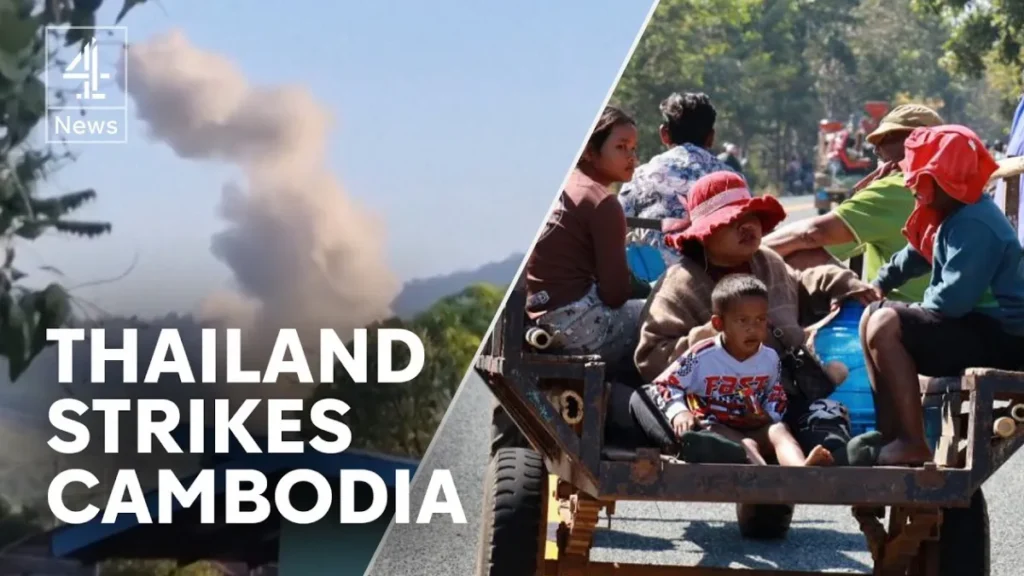
Thailand Cambodia news: In a sudden and dramatic escalation that has reignited long-standing tensions in Southeast Asia, Thailand carried out targeted airstrikes on Cambodian military positions early Monday morning. The attack has shattered a fragile ceasefire negotiated just two months ago in the presence of former U.S. President Donald Trump. The renewed violence has pushed thousands of border residents into panic and raised serious concerns across the international community about the stability of the region. This fast-developing situation is now one of the most significant events dominating Thailand Cambodia news.
Airstrike Follows Fresh Clashes Along the Border
According to Thailand’s military command, the airstrikes were launched only after Cambodian forces allegedly fired across the border, killing one Thai soldier and injuring two others. Thai officials stated that their air force targeted only Cambodian military installations believed to be responsible for the earlier aggression.
Thai military spokespersons also claimed that Cambodia had been steadily deploying heavy weaponry near the border for several days. They accused Phnom Penh of quietly positioning troops at new strategic locations, which Bangkok interpreted as preparation for a larger confrontation.
Thailand’s justification for the airstrike has been met with sharp criticism from Cambodia, which has rejected every accusation of cross-border aggression. Cambodian authorities responded by calling Thailand’s actions “provocative, unjustified, and dangerous,” while maintaining that they had not initiated any attack.

Cambodia Denies Aggression, Accuses Thailand of Provocations
Cambodia firmly denied that it had fired the first shot. Officials in Phnom Penh insisted that their forces had remained committed to peace and diplomacy following the ceasefire agreement arranged just two months ago with international support.
A Cambodian government spokesperson argued that Thailand had been undertaking a series of “provocative military movements” for several days, escalating tensions unnecessarily. The spokesperson added that Cambodia had repeatedly communicated its willingness to address all outstanding issues through negotiations rather than force.
The renewed fighting has caused extensive disruption in border communities, particularly on the Thai side. Local authorities confirmed that approximately 70% of residents living close to the conflict zone have already been relocated to emergency shelters. Many families fled overnight, fearful that fighting could rapidly intensify. One civilian death has been reported in the region, though Thai officials clarified that the fatality was due to illness and not connected to military operations.
How the Latest Conflict Started: A Timeline of Escalation
The immediate spark for the renewed crisis came on May 28, when troops from both nations clashed near the Emerald Triangle-the point where the borders of Thailand, Cambodia, and Laos meet. The area has been disputed for decades, and both countries maintain competing territorial claims over the region.
During the clashes on May 28, one Cambodian soldier lost his life. From that moment, mistrust and military readiness on both sides began to increase dramatically.
Cambodia alleges that Thai forces moved forward toward the Ta Muen Thom temple-another historical site near the border-and erected barbed wire around the surrounding area. Cambodian forces accuse Thailand of subsequently deploying surveillance drones and firing shots into the air, further escalating tensions.
Thailand, however, offers a completely different narrative. According to Bangkok, Cambodian soldiers initiated the confrontation. Thai forces claim they attempted diplomatic dialogue and communicated through multiple channels to reduce tensions. Only when negotiations failed, they say, did the situation deteriorate into active gunfire and, eventually, Monday’s airstrike.
As the situation becomes increasingly volatile, both sides continue to present conflicting accounts-a hallmark of every major flare-up recorded in Thailand Cambodia news over the years.
The Long Shadow of the Preah Vihear Temple Dispute
At the heart of this conflict lies a decades-old dispute over the ancient Preah Vihear (Preah Vihear/Prasat Preah Vihear) Shiva temple, a centuries-old monument dramatically positioned atop a cliff along the Thai-Cambodian border.
Although the temple complex itself is located inside Cambodian territory, the surrounding land has long been contested by both nations. This small patch of land-rugged, forested, and lightly populated-has become a symbol of national pride for both sides, elevating the dispute beyond mere geography.
In 1959, Cambodia raised the dispute before the International Court of Justice (ICJ), seeking a definitive legal resolution. In 1962, the ICJ ruled that the temple belonged to Cambodia. The verdict also directed Thailand to withdraw its troops from the temple premises. Bangkok complied with the ruling but maintained that the court had not clarified ownership of the surrounding land, keeping the dispute alive.
The situation worsened in 2008 when UNESCO designated the Preah Vihear temple as a World Heritage Site. Thailand objected strongly, arguing that recognition of the temple without resolving adjacent territorial boundaries would embolden Cambodian claims. Almost immediately, clashes erupted between the two military forces. Between 2008 and 2011, several violent exchanges occurred, forcing thousands of civilians to flee from both sides of the border.
In 2013, the ICJ issued a clarifying opinion affirming that not only the temple itself but also the adjacent land belonged to Cambodia. The ruling again mandated Thailand to withdraw all military personnel from the area. Yet, despite this clarification, disagreements over the border remained unresolved-creating a simmering tension that never fully subsided and continues to resurface prominently in Thailand Cambodia news.
Other Long-Standing Flashpoints Between the Two Nations
While Preah Vihear is the most internationally recognized symbol of their territorial rivalry, it is far from the only disputed area. The Ta Muen Thom temple, mentioned in the recent clashes, is another historical structure claimed by both countries. Each side cites ancient maps, colonial-era documents, and historic cultural ties to justify its claim.
The roots of these territorial tensions go back centuries, influenced by the power struggles between the old Khmer Empire (centered in present-day Cambodia) and the Siamese kingdoms that later evolved into modern Thailand. These historic rivalries were further complicated when European colonial powers-particularly France and Britain-imposed new borders across the region during the 19th and early 20th centuries.
In 1907, while Cambodia was under French rule, France and Siam signed a treaty establishing an 817-kilometer border. This border placed the Preah Vihear temple on the Cambodian side, but Thailand later disputed the accuracy of the colonial-era map used during the negotiations. To this day, Thailand argues that the map did not accurately reflect the natural geographic features of the area.
Ta Muen Thom, meanwhile, was mapped inside Thailand, though Cambodia maintains it historically belonged to the Khmer Empire. Geographic ambiguity, differing interpretations of colonial documents, and strong nationalistic sentiments continue to fuel the dispute.
Impact on Civilians: Fear and Displacement Return to the Region
For residents of the border regions, renewed conflict brings back painful memories of earlier clashes. Over the last decade, periodic fighting has repeatedly forced families to evacuate their homes, abandon farmlands, and live in temporary shelters for weeks or months.
With Monday’s airstrike and the possibility of more violence, many locals fear a prolonged conflict. Emergency evacuation centers in Thailand are now receiving families who left their homes suddenly, without knowing when they will return.
Humanitarian agencies in both countries are monitoring the situation, though access to some areas remains restricted due to heightened military activity.
Collapse of the Recent Ceasefire Raises Global Concerns
The timing of the airstrike has drawn international attention because it follows closely on a peace agreement mediated in the presence of former U.S. President Donald Trump. The ceasefire was expected to cool longstanding tensions, but the rapid escalation has raised questions about the effectiveness and durability of the agreement.
Foreign ministries across Southeast Asia have called for immediate restraint. Regional organizations, including ASEAN, are monitoring the situation closely, though neither Thailand nor Cambodia has formally requested external intervention.
What Happens Next?
With both sides reinforcing their border positions, the possibility of further clashes cannot be ruled out. Analysts warn that unless both countries agree to resume diplomatic talks, the situation could spiral into a larger conflict.
The Preah Vihear dispute remains the central unresolved issue-a reminder that historical grievances, when left unsettled, can re-ignite with little warning. As tensions rise, the world is watching closely, and the situation is likely to remain a major focus in Thailand Cambodia news in the coming weeks.