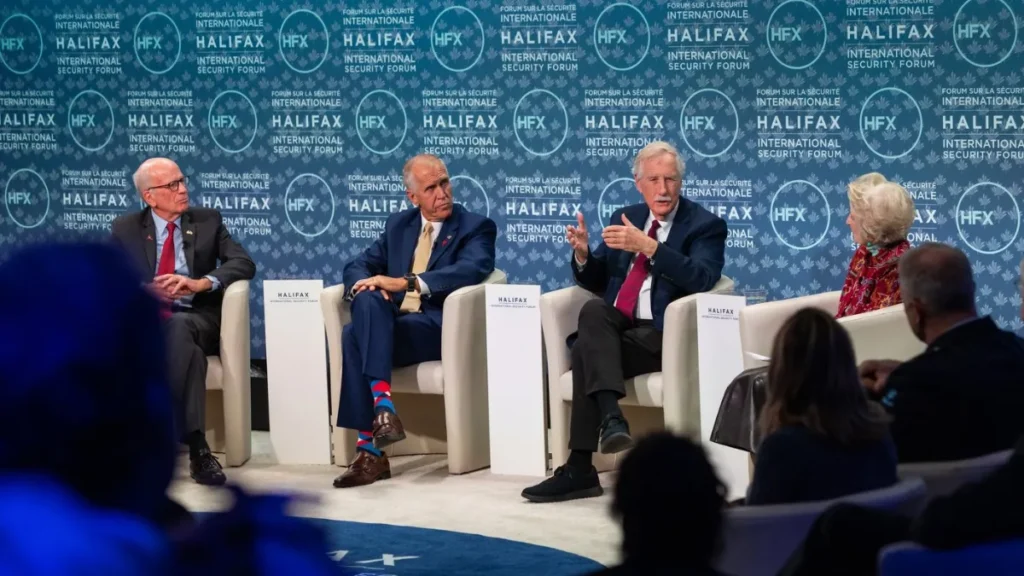
Halifax, Canada — Cultural Break: Concerns about the deteriorating emotional and cultural bond between Canadians and Americans took center stage at the Halifax International Security Forum this weekend, where several U.S. senators warned that economic disputes triggered by Washington’s tariff policies are now reshaping public sentiment in both countries.
Attending the annual forum in Halifax, Canada, Senator Angus King of Maine said that although trade disagreements between the two nations are not new, the current shift in attitudes worries him more than the financial costs. According to King, decades of cooperation and mutual trust between Canadians and Americans have been undermined by deeply unpopular tariff measures introduced by U.S. President Donald Trump.
Senator King: “Economic pain is serious, but the cultural divide is worse”
Speaking on Saturday before an audience of international delegates, King stressed that while tariffs have resulted in measurable financial damage for Canadian industries, the most dangerous outcome is how ordinary Canadians are beginning to perceive their southern neighbours.
“Like any neighbours, there will always be disagreements,” King said, recalling that both nations have argued over softwood lumber for as long as he could remember. “But now the deeper concern is the cultural break — the feeling that Canadians are beginning to see Americans not as friends or partners, but as adversaries.”
The senator, one of only two Independents in the U.S. Senate, emphasized that this divide is particularly troubling for border states like Maine, which depend on stable relations with nearby Canadian provinces. King described everyday interactions traditionally shared by communities on both sides — people traveling across the border for school, shopping, tourism, or even something as simple as a haircut. He said that such ordinary exchanges have now been overshadowed by resentment and hesitation.
“Being from a state where crossing into New Brunswick or Quebec for daily errands is normal, it’s a sad day when Canadians no longer feel welcome or interested in doing that,” King said. “If there was genuine benefit for the United States in imposing these tariffs, that would be one thing. But there is none. We are paying a price in goodwill as well as economics.”
Halifax International Security Forum: Democracy issues overshadowed by Canada–U.S. tension
The Halifax International Security Forum, which opened Friday, brought together more than 300 participants from around the world, including state officials, military leaders, academics, diplomats, and policy specialists. Although the official theme of this year’s conference is global democracy and security, the topic of strained Canada–U.S. relations quickly ignited one of the most heated debates of the weekend.
Moderators asked four American politicians to discuss the role of the United States in the modern geopolitical landscape. Instead of focusing exclusively on foreign affairs, the conversation turned inward — toward one of America’s closest allies and largest trading partners.
Republican Sen. Thom Tillis disputes the pessimism-but criticizes Canada on NATO spending
Senator Thom Tillis of North Carolina offered an alternative framing. While he agreed that there are tensions, he argued the two countries remain united on fundamental values and obligations as democratic partners.
“We may argue over trade,” Tillis said, “but if either nation were ever under serious threat, I know we would come to each other’s aid instantly. That’s what family does.”
However, his message soon pivoted toward frustration with Canada’s defence spending commitments. Tillis claimed Ottawa has repeatedly failed to contribute its agreed share to NATO, asserting that Canada still owes more than $300 billion in long-promised financial commitments.
According to Tillis, “Every Canadian prime minister has repeated the same line — ‘We’re going to get there’ — yet no government has delivered. Meanwhile, many Canadians harshly criticize the United States for its health care system. But while they do that, the United States has consistently met its obligations to fund our mutual defence for as long as NATO has existed.”
Canadian defence spending commitments challenged
Former California congresswoman Jane Harman, a Democrat, pushed back against Tillis’s criticism. She pointed out that Canada has recently taken steps to increase defence spending significantly. In June, Prime Minister Mark Carney announced that the federal government will allocate an additional $9 billion by March of next year, increasing military spending to 2 percent of the country’s GDP — a target previously emphasized by NATO.
Tillis remained unconvinced, arguing that new spending does not erase previous decades of underfunding. “That’s great, but what about the 20 years of shortfall? Will Canada make up for that too?”
The exchange drew murmurs in the audience. The forum hall in Halifax, Canada reflected visible tensions, not just between politicians of different parties, but between different visions of the Canada–U.S. relationship itself.
Senator Kevin Cramer: Fewer Canadian tourists and shoppers is evidence of resentment
Senator Kevin Cramer of North Dakota echoed King’s concerns about a growing emotional rift. According to Cramer, what was once one of the most seamless cross-border relationships in the world has shifted into something colder and more hesitant.
“There’s become a tension,” Cramer said at a later news conference. He emphasized that declining numbers of Canadians visiting the United States are not random — they are a direct reaction to policy decisions made in Washington.
In border states like North Dakota, Canadian tourism plays an important economic role, particularly through retail shopping, hotels, and seasonal travel. “Those numbers are down because people are angry,” Cramer said plainly.
He added that resentment is now being felt reciprocally: “People in the United States are frustrated too, and that mutual frustration is new. That’s what makes this more serious than past trade disputes.”
Long-term effects: More than a trade dispute
While tariffs themselves can be negotiated, reversed or replaced, several experts at the forum warned that cultural attitudes shift slowly — and take far longer to repair than policy decisions.
The senators agreed that although the tariffs affect steel, aluminum, agriculture and other trade sectors, the intangible consequences are more damaging than the numbers suggest. Families, tourist businesses, border cities and small towns are among the groups most affected by the shift in sentiment.
In places like Halifax, Canada, where historical ties with the United States include military cooperation, educational programs, tourism and economic exchange, observers at the forum expressed concern that resentment could become entrenched if left unchecked.
A call for negotiation and reconciliation
Despite his criticism of Canada earlier in the debate, Senator Cramer said he remains optimistic that both governments can repair the relationship.
“Our relationship with Canadians is very personal,” Cramer said. “The solution is simple — it’s going back to the negotiating table and fixing whatever we disagree on. People in both countries want to reunite. They want normalcy back.”
Senator King agreed, closing his remarks by emphasizing that the longstanding friendship between the nations is worth fighting for. “We cannot let temporary political strategies poison something that took generations to build.”
A deeper question for the future
Beyond tariffs, the debate in Halifax, Canada prompted a larger question: What happens when two of the world’s closest allies — nations that share the world’s longest undefended border and a tightly integrated economy — begin to lose trust in one another?
Economists at the forum noted that more than $2.5 billion in goods crosses the Canada–U.S. border every day. But several security strategists argued that mutual respect and shared identity are even more vital than trade revenue, especially at a time when international alliances are under pressure from authoritarian regimes.
Political analysts suggested that the current moment will likely influence U.S.-Canadian relations for years to come. Public opinion polls in both countries show that citizens are more skeptical of each other’s governments than they were a decade ago.
Halifax’s global backdrop
For the people of Halifax, Canada, the debate is more than symbolic. The city has been the host of the Halifax International Security Forum for 15 consecutive years, welcoming diplomats and defence specialists from dozens of countries. Many locals view the forum as a chance to strengthen international dialogue and encourage democratic cooperation.
Several participants expressed hope that the conversation sparked in Halifax will encourage renewed diplomatic engagement between Ottawa and Washington before resentment deepens any further.
Looking ahead
As the forum concluded, senators from both parties acknowledged that Canada and the United States cannot afford a divided future. Whether through trade negotiations, diplomatic initiatives, or joint military cooperation, restoring trust will be essential for both economies — and for the stability of the North American partnership.
The coming months, they agreed, will determine whether the two nations continue to drift apart or begin to rebuild their historic bond.