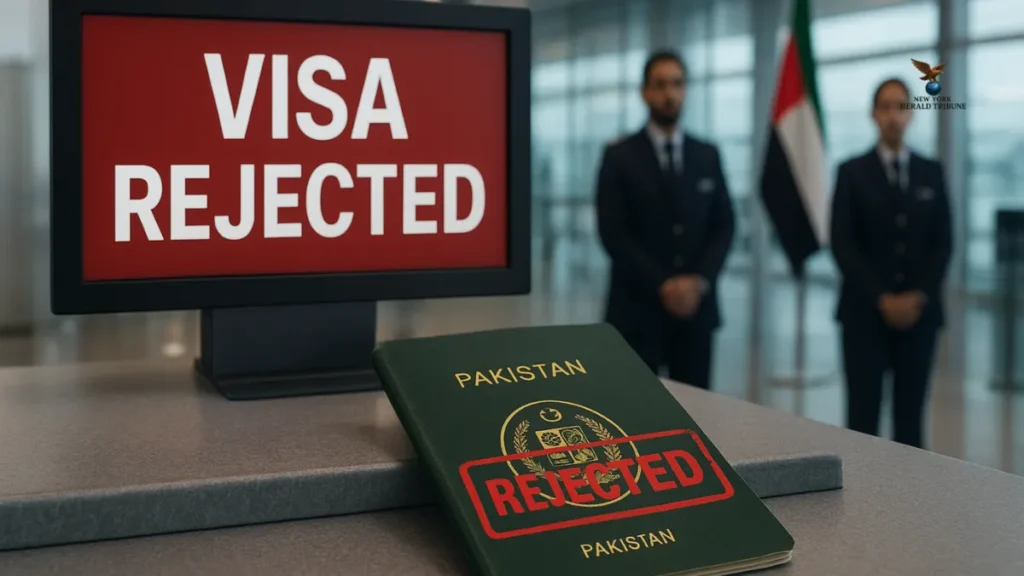
UAE Not Issuing Visas to Pakistanis: In a development that has triggered growing concern across Pakistan, authorities have confirmed that the United Arab Emirates (UAE) has sharply reduced the approval of visa applications submitted by Pakistani citizens. While the UAE has not officially announced any blanket ban, the unprecedented surge in rejections has effectively halted travel for thousands of applicants-especially young, first-time travelers.
According to senior official Salman Chaudhry from Pakistan’s Ministry of Interior, the UAE continues to accept visa applications only from individuals holding blue (official) and diplomatic passports. Ordinary passport holders, however, are facing severe scrutiny, with approval rates dropping at an alarming pace.
Travel agencies across Pakistan, speaking to local media outlets, stated that 70–80% of first-time and single-entry visa applications from Pakistan are being rejected. Many applicants say their rejections come without detailed explanation, leaving them uncertain about whether, when, or how they may be allowed to enter the UAE again.
This rise in rejections-combined with reports of increased background checks and stricter vetting-has made the issue highly visible on social and mainstream media worldwide. Keywords such as “UAE not issuing visas to Pakistanis” have surged in search trends across Pakistan, India, the Middle East, the UK, and the US.
Personal Stories Highlight a Worsening Trend
The growing concern is reflected in the experiences of individuals like Nadeem, a 28-year-old resident of Lahore. Planning his first holiday trip to Dubai, he submitted his visa application twice-and faced rejections both times. His travel agency later informed him that applicants aged below 40 are undergoing deeper checks, which significantly reduces their chances of approval.
Cases like Nadeem’s are becoming increasingly common, with travel consultants reporting an unusually high number of rejected applications for tourist, work, and single-entry visit visas.
No Official Ban, But Strict Vetting Behind the Scenes
Although the UAE government has not issued an official notification announcing a visa ban on Pakistani nationals, the pattern of rejections suggests a de facto tightening of visa issuance. Pakistani officials, while acknowledging the issue, maintain that there is no formal policy change communicated through diplomatic channels.
Political and economic relations between Pakistan and the UAE remain publicly strong, making an official ban unlikely. However, analysts note that several recent incidents may have contributed to the stricter visa policies.
Increase in Crime and Begging Cases Reported
Over the past several months, UAE authorities have recorded a notable rise in:
- cases of illegal begging,
- fraudulent documentation, and
- petty crime allegedly involving individuals holding Pakistani passports.
These incidents have prompted Emirati immigration authorities to adopt enhanced verification measures. Dubai and Abu Dhabi have already strengthened their border-security systems with AI-powered verification tools capable of identifying forged or manipulated documents instantly.
Travel agents report that if any inconsistency is detected by the AI system-even a minor discrepancy-the application is immediately rejected, often without the applicant being informed of the specific reason.
Family Connections Make Visa Approval Easier
Despite the surge in rejections, Pakistanis with close family members already residing in the UAE have a higher chance of obtaining a visa. For such applicants, immigration officers consider factors like:
- existing residency sponsorship,
- verified family relations,
- employment history, and
- financial stability.
This has led to widespread frustration among first-time travelers who lack such connections, making UAE tourism and employment opportunities increasingly inaccessible.
Other Countries Also Tightening Visa Rules for Pakistani Nationals
The UAE is not the only country that has strengthened or restricted travel access for Pakistani passport holders. Pakistan’s passport continues to rank among the weakest globally, limiting visa-free or easy-entry opportunities. As of 2025, several countries have either imposed strict entry regulations or halted visa issuance almost entirely.
Below are four major countries where Pakistani citizens currently face significant restrictions:
1. India – Complete Suspension of Visa Services
India has fully suspended all visa services for Pakistani citizens. This includes:
- tourist visas
- business visas
- medical visas
- conference visas
- track-two engagement travel
Even previously issued visas have been cancelled, resulting in a complete halt of entry into India for Pakistani nationals. With diplomatic tensions remaining high, there is no indication of when, or if, this policy will be reversed.
2. Israel – Long-Standing Restrictions on Pakistani Passports
Pakistan and Israel do not maintain diplomatic relations, and therefore Israel does not recognize Pakistani passports for general travel. Entry is only granted in rare cases involving:
- special diplomatic clearances,
- humanitarian needs, or
- government-approved missions.
Security concerns and the absence of diplomatic ties have kept this restriction firmly in place for decades.
3. Libya – Travel Nearly Impossible Due to Security Concerns
Libya continues to experience prolonged political instability, militia violence, and law-and-order challenges. Due to these conditions, the Libyan authorities reject most visa applications from Pakistan. Entry is highly restricted, and ordinary Pakistani citizens find it nearly impossible to secure a Libyan visa.
The ongoing crisis in Libya, coupled with concerns over undocumented migrant activities, has led to one of the strictest visa environments for Pakistanis.
4. Sudan – Very Stringent Policies Amid Political Turmoil
Sudan has adopted an extremely cautious approach toward all foreign visitors, especially those from countries facing documentation inconsistencies. Pakistani applicants frequently encounter:
- non-processing of applications,
- prolonged delays,
- rejections without clarification, and
- heightened scrutiny of supporting documents.
Political instability, internal conflict, and the risk of illegal immigration have driven Sudan’s restrictive stance.
Why These Global Restrictions Matter
The rising number of countries tightening entry requirements for Pakistani travelers-combined with the UAE not issuing visas to Pakistanis in large numbers—reflects a broader global shift toward more intensive border security.
Experts highlight several contributing factors:
- Illegal immigration concerns
- Document fraud cases involving fake employment letters or forged bank statements
- Human trafficking networks using tourist visas as entry routes
- Economic pressure in Gulf states leading to preference for skilled or documented labor
- AI-driven immigration systems capable of detecting inconsistencies previously overlooked
As more countries integrate advanced verification technology, applicants from regions with higher documentation issues face stricter oversight.
Impact on Pakistani Travelers and the Tourism Industry
The sharp decline in UAE visa approvals has had immediate consequences:
1. Travel Disruptions
Holiday plans, tourism bookings, and family visits are being postponed or cancelled altogether.
2. Financial Losses
Applicants lose money on:
- non-refundable airline tickets,
- visa processing fees,
- hotel bookings,
- travel insurance, and
- service charges paid to agents.
3. Job Market Challenges
Pakistanis seeking employment in the UAE-one of the most popular work destinations-are finding it increasingly difficult to enter for job searches or interviews.
4. Industry-wide Uncertainty
Travel agencies and recruitment consultants say the unpredictability has severely affected their business and damaged consumer confidence.
Conclusion
While the UAE has not officially imposed a ban, the overwhelming rejection of visa applications-affecting up to 80% of first-time Pakistani applicants-has effectively created a situation widely perceived as the UAE not issuing visas to Pakistanis. Rising crime reports, documentation issues, and stricter AI-based verification have all contributed to this environment.
Unless diplomatic engagement leads to new guidelines or better coordination between the two countries, Pakistani travelers may continue to face substantial challenges in obtaining UAE visas, mirroring similar restrictions seen in India, Israel, Libya, and Sudan.