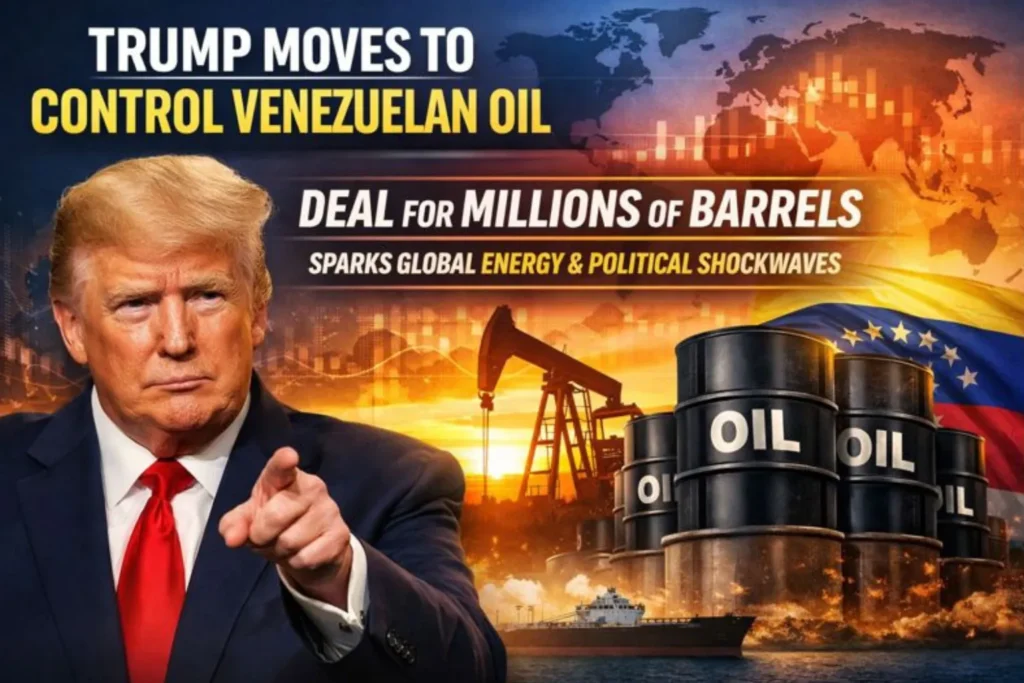
Trump barrels of oil: In a dramatic development that could reshape global energy markets and intensify geopolitical tensions, former US President Donald Trump has announced plans for the United States to take control of tens of millions of barrels of Venezuelan crude oil. The announcement, made through Trump’s social media platform Truth Social, claims that Venezuela’s interim leadership has agreed to transfer between 30 million and 50 million barrels of sanctioned oil to the United States under American oversight.
The move has drawn immediate international attention, not only because of the massive scale of the oil involved, but also because Trump stated that the revenue generated from selling the oil would remain under his direct control. According to Trump, the initiative will benefit both American and Venezuelan citizens while reviving Venezuela’s collapsing oil infrastructure.
At the heart of the announcement is what Trump described as a strategic energy partnership built around Trump barrels of oil, a phrase that has already begun circulating widely among analysts and media outlets as shorthand for the unprecedented proposal.
Oil Worth Billions Under US Oversight
At current global crude prices, 50 million barrels of oil are estimated to be worth approximately ₹25,000 crore (over $3 billion USD). Trump has said the oil will be sold at prevailing market rates, with proceeds managed by the US administration to fund reconstruction and economic stabilisation efforts in Venezuela.
“The money will be used for the benefit of the Venezuelan people and the American people,” Trump said, asserting that strict oversight would prevent corruption and misuse of funds.
He further revealed that US Energy Secretary Chris Wright has been instructed to immediately implement the plan. The oil will reportedly be transported directly to American ports using large storage tankers, bypassing traditional commercial supply chains that have been restricted due to international sanctions.
Background: US Military Action in Venezuela
The oil announcement follows a highly controversial military operation carried out by the United States in Venezuela on January 2. According to US officials, American forces conducted a targeted operation that resulted in the arrest of Venezuelan President Nicolás Maduro and his wife, Cilia Flores.
Both were flown to the United States and are currently being held in detention facilities in New York. US authorities have accused Maduro of long-standing involvement in international drug trafficking and arms smuggling networks, allegations that have been denied by his supporters.
Trump described the military intervention as “a necessary step toward restoring democracy in Venezuela,” a statement that has sharply divided international opinion and raised concerns across Latin America.
Following Maduro’s removal, Trump publicly backed Delcy Rodríguez as Venezuela’s interim president, stating that her leadership would enable a reset in US–Venezuela relations and allow international investment to return to the country’s energy sector.
US Investment in Venezuela’s Oil Sector
Speaking at a press conference in Florida, Trump said American oil companies would invest billions of dollars to rebuild Venezuela’s deteriorating oil infrastructure, which has suffered years of neglect, sanctions, and mismanagement.
“For years, Venezuela had the oil but couldn’t get it out of the ground properly,” Trump said. “Their infrastructure collapsed. American companies know how to fix that.”
Venezuela possesses some of the world’s largest proven oil reserves, yet its production has fallen dramatically over the past decade. Aging refineries, lack of spare parts, and restricted access to global markets have crippled the industry.
Trump claimed that with US technical expertise and financial backing, Venezuela could once again become a major global oil producer. He added that America would not only use the oil domestically but could also export it to other countries, positioning the US as a dominant global energy supplier.
“We Need Full Access,” Trump Says
In earlier remarks to journalists, Trump said the US required “full access” to Venezuela’s oil and other natural resources to rebuild the country’s economy.
“Venezuela is a dead country right now,” Trump said bluntly. “We need full access to its oil and resources so we can bring it back to life.”
These comments have fueled criticism from political opponents and human rights groups, who argue that the language suggests resource control rather than partnership. However, Trump supporters insist the approach is pragmatic and necessary to stabilise a country in economic freefall.
The phrase Trump barrels of oil has since become symbolic of the administration’s hardline approach to energy diplomacy.
Dispute Over Oil Rights and Nationalisation History
Trump has repeatedly claimed that Venezuela unlawfully seized oil assets belonging to American companies. However, the historical record paints a more complex picture.
In 1976, under President Carlos Andrés Pérez, Venezuela legally nationalised its oil industry. The move transferred all foreign-operated oil assets to a newly created state-owned company, Petróleos de Venezuela S.A. (PDVSA).
At the time, major US companies such as Exxon, Mobil, and Gulf Oil had been operating in Venezuela for decades. While compensation was provided following nationalisation, some companies remained dissatisfied, believing the payouts undervalued their investments.
Because American firms played a central role in developing Venezuela’s oil industry in the mid-20th century, sections of US political discourse have continued to describe Venezuelan oil as having “American roots,” a claim that remains legally disputed.
Maduro’s Arrest and Criminal Charges
After his arrest, Nicolás Maduro was transferred to New York, where US prosecutors formally charged him with multiple offences, including conspiracy to traffic narcotics and weapons into the United States.
His wife, Cilia Flores, has also been named as a co-accused. US agencies allege that Flores was involved in ordering kidnappings and extrajudicial killings, claims that her legal team has categorically denied.
The arrests have sent shockwaves through Latin America, with several governments expressing concern over the precedent set by US military action against a sitting head of state.
Regional and Global Reactions
The developments have heightened tensions across the region. Some Latin American countries have condemned the intervention as a violation of sovereignty, while others have cautiously welcomed the prospect of political change in Venezuela.
Global energy markets are also watching closely. Analysts say that the sudden injection of tens of millions of barrels into the market could influence oil prices, particularly if the US chooses to export surplus supplies.
The idea of Trump barrels of oil being sold under American control has raised questions about sanctions enforcement, international law, and the future of energy diplomacy.
Strategic Implications for the US and Global Energy
If implemented, the plan could mark one of the most significant shifts in US energy policy in decades. By directly managing foreign oil assets, the US would move beyond traditional sanctions and diplomacy into a more interventionist economic role.
Supporters argue that the strategy strengthens energy security, reduces reliance on unstable suppliers, and weakens hostile regimes. Critics warn that it risks destabilising global markets and undermining international norms.
Energy experts also note that rebuilding Venezuela’s oil industry will take years, not months, even with significant investment. Infrastructure damage, workforce shortages, and political instability remain major hurdles.
Also read: Presidents/Heads of State Detained by the United States: A Complete Historical Analysis
What Comes Next?
As of now, details of the oil transfer agreement remain limited. It is unclear how international bodies, including the United Nations and OPEC, will respond to the arrangement or whether legal challenges will emerge.
What is certain is that Trump’s announcement has reignited global debate over resource control, sovereignty, and the role of major powers in reshaping energy markets.
With billions of dollars, millions of barrels, and the future of an entire nation’s oil industry at stake, the world will be watching closely to see whether Trump barrels of oil become a turning point-or a flashpoint-in modern geopolitical history.