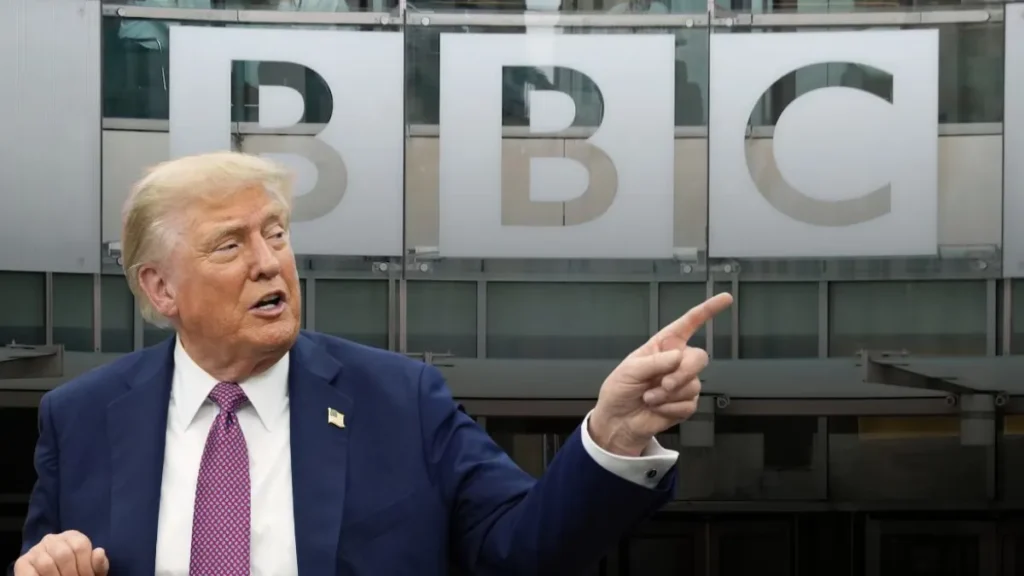
The long-running tension between Trump and BBC escalated again this week after former U.S. President Donald Trump rejected the British broadcaster’s public apology and declared that he will file a massive lawsuit against the network. Despite the BBC admitting to “incorrect editing” in a documentary on Trump’s January 6, 2021 speech, the former president insists that the issue is far from resolved and demands financial compensation.
Trump’s latest reaction has pushed the Trump and BBC controversy back into international headlines, raising fresh questions about media accuracy, political accountability, and the responsibility of global news organizations.
Trump’s Warning: “We Will Sue Them Next Week”
Speaking to reporters aboard Air Force One on Saturday night, Trump made it clear that he is moving forward with legal action. He stated that his legal team is preparing a lawsuit worth between $1 billion and $5 billion.
“We are going to sue them,” Trump said. “Maybe sometime next week. They admitted they committed fraud. They changed the words coming out of my mouth. We cannot let that go.”
According to Trump, the BBC’s acknowledgment of its editing error proves that corrective measures must go beyond an apology. He argued that failing to take strong action would set a dangerous precedent for future media misconduct.
BBC Apologizes, But Refuses Compensation
The BBC publicly apologized last Thursday, admitting that “incorrect editing” of Trump’s 2021 speech created the misleading impression that he had called for violent action ahead of the Capitol breach.
The broadcaster said the mistake was unintentional and assured that the documentary will not be aired again. However, the BBC firmly declined to offer any monetary compensation — a decision that further intensified Trump’s anger.
Trump earlier warned that unless the BBC retracted the disputed segment, issued a full apology, and offered compensation, he would pursue a lawsuit worth $1 billion. Now, after rejecting the apology as inadequate, he plans to proceed with legal action anyway.
The Trump and BBC dispute has become a major international media controversy, especially in the U.S. and U.K., where press freedom and political influence are closely scrutinized.
Top BBC Leaders Resign Amid Controversy
The fallout from the documentary has already shaken the BBC internally. The controversy led to the resignation of several senior figures, including Director-General Tim Davie and News Chief Deborah Turness.
Additionally, BBC Chairman Sameer Shah, who is of Indian origin, apologized for “errors in judgement” made during the documentary’s production. The organization admitted that the edited sequence unintentionally created a false narrative about Trump’s intentions on January 6.
Despite these resignations and apologies, the former U.S. president continues to claim that the BBC’s actions caused significant reputational damage.
Trump: “I Don’t Want to Sue, But It’s My Responsibility”
In an interview with a British news channel, Trump emphasized that he is not filing the lawsuit out of personal desire but out of a sense of duty.
“I don’t want to get into lawsuits,” Trump said. “But it feels like my responsibility. If you don’t take action, you can’t stop this from happening to others.”
His comments highlight the broader theme of political leaders demanding accountability from media giants. The Trump and BBC conflict is now being framed as a case study in journalistic ethics, media influence, and political narratives.
What Was in the Controversial Documentary?
The disputed BBC documentary, which aired in October 2024, focused on Trump’s role in the events leading up to the January 6 Capitol riot. It featured segments from his 50-minute speech delivered at a rally in Washington, D.C.
In the actual footage, Trump had said:
- “We will walk down to the Capitol.”
- “We will cheer on our brave senators and congressmen.”
- “We fight — we fight like hell.”
However, the BBC documentary reportedly edited the statements in a way that conveyed a more direct call for aggression. The edited line presented Trump saying:
“We will walk to the Capitol… and I will be there with you. And we will fight. We will fight hard.”
Trump and his team argue that this version significantly alters the meaning and context of his speech, making it appear as though he directly encouraged violence, which he denies.
The BBC’s admission of “incorrect editing” appears to support criticism that the documentary did not present Trump’s statements with full accuracy.
Also read: New York Film Festival Called Off Amid Claims of Pressure on Filmmakers From Chinese Authorities
A Global Debate on Media Integrity
The Trump and BBC dispute has reignited global conversations about the role of news organizations during politically sensitive moments. Critics argue that even unintentional editing errors can have severe consequences, especially when they involve world leaders.
Trump’s supporters claim that the BBC’s mistake reflects broader media bias, while critics of Trump argue that his aggressive stance against the BBC is politically motivated. Nevertheless, the dispute underscores the importance of transparency and accuracy in major international news organizations.
Legal Experts Weigh In
Several U.S. legal analysts say that Trump’s lawsuit could be one of the largest media-related legal battles in recent years. However, they also note that proving intentional defamation against a major broadcaster like the BBC may be challenging.
Still, the BBC’s admission of “incorrect editing” could become a critical factor in the case. If Trump proceeds with a multi-billion-dollar claim, the lawsuit will likely attract global attention and may influence how media organizations handle politically charged content in the future.
What Happens Next?
With Trump promising to file the lawsuit “next week,” the world is watching how the Trump and BBC conflict unfolds. The BBC may face intense legal and public scrutiny, while Trump continues to leverage the controversy as a key talking point in his political narrative.
As of now, the BBC has offered no further comment beyond its initial apology. Meanwhile, Trump remains firm, framing the lawsuit as a stand for truth, accountability, and media transparency.