A Moment of Calm Along a Volatile Border
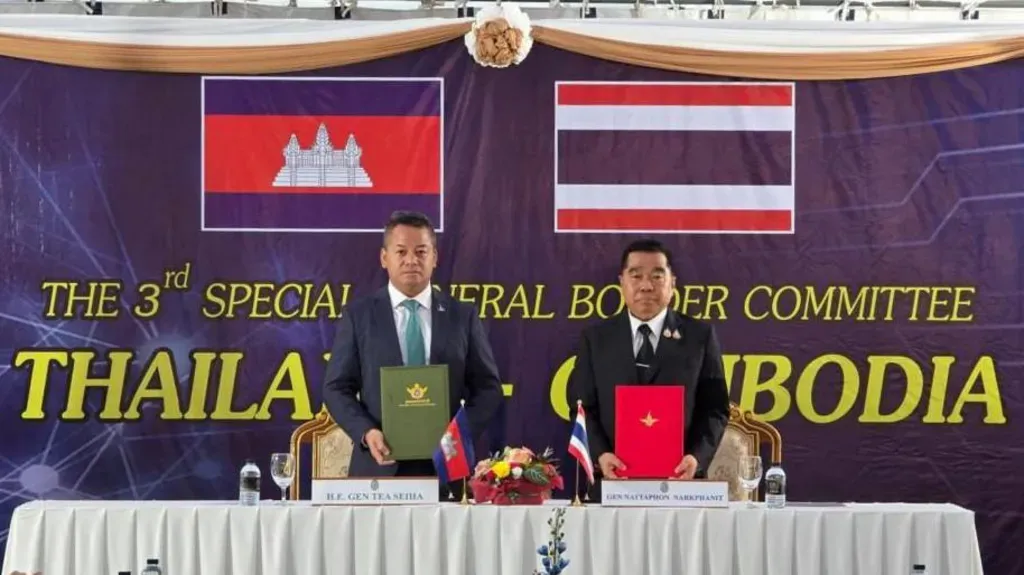
The Thailand Cambodia ceasefire deal signed on December 27, 2025, has brought a cautious sense of relief to a region battered by months of violence and decades of unresolved tension. At a heavily guarded border checkpoint linking Cambodia’s Pailin Province with Thailand’s Chanthaburi Province, senior defense officials from both nations formally agreed to silence the guns-at least for now.
The agreement, which took effect at noon local time on the day of signing, mandates an immediate and comprehensive halt to all hostilities. This includes the use of heavy and light weapons, aerial strikes, ground assaults, and any attacks directed at civilians, civilian infrastructure, or military installations. Beyond the battlefield, the deal also outlines commitments to demining dangerous border areas and introduces confidence-building measures such as the planned release of 18 Cambodian soldiers detained by Thailand since July, contingent on the ceasefire holding for a minimum of 72 hours.
ASEAN observers have been tasked with monitoring compliance, while new direct communication channels between senior military and political leaders aim to prevent miscalculations that could once again plunge the frontier into chaos. Though the agreement has been welcomed across Southeast Asia and beyond, many analysts caution that it represents only a pause in hostilities rather than a definitive resolution to one of the region’s most enduring disputes.
The Road Back to War: How the Conflict Reignited
The current crisis did not emerge in isolation. It followed the collapse of an earlier peace arrangement that had briefly calmed the Thailand–Cambodia border earlier in 2025. In late July, the region witnessed five days of intense combat involving artillery duels, airstrikes, and coordinated ground operations. That outbreak of fighting killed dozens of people, wounded many more, and forced thousands of civilians to flee their homes on both sides of the border.
International alarm prompted swift diplomatic intervention. Malaysia, acting in its capacity as a key ASEAN member, helped facilitate negotiations, while pressure from the United States—reportedly led by President Donald Trump-pushed both governments toward a formal ceasefire agreement in October. That deal was hailed as a breakthrough, but it soon became clear that the underlying causes of the conflict had not been addressed.
Accusations of new landmine placements, alleged troop buildups near sensitive areas, and an increasingly hostile information war between Bangkok and Phnom Penh eroded trust. Each side accused the other of violating the spirit, if not the letter, of the October agreement. By early December, sporadic clashes escalated into sustained fighting once more.
This renewed phase of the conflict proved even more destructive. Weeks of combat left hundreds killed or wounded and triggered one of the largest civilian displacements in the region in recent years. More than half a million people were forced from their homes, seeking safety in temporary shelters or with relatives farther inland. As humanitarian agencies struggled to cope, regional leaders warned that the conflict risked destabilizing mainland Southeast Asia.
A Border Drawn by History: The Origins of the Dispute
To understand why the Thailand Cambodia ceasefire deal is so fragile, one must look back over a century to the origins of the border itself. The 817-kilometer frontier separating Thailand and Cambodia was largely defined during the era of French colonial rule in Indochina. Treaties signed in 1904 and subsequent maps produced in 1907 attempted to formalize boundaries that had long been fluid and loosely defined.
Thailand has consistently argued that these colonial-era maps departed from the natural watershed lines specified in earlier agreements, effectively transferring territory to French-controlled Cambodia. From Bangkok’s perspective, these deviations were imposed under unequal colonial conditions and should not bind a modern, sovereign Thailand.
Cambodia, on the other hand, inherited these boundaries at independence and regards them as legally valid and internationally recognized. Any attempt to redraw the border, Cambodian leaders argue, constitutes an infringement on national sovereignty. This fundamental disagreement has left sections of the border ill-defined, disputed, and prone to confrontation.
Preah Vihear: A Temple at the Center of Conflict
No symbol better encapsulates the depth of the Thailand-Cambodia dispute than the Preah Vihear Temple. Built in the 11th century during the height of the Khmer Empire, the temple complex sits dramatically atop a 525-meter cliff in the Dângrêk Mountains, overlooking the Cambodian plains.
Dedicated to the Hindu god Shiva, Preah Vihear is a masterpiece of Angkorian architecture. Unlike most Khmer temples, which are oriented eastward, Preah Vihear stretches along a north–south axis, following the natural contours of the escarpment. Its remote location and breathtaking setting have long made it a source of national pride for Cambodians.
In 1962, the International Court of Justice ruled that the temple itself belonged to Cambodia, citing the colonial-era maps and Cambodia’s historical administration of the site. However, the court declined to definitively settle ownership of the surrounding 4.6 square kilometers of land, leaving a grey zone that has repeatedly erupted into violence.
Tensions around Preah Vihear flared dramatically between 2008 and 2011, resulting in deadly clashes and temporary evacuations. A subsequent 2013 clarification by the ICJ reaffirmed Cambodia’s sovereignty over the immediate promontory but again stopped short of resolving broader border demarcations. As a result, the temple remains both a cultural treasure and a geopolitical flashpoint.
Heritage Under Threat: Temples Caught in the Crossfire
The fighting in 2025 has taken a heavy toll not only on human lives but also on cultural heritage of global significance. Cambodian officials have reported extensive damage to the Preah Vihear complex, alleging that Thai artillery and airstrikes struck pagodas, stairways, and conservation facilities associated with a joint Cambodia–India restoration project.
Further west, the ancient Ta Krabey Temple-also known as Ta Krabei-was reportedly hit by missiles during intense fighting. Though less famous than Preah Vihear, Ta Krabey is an 11th-century Khmer sanctuary of considerable historical value. Images showing smoke rising from the site circulated widely, sparking outrage among cultural preservationists.
Another disputed site, Prasat Ta Muen Thom (also called Ta Moan Thom), saw heavy military activity in its vicinity. This temple complex, straddling contested territory, has long been a sensitive point along the border.
Thailand has firmly rejected accusations of deliberately targeting cultural sites. Thai officials insist their military operations were aimed solely at legitimate military positions and argue that Cambodian forces had illegally occupied and fortified areas near these temples, thereby stripping them of protected status under the 1954 Hague Convention for the Protection of Cultural Property in the Event of Armed Conflict.
One particularly contentious episode involved the destruction of a modern Vishnu statue erected near Preah Vihear in 2014. Thai authorities described the action as the removal of an unauthorized structure in a disputed zone, while Cambodian leaders condemned it as a provocative act aimed at undermining their cultural and historical claims.
UNESCO has expressed serious concern over reports of damage to World Heritage and heritage-adjacent sites, warning that continued fighting could cause irreversible harm. India, which has played a significant role in restoring Khmer monuments, also voiced deep alarm over the impact of the conflict on the Preah Vihear complex.
Temples, Nationalism, and Political Identity
In the Thailand–Cambodia conflict, ancient temples are far more than archaeological remains. They are potent symbols of national identity, historical memory, and political legitimacy. For Cambodia, these sites evoke the grandeur of the Khmer Empire, which from the 9th to the 15th centuries dominated much of mainland Southeast Asia. Protecting and asserting ownership over these monuments is closely tied to Cambodian narratives of resilience and cultural continuity.
In Thailand, the dispute is often framed through a different historical lens. Many Thais view the colonial-era border arrangements as unjust impositions that unfairly deprived the country of territory. Access to and control over temple sites near the border are thus seen not only as strategic concerns but also as matters of historical fairness.
Domestic politics in both countries have repeatedly amplified these sentiments. Nationalist rhetoric, particularly during times of political uncertainty, has turned border disagreements into rallying points. Media coverage, social media campaigns, and public demonstrations have all played roles in hardening positions and reducing the political space for compromise.
The Ceasefire’s Key Provisions
Against this complex backdrop, the Thailand Cambodia ceasefire deal lays out a series of concrete measures designed to stabilize the situation in the short term.
First and foremost is the immediate cessation of all hostilities. Both sides have committed to halting the use of any weapons, whether heavy artillery, air power, or small arms. Attacks on civilians, civilian infrastructure, and military targets are explicitly prohibited.
Second, the agreement includes a pledge to cooperate on demining operations in hazardous border areas. Landmines, many dating back decades, pose a serious threat to returning civilians and have been a persistent source of casualties.
Third, the deal addresses the sensitive issue of detained personnel. Thailand has agreed to release 18 Cambodian soldiers captured during earlier phases of the conflict, provided the ceasefire holds for at least 72 consecutive hours. This provision is seen as a crucial confidence-building step.
Finally, the agreement establishes mechanisms for oversight and communication. ASEAN observers will monitor compliance on the ground, while direct hotlines between senior officials are intended to resolve incidents quickly before they escalate.
ASEAN and External Actors: Regional and Global Stakes
ASEAN’s role in the ceasefire reflects its long-standing approach to regional security-emphasizing dialogue, consensus, and non-interference. While critics argue that this approach can be slow and overly cautious, ASEAN’s involvement provides a neutral framework that both Thailand and Cambodia find acceptable.
External powers have also played influential roles. The earlier October ceasefire was reportedly shaped in part by U.S. diplomatic pressure, with trade considerations adding leverage. China, a major partner to both countries, has maintained a lower profile but is widely believed to favor stability along its southern periphery. Malaysia’s mediation efforts underscore the importance of middle powers in managing regional crises.
Read also: India New Zealand trade Enters a New Era as Landmark Free Trade Agreement Is Finalised
Humanitarian Impact: Lives on Hold
Beyond diplomacy and military maneuvers, the conflict has exacted a heavy human cost. Entire communities along the border have been uprooted, their livelihoods disrupted and their futures thrown into uncertainty. Schools have closed, farmland has been abandoned, and access to basic services has been severely constrained.
Humanitarian agencies have warned of long-term consequences if displaced populations are unable to return safely. Landmines, unexploded ordnance, and damaged infrastructure present significant obstacles. The success of the ceasefire will therefore be measured not only by the absence of gunfire but by the speed and safety with which civilians can rebuild their lives.
Can This Peace Hold?
History offers reasons for both hope and skepticism. Previous ceasefires between Thailand and Cambodia have brought temporary calm, only to unravel amid renewed accusations and incidents. The current agreement benefits from more robust monitoring and clearer communication channels, but it still rests on fragile trust.
Analysts argue that lasting peace will require addressing the root causes of the dispute. This includes comprehensive border demarcation, joint management of heritage sites, and mechanisms to depoliticize nationalist narratives. Without such measures, any ceasefire risks becoming merely an interlude between rounds of fighting.
Conclusion: A Pause, Not an End
As the guns fall silent along the Dângrêk Mountains, the Thailand Cambodia ceasefire deal offers a chance to step back from the brink. For families displaced by violence, it represents hope of returning home. For the region, it is a test of whether diplomacy can prevail over history’s long shadow.
Yet peace along this ancient frontier remains precarious. The temples that crown its hills stand as reminders of a shared past-and of the enduring challenges of reconciling history, identity, and sovereignty. Whether this ceasefire becomes the foundation for lasting stability or another fragile truce will depend on choices made in the weeks and months ahead.