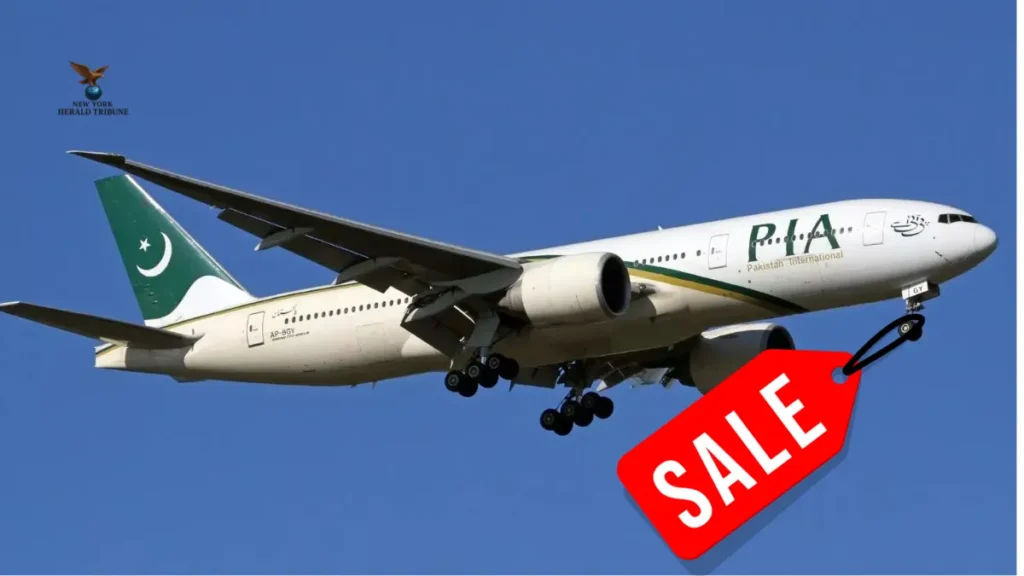
Pia Bidders: Pakistan is preparing for one of the most consequential privatization decisions in its history as the country moves forward with the sale of Pakistan International Airlines (PIA), its state-owned national carrier. On December 23, three major corporate groups will formally submit sealed bids to acquire a controlling stake in the airline, marking a turning point driven by economic desperation, international financial pressure, and the powerful shadow of Pakistan’s military establishment.
The sale of PIA is not merely a business transaction. It is deeply intertwined with Pakistan’s fragile economy, its reliance on the International Monetary Fund (IMF) for survival, and the expanding role of the Pakistan Army in commercial enterprises. As Pia bidders line up to take ownership of the loss-making airline, the move raises critical questions about sovereignty, transparency, economic reform, and who truly controls Pakistan’s strategic assets.
A National Airline on Sale: Why Pakistan Is Selling PIA
Pakistan International Airlines, once a symbol of national pride and one of Asia’s most respected carriers in the 1960s and 1970s, has been struggling for more than two decades. Continuous financial losses, poor governance, political interference, and outdated infrastructure have pushed the airline into deep crisis.
According to official figures, PIA is burdened with debt of approximately 78,000 crore Pakistani rupees, which translates to nearly ₹25,000 crore in Indian currency. The airline is currently operating at an annual loss of around 7,500 crore Pakistani rupees, a figure that has steadily worsened over the years.
The situation became particularly dire after the tragic Karachi plane crash in 2020, which killed 96 people. Investigations into the crash exposed a shocking scandal: more than 260 PIA pilots were found to have suspicious or fake licenses. This revelation shattered the airline’s credibility and prompted aviation authorities in Europe, the United Kingdom, and the United States to ban PIA flights.
These bans struck at the airline’s most profitable international routes, sharply reducing revenue. Despite repeated promises of reform, PIA failed to modernize its fleet, improve safety oversight, or adopt new technologies. Excess staffing, high salary bills, and inefficient management further drained public funds.
As losses mounted and debt ballooned, the airline became a major liability for Pakistan’s already struggling economy. Eventually, selling PIA was no longer a policy option-it became a financial necessity.
IMF Pressure: The Key Trigger Behind the Sale
The immediate catalyst behind PIA’s privatization is Pakistan’s agreement with the International Monetary Fund. In 2023, Pakistan stood on the edge of economic collapse. Foreign exchange reserves were nearly exhausted, inflation was soaring, and the government faced the real risk of defaulting on external debt obligations.
In desperation, Islamabad turned to the IMF for a bailout. After months of negotiations, the IMF approved a $7 billion loan package-equivalent to roughly ₹63,000 crore-but attached 64 strict conditions to the agreement.
One of the IMF’s core demands was the privatization of loss-making state-owned enterprises, including PIA.
According to the IMF, companies like PIA impose an unsustainable burden on Pakistan’s public finances. Taxpayer money used to cover airline losses diverts resources away from essential services such as healthcare, education, and infrastructure. In its May 2024 review report, the IMF explicitly named PIA as a prime candidate for privatization.
Pakistan has already received approximately ₹30,000 crore from the IMF loan in installments. However, future disbursements are conditional on continued compliance with IMF reforms. Officials have confirmed that the next IMF installment will only be released after tangible progress in PIA’s privatization, making the airline sale a non-negotiable condition.
Failure to proceed could freeze IMF funding, triggering another financial crisis.
IMF Conditions Explained: Why Selling PIA Matters
The IMF bailout package requires Pakistan to implement deep structural reforms aimed at stabilizing its economy. These conditions include:
- Reducing the fiscal deficit by narrowing the gap between government spending and revenue
- Increasing tax collection and improving revenue efficiency
- Privatizing or restructuring loss-making state-owned enterprises
- Enforcing asset declarations for public officials
- Strengthening anti-corruption mechanisms
- Reducing political interference in commercial operations
From the IMF’s perspective, PIA represents everything that has gone wrong with Pakistan’s economic governance: political appointments, unchecked corruption, inefficient operations, and chronic financial mismanagement.
By forcing privatization, the IMF hopes to remove PIA from government control, reduce future fiscal losses, and restore market discipline.
Who Are the Pia Bidders?
Three companies have officially qualified to participate in the bidding process for PIA. These Pia bidders are expected to submit sealed bids between 10:45 AM and 11:15 AM on December 23, with envelopes opened later that afternoon at 3:30 PM.
The confirmed bidders are:
1. Lucky Cement Limited
A major industrial conglomerate with interests in cement, energy, and infrastructure. Lucky Cement has experience managing large-scale operations and is seen as a financially strong contender.
2. Arif Habib Corporation Limited
One of Pakistan’s leading investment groups, with diversified holdings across banking, energy, and manufacturing sectors.
3. Air Blue Private Limited
A private airline operator, Air Blue brings aviation experience to the table, making it a technically strong bidder.
The government has stated that ownership transfer will begin immediately after the highest bid is finalized.
The Army Factor: Why Pakistan’s Military Is Interested in PIA
Although not officially participating as a bidder, the Pakistan Army has emerged as a powerful behind-the-scenes player in the PIA sale.
Initially, Fauji Fertilizer Company (FFC)-a corporate entity backed by the military-controlled Fauji Foundation-was expected to bid for PIA. However, the company withdrew at the last moment, failing to deposit the mandatory bid security by December 21.
Despite its withdrawal, Pakistani media reports suggest that Fauji Fertilizer may later partner with the winning bidder, allowing the military to retain influence over the airline without formally owning it.
This strategy reflects a broader pattern in Pakistan, where the military maintains control over strategic sectors through indirect corporate partnerships.
Why Fauji Fertilizer Stepped Back
Analysts believe Fauji Fertilizer withdrew for strategic reasons. Had it participated and lost the auction, regulations would have prevented it from partnering with the winning bidder later. By stepping aside, the company preserved the option to collaborate post-sale.
This maneuver allows the military to exert control without the political scrutiny that would come with a direct acquisition.
The military’s interest in PIA is not surprising. Earlier this year, the government transferred full ownership of Precision Engineering Complex (PEC)-a company manufacturing aircraft parts-to the Pakistan Air Force, reinforcing concerns about military expansion into civilian economic sectors.
Pakistan Army’s Vast Business Empire
Pakistan’s military is one of the few armed forces in the world with a vast commercial empire. According to a 2025 report by Economic Policy and Business Development (EPBD), military-linked enterprises dominate Pakistan’s corporate landscape.
The Fauji Foundation, controlled by the army, tops the list of Pakistan’s 40 largest business groups, with assets worth $5.9 billion (approximately ₹52,000 crore). In 2024 alone, it generated revenues exceeding 80,000 crore Pakistani rupees.
Military-linked companies operate across more than 50 sectors, including:
- Cement and construction
- Fertilizers and agriculture
- Oil and energy
- Banking and insurance
- Telecom and media
- Education and healthcare
- Shipping and logistics
Military-Controlled Land and Housing
The army also controls massive real estate assets through the Defence Housing Authority (DHA), operating in major cities such as Islamabad, Karachi, Lahore, Rawalpindi, Multan, Peshawar, and Quetta.
The estimated value of military-controlled land exceeds ₹2 lakh crore, making the army Pakistan’s largest landowner.
Corruption Allegations Within the Military
Alongside its commercial power, Pakistan’s military has faced persistent corruption allegations. Former Army Chief General Qamar Javed Bajwa reportedly amassed personal assets worth over 1,200 crore Pakistani rupees upon retirement. His spouse’s declared assets rose from zero in 2016 to 200 crore rupees by 2022.
Similar allegations have surfaced against former chiefs Raheel Sharif and Ashfaq Parvez Kayani. An audit report revealed that the Pakistan Air Force used land acquired for national security to develop housing projects.
A 2021 Credit Suisse report found that at least 25 retired Pakistani military officers held Swiss bank accounts containing deposits exceeding ₹80,000 crore.
Why PIA Failed to Sell Last Year
Pakistan attempted to privatize PIA in the previous year, but the effort collapsed. Prospective investors demanded:
- Exemption from 18% sales tax on leased aircraft
- Full clearance of PIA’s liabilities
The Federal Board of Revenue refused tax exemptions, citing IMF restrictions. The Finance Ministry declined to absorb all debts. As a result, most investors withdrew.
Ultimately, only one bidder-a real estate developer-offered 1,000 crore Pakistani rupees, far below the government’s expectation of 8,500 crore. The deal was rejected.
What Pakistan Hopes to Gain From the Sale
Prime Minister Shehbaz Sharif has defended privatization as essential to restoring PIA’s reputation and financial viability.
The government is selling 75% ownership in the airline. Of the winning bid amount, only 7.5% will go directly to the government, while 92.5% will be reinvested into reviving PIA.
According to Privatization Commission Chairman Muhammad Ali, the aviation sector currently contributes just 1.3% to Pakistan’s GDP-far lower than Saudi Arabia’s 8.5% or the UAE’s 18%.
The government believes privatization will:
- Increase aviation’s GDP contribution
- Save ₹2,600 crore in airport charges and taxes over five years
- Shift employee salaries, pensions, and healthcare costs to private owners
- Enable fleet expansion (PIA currently has 34 aircraft, only 18 operational)
To make the deal attractive, the government has transferred 67,000 crore Pakistani rupees of PIA’s debt into a separate holding company, which the state will repay.
Payment Structure and Future Options
The winning bidder must pay two-thirds of the bid amount within 90 days, with the remainder due within one year. After full payment, the buyer will have one month to decide whether to acquire the remaining 25% stake from the government.
Conclusion: A Defining Moment for Pakistan
As Pia bidders prepare to submit their offers, Pakistan stands at a crossroads. The sale of PIA could help stabilize the economy, unlock IMF funding, and modernize the aviation sector. But it also raises serious concerns about transparency, military influence, and long-term accountability.
Whether privatization will revive Pakistan’s national airline-or merely transfer control from one powerful institution to another-remains an open question. What is certain is that the outcome of this auction will shape Pakistan’s economic and political future for years to come.