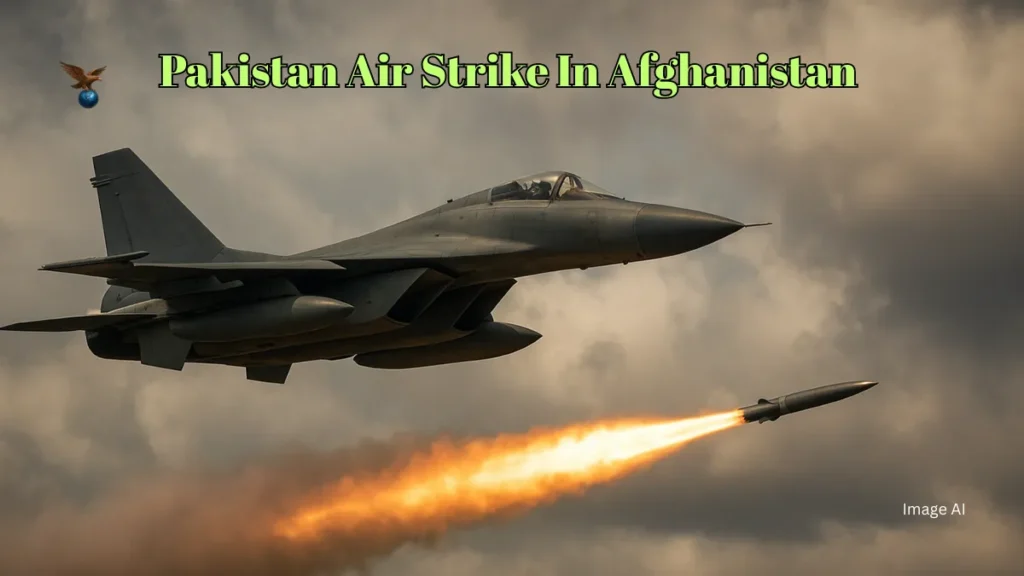
In a sharp escalation of regional tensions, Pakistan has once again carried out air strikes inside Afghanistan, triggering widespread condemnation from the Taliban administration and heightening fears of a potential cross-border conflict. The latest attack coincided with the India visit of Afghanistan’s acting Minister of Commerce and Industry, Nooruddin Azizi — the second such incident to occur during a senior Taliban official’s trip to New Delhi.
The Pakistan Air Strike In Afghanistan has intensified long-standing hostilities between the two neighbours, with Afghan authorities vowing a decisive response and warning that Islamabad’s actions will no longer go unanswered. The strikes, which hit three Afghan provinces shortly after midnight on 25 November, have revived concerns of an open confrontation between Pakistan and the Taliban regime at a time when regional diplomacy is undergoing rapid shifts.
A New Flashpoint in South Asia
Relations between Pakistan and Afghanistan have remained tense for months, but the latest air strikes mark a significant turning point. According to Afghan officials, Pakistani fighter jets targeted areas in Paktika, Khost and Kunar provinces, launching missiles and dropping ordnance that hit both residential and border-adjacent zones.
In Khost province, the attack devastated a home belonging to Waliat Khan, killing ten civilians — including nine children and one woman. Local residents reported that the strike hit the house shortly after midnight, leaving the structure in ruins and wiping out nearly the entire family. In other affected provinces, at least four additional civilians were injured.
The Taliban administration’s spokesperson, Zabihullah Mujahid, condemned the assault in unusually strong language, declaring that Pakistan would receive a “crushing response” at a time of the Taliban’s choosing. He dismissed Islamabad’s justification that it acted on intelligence related to militant activity, stating that Pakistan “killed innocent civilians based on false assumptions” and must now prepare for consequences.
Second Strike in Two Months During Taliban Officials’ India Visits
The timing of the Pakistan Air Strike In Afghanistan has raised questions across diplomatic circles. It follows a similar strike in October that occurred while Afghanistan’s acting Foreign Minister, Amir Khan Muttaqi, was in New Delhi for meetings. That earlier attack killed several civilians, including individuals associated with Afghanistan’s cricket community.
Now, with Minister Azizi concluding his six-day India visit — focused primarily on trade, investment and economic cooperation — Pakistan’s air force has again carried out strikes inside Afghanistan. Regional observers see this as part of a pattern in which Islamabad reacts nervously whenever India and the Taliban administration appear to strengthen their engagement.
While Pakistan has historically viewed Afghanistan as within its strategic sphere, the Taliban’s growing outreach to India, especially in sectors like mining, agriculture, IT and pharmaceuticals, has complicated geopolitical dynamics. Indian and Afghan officials have announced a series of commercial frameworks that bypass Pakistan entirely, at a time when Islamabad’s own economic and security situation remains precarious.
India–Afghanistan Cooperation Gains Momentum
During his New Delhi visit, Minister Nooruddin Azizi announced several major policy steps aimed at expanding bilateral trade and investment. India confirmed that its commercial attaché would soon resume duties in Kabul — a move expected to significantly ease business coordination between the two nations.
Afghanistan also opened its doors to Indian companies with substantial incentives:
- Investors in new sectors, particularly gold mining, will receive five years of tax exemption.
- Tariffs for Indian companies establishing manufacturing units in Afghanistan will be reduced to as low as 1%.
- Land and logistics facilities will be provided at discounted rates.
- Processing of minerals, especially gold, must be conducted within Afghanistan to generate local employment.
Azizi told reporters that Afghanistan seeks to increase its bilateral trade volume with India beyond the current USD 1 billion, calling on Indian companies to explore opportunities across mining, agriculture, energy, pharmaceuticals, textiles and technology. He emphasised that Afghanistan wants long-term cooperation with India and intends to revive the air cargo corridor between Kabul–Delhi and Kabul–Amritsar.
Indian officials confirmed that air cargo operations — suspended for several years — would restart soon, allowing Afghan fresh produce and exports to reach Indian markets more efficiently. This development strengthens economic links at a time when Pakistan has shut down direct trade routes with both India and Afghanistan.
Pakistan Faces Internal Security Turmoil
One reason behind Islamabad’s aggressive posture lies in its worsening domestic security environment. The Tehrik-e-Taliban Pakistan (TTP), a militant group ideologically aligned with Afghanistan’s Taliban but operating within Pakistan, has intensified attacks on Pakistani police, army and judicial institutions.
Within the past 15 days, Pakistan suffered two significant extremist incidents:
• 11 November – Islamabad Blast
A powerful explosion near the district court complex in Islamabad killed 12 people and injured 27 others. The attack shook the capital and exposed vulnerabilities in Pakistan’s internal security apparatus.
• 24 November – Suicide Attack on Frontier Constabulary HQ
A day before the air strike, a suicide bomber infiltrated the Frontier Constabulary headquarters in Peshawar. Disguised under a shawl, the attacker detonated explosives at a checkpoint, killing three security personnel. Additional casualties included the attackers themselves and several injured officers.
Pakistani authorities allege that these attacks were orchestrated by the TTP with support from sanctuaries inside Afghanistan. This accusation, denied by Kabul, has been cited as the rationale for the Pakistan Air Strike In Afghanistan, though no verifiable evidence has been shared publicly.
Long-Standing Border Disputes and Historical Hostility
The tensions between the two neighbours stretch far beyond recent events. For decades, Afghanistan has not formally recognised the Durand Line — the colonial-era border drawn between the two territories. Large Pashtun-majority regions such as Khyber Pakhtunkhwa, Balochistan and adjacent border belts have historically been points of dispute.
Some factions within Afghanistan believe these areas culturally and historically belong to the Afghan nation, a claim Pakistan rejects. The re-emergence of the Taliban in 2021 has further complicated the matter, as the group asserts ideological alignment with Pashtun identity and governance across both sides of the border.
Pakistan has previously used the Taliban as a strategic asset, but after the Taliban takeover, ties deteriorated when Kabul refused to help Islamabad suppress the TTP. Afghan officials argue that Pakistan’s own policies created the TTP problem and that blaming Afghanistan for every attack is politically convenient for Islamabad.
Peace Talks Fail in Istanbul
On 6 November, representatives from Pakistan and Afghanistan met in Istanbul to negotiate a framework for reducing cross-border tensions and controlling militant movements. The talks, however, collapsed without any agreement.
Pakistan’s Defence Minister, Khawaja Asif, warned at the time that if attacks on Pakistani soil continued, Islamabad “would be forced to take harsh measures.” Just weeks later, his prediction materialised through the Pakistan Air Strike In Afghanistan, widening the diplomatic rift.
Now, with both sides issuing open threats and no functional communication mechanism remaining, analysts fear the situation could escalate into a more direct confrontation.
Taliban’s Strongest Warning So Far
In previous instances, the Taliban has responded to Pakistani strikes with moderated language, condemning the attacks but avoiding overt threats. This time, however, the tone shifted dramatically.
Spokesperson Zabihullah Mujahid stated:
- Pakistan will receive a “decisive and crushing” response.
- Kabul will “no longer tolerate violations of its sovereignty.”
- Pakistan’s intelligence claims were “fabricated” and must be corrected.
- Civilian killings have pushed Afghanistan “to reassess its approach.”
For a regime that relies heavily on maintaining political stability while navigating global isolation, this aggressive stance signals that patience with Pakistan may be running out.
Is a Pakistan–Afghanistan War Possible?
While a full-scale conflict may not be imminent, several developments indicate an escalating trajectory:
1. Continuous border clashes
Skirmishes at the Durand Line have increased, with both sides accusing each other of provocations.
2. Collapse of diplomatic channels
The failed Istanbul talks suggest neither side is willing to compromise.
3. Pakistan’s domestic instability
Economic crises, political infighting and rising militancy pressure Islamabad to demonstrate strength externally.
4. Taliban’s desire for legitimacy
Confronting Pakistan could help the Taliban rally nationalist sentiment within Afghanistan.
Regional observers warn that another large-scale Pakistan Air Strike In Afghanistan could trigger retaliatory actions from the Taliban, creating a conflict corridor with wider implications for South and Central Asia.
Pakistan Blames India; Questions Rise About External Influence
In an interview with Geo News, Pakistan’s Defence Minister Khawaja Asif claimed that the TTP threat inside Pakistan is being influenced by India. He alleged that Delhi is encouraging unrest through militant channels — an accusation India categorically rejects.
Critics inside Pakistan question why Islamabad rarely discusses the role of other countries, including China or Turkey, despite their growing involvement in security and trade affairs. Some analysts argue that Pakistan’s leadership is using India as a convenient scapegoat while avoiding scrutiny of its own strategic miscalculations.
Conclusion: A Region on the Brink
The latest Pakistan Air Strike In Afghanistan has pushed South Asia into a delicate and dangerous phase. With Afghanistan asserting its sovereignty more aggressively than ever, and Pakistan under internal and external pressure, the possibility of deeper conflict cannot be dismissed.
As India and Afghanistan expand their economic cooperation — including the reopening of air cargo corridors and major investment incentives — Pakistan finds itself increasingly isolated diplomatically and economically.
Unless both nations resume structured dialogue and address long-standing grievances, the region could witness a prolonged period of instability, civilian casualties and cross-border tension. For now, the situation remains volatile, and the world is watching closely as Pakistan and Afghanistan stand face-to-face at a critical juncture in their turbulent shared history.