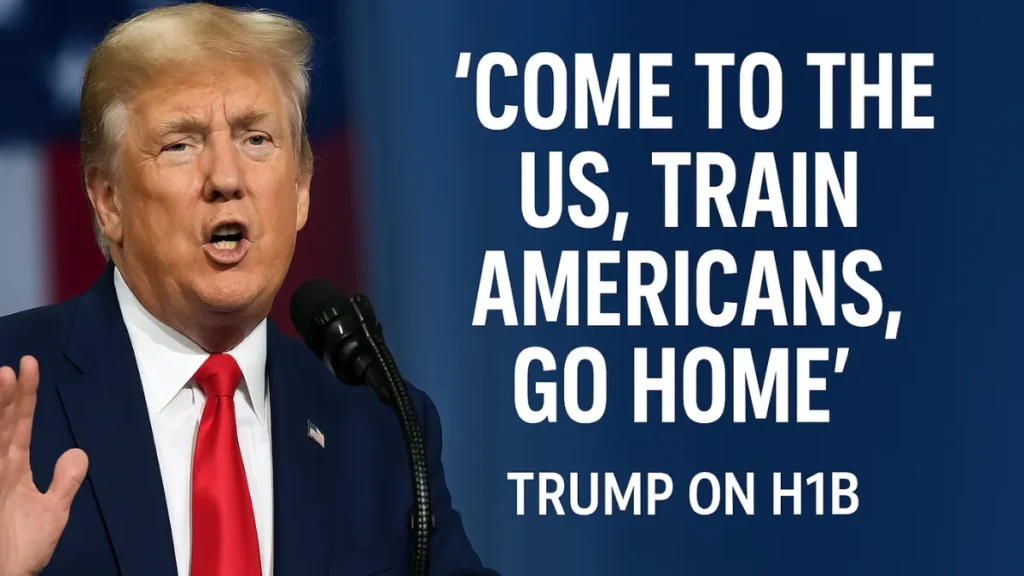
H-1B Visa Program: In a major policy shift, former U.S. President Donald Trump has unveiled a new approach to the H-1B visa program, signaling a return to his “America First” principles while emphasizing skill transfer and domestic workforce development. The new plan, described by U.S. Treasury Secretary Scott Bessent, focuses on bringing skilled foreign professionals to America — not to replace U.S. workers, but to train them for high-value, high-tech roles in critical industries such as semiconductors and shipbuilding.
🚨 BREAKING: Treasury Sec. Scott Bessent says President Trump's plan for visas is to TEMPORARILY bring in expert overseas workers to train Americans, they they go BACK home.
— Eric Daugherty (@EricLDaugh) November 12, 2025
"Train the US workers. Then, go home. Then, the US workers fully take over."
KILMEADE: You understand… pic.twitter.com/vDbabSVxDW
Trump’s New H-1B Visa Program: Training Over Dependency
Under the revised strategy, the U.S. government will invite foreign talent for short-term roles, typically lasting between three to seven years, during which they will train American workers in advanced skills. Once that training is complete, these professionals will return to their home countries — allowing U.S. citizens to take over the specialized jobs they helped establish.
“This isn’t about outsourcing or dependency anymore,” Bessent explained during an interview with Fox News host Brian Kilmeade. “It’s about knowledge transfer. The President’s goal is to bring skilled workers here temporarily, teach our workforce, and rebuild what we’ve lost in American manufacturing.”
According to Bessent, the program’s core idea is to reverse decades of industrial outsourcing that saw manufacturing powerhouses like Japan, Taiwan, and South Korea dominate sectors once led by the United States. “For the last 20 to 30 years, we’ve seen critical manufacturing — precision engineering, semiconductor fabrication, shipbuilding — move overseas,” Bessent said. “Now, we’re taking concrete steps to bring it all back.”
“Trump on H1B”: A Knowledge Transfer Revolution
The Trump on H1B approach marks a notable departure from previous U.S. immigration policies. While Trump has historically criticized the misuse of H-1B visas — claiming they displaced American workers — his administration now envisions a temporary collaboration model where the U.S. benefits from global expertise before building self-sufficiency.
“We want to bring the semiconductor industry back to the U.S.,” Bessent added. “Large facilities are already planned in Arizona. But we can’t just snap our fingers — it takes expertise, time, and education. The plan is to let foreign experts help train our people for a few years, then hand the reins over.”
The concept aligns with the “Repatriate and Rebuild” framework, which aims to reduce dependency on imports while strengthening America’s domestic production base. By integrating foreign knowledge into U.S. industry and workforce training programs, Trump’s plan seeks to create a sustainable ecosystem of innovation and employment.
Rebuilding American Manufacturing from Within
Bessent highlighted that Trump’s H-1B reforms are not merely about visas — they’re a blueprint for economic independence. The approach combines workforce education, targeted trade policy, and infrastructure investment to reestablish the U.S. as a global industrial leader.
He pointed out that semiconductor manufacturing, an industry vital to national security, is a central focus. “We can’t rely on foreign nations for chips that power everything from cars to defense systems,” Bessent said. “Overseas partners coming in and teaching American workers — that’s a home run for America.”
This sentiment echoes Trump’s long-standing stance that American prosperity must be built on American soil. His previous administration’s trade policies — including tariffs on Chinese imports and incentives for domestic manufacturing — now appear to be evolving into a more collaborative, education-driven model.
Economic Vision: From Tariffs to Training
The new H-1B direction complements Trump’s broader economic agenda, which Treasury Secretary Bessent described as one of “Parallel Prosperity.” The concept envisions Wall Street and Main Street growing together, where both investors and working-class families benefit from economic expansion.
As part of this initiative, Bessent confirmed that the administration is considering a $2,000 tariff rebate for families earning under $100,000 annually. “The President’s talking about a $2,000 rebate,” he noted. “It’s designed to make sure working families feel the benefits of strong trade and domestic manufacturing policies.”
This rebate plan — paired with tariff revenues and reshoring incentives — is seen as a direct-to-consumer economic stimulus, rewarding middle-class Americans for supporting policies that strengthen national industries.
Why the H-1B Program Matters
The H-1B visa has long been a focal point of U.S. immigration and labor policy. It allows companies to hire foreign workers in specialty occupations such as engineering, information technology, and healthcare. While the program was originally intended to fill skill gaps, critics — including Trump during his 2016 campaign — argued that it led to job displacement and wage suppression for American workers.
The Trump on H1B plan seeks to fix those flaws by limiting duration, mandating mentorship, and tying visa approval to workforce development outcomes. Foreign employees under the new system would be required to train U.S. counterparts as part of their employment contracts, ensuring long-term domestic benefits.
Experts note that this shift could reshape how global companies view U.S. hiring, transforming the visa from a labor replacement mechanism into an innovation accelerator. If executed effectively, the policy could create a new era of skill-based collaboration between America and its global partners.
Global Reactions to Trump’s H-1B Reset
The global tech community has responded with mixed feelings. Some Indian and Asian technology firms — traditionally large users of H-1B visas — are cautious about the temporary nature of the new policy. However, many industry leaders see opportunity in Trump’s focus on structured training partnerships.
Analysts believe that countries with strong technical education systems, such as India, South Korea, and Taiwan, could benefit from the exchange model. “It’s a two-way win,” said a Washington-based trade expert. “Foreign engineers gain U.S. experience, American workers gain advanced skills, and industries on both sides become stronger.”
Still, labor advocates have raised concerns about potential exploitation if oversight mechanisms are weak. Bessent assured that the new visa model will include strict compliance rules, worker protections, and periodic reviews to ensure ethical implementation.
Also read: Donald Trump Promises $2,000 Tariff Dividend to Americans, Calls Critics “Fools”
Repatriating Critical Industries
Trump’s administration has long emphasized the need to repatriate critical industries, from pharmaceuticals and defense to microchips and shipbuilding. The pandemic-era supply chain crisis exposed how dependent the U.S. had become on global suppliers, especially China. The Trump on H1B approach is part of a larger strategy to regain industrial sovereignty.
“This is about national security as much as it’s about jobs,” Bessent said. “If we can’t make our own ships, our own semiconductors, or even basic medical supplies, we are at risk. The President’s vision is to fix that.”
By pairing immigration reform with trade and industrial policy, the Trump team hopes to align workforce development with national interests, ensuring that every foreign hire contributes directly to America’s long-term resilience.
Political and Economic Implications
The announcement comes as Trump continues to shape his post-presidency political agenda and influence the Republican platform ahead of 2028. The H-1B revamp is seen as a centrist compromise between business interests that demand global talent and populist voters who prioritize American jobs.
Economists suggest the plan could boost U.S. competitiveness if implemented effectively, though it requires significant coordination between corporations, training institutions, and immigration authorities. “It’s ambitious,” said Dr. Elaine Roberts, an economist at the Brookings Institution. “But if the U.S. can convert foreign expertise into domestic skill pipelines, it’s a game-changer.”
Also read: US Shutdown Crisis Deepens: America’s Air Travel in Chaos as Government Closure Enters Day 40
A Strategic Balancing Act
The Trump on H1B proposal encapsulates a broader balancing act — maintaining global talent access while fortifying national labor markets. It reflects Trump’s evolving approach: pragmatic, protectionist, yet adaptive to global realities.
By turning the H-1B system into a bridge for learning rather than a loophole for outsourcing, the administration hopes to build a stronger, more self-reliant America — one skilled worker at a time.
As Bessent concluded in his Fox News interview:
“Overseas partners coming in, teaching American workers — that’s a home run. It’s how we rebuild America’s future.”
Key Takeaways
- Trump on H1B emphasizes short-term foreign employment focused on training U.S. workers.
- Aims to rebuild critical industries like semiconductors and shipbuilding.
- Includes potential $2,000 tariff rebate for families under $100,000 annual income.
- Seeks to balance global collaboration with domestic self-sufficiency.
- Represents a major step in Trump’s economic repatriation agenda.