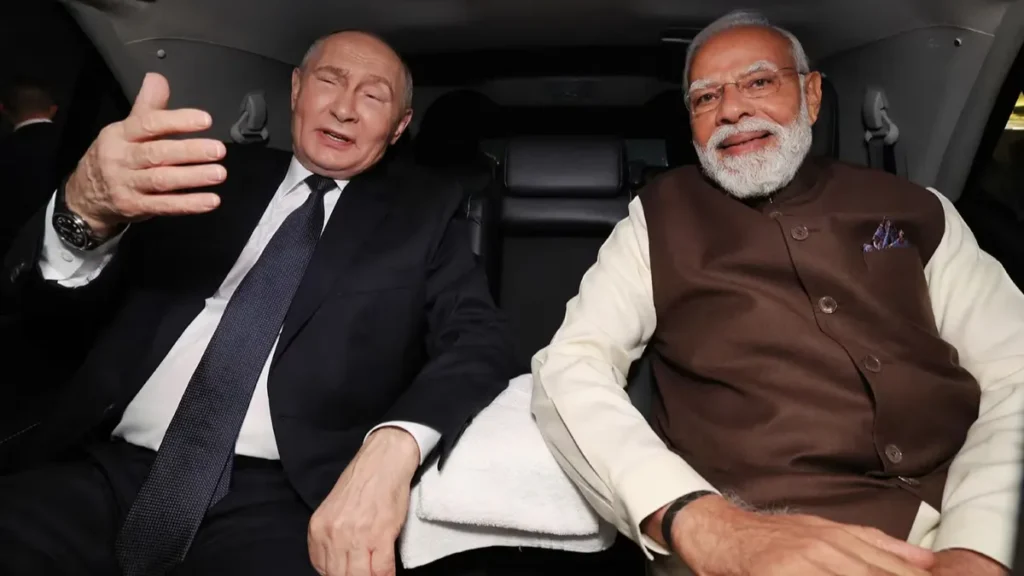
Modi-Putin’s Car Picture: The recent visit of Russian President Vladimir Putin to India continues to echo far beyond New Delhi-reaching the halls of the United States Congress. During a congressional hearing, an American lawmaker displayed Modi-Putin’s car picture in US Parliament, using the viral photograph to sharply critique former President Donald Trump’s foreign policy approach toward India.
The image, which shows Indian Prime Minister Narendra Modi and Russian President Vladimir Putin posing cheerfully during Putin’s high-profile trip to India, was described by U.S. Representative Sydney Kamlager-Dove as “a poster worth a thousand words.” Her comments came during a session of the House Foreign Affairs Subcommittee on South and Central Asia, where lawmakers were evaluating the future of U.S.–India strategic relations.
#WATCH | US representative Sydney Kamlager-Dove says, "When Trump took office at the beginning of this year, the Biden administration handed him a bilateral relationship at the height of its strength… These were hard-earned accomplishments and the product of strategic… pic.twitter.com/GcVUTKvIq4
— ANI (@ANI) December 10, 2025
Lawmaker Uses Viral Modi-Putin Photo to Question US Approach to India
Pointing toward the enlarged copy of the now-famous photograph-widely shared on social media during Putin’s India visit-Rep. Kamlager-Dove argued that the image symbolizes what she sees as the breakdown of American diplomacy during the Trump administration.
“This poster speaks a thousand words,” she said, emphasizing that it reflects how U.S. pressure tactics inadvertently pushed India closer to Russia. According to her, the picture carried a deeper diplomatic message, one that underlined America’s own strategic missteps.
Kamlager-Dove stated that Trump’s foreign policy framework was built on coercion rather than cooperation. “The policies toward India under the Trump administration were self-damaging. Trying to strong-arm a partner always proves costly-and this image is the clearest evidence of that,” she remarked.
The congresswoman warned that an overly forceful approach from Washington pushed New Delhi further toward Moscow, thereby weakening the U.S.’s long-term strategic positioning in Asia.
Sharp Criticism of Trump’s Claims on Peace Efforts
Rep. Kamlager-Dove did not limit her criticism to diplomatic tactics alone. She also took aim at Donald Trump’s repeated assertions that he was responsible for preventing several global conflicts, including tensions between India and Pakistan. The former president has often said he deserved the Nobel Peace Prize for “stopping eight wars.”
The Democratic lawmaker dismissed the claim, suggesting that a country cannot claim to be a champion of peace while simultaneously alienating its most valuable strategic partners.
“When a nation pushes its most important allies toward its adversaries, it cannot call itself a contender for the Nobel Peace Prize,” she said. Her remarks drew attention in the hearing, highlighting growing concerns within Washington about how the previous administration handled its India policy.
Urgent Call to Repair Washington’s Relationship With New Delhi
In her testimony, Rep. Kamlager-Dove emphasized that the United States must move quickly to repair the damage done to the U.S.–India relationship. She argued that restoring trust with New Delhi is not only beneficial but essential for American economic strength, national security, and global influence.
“The United States must act swiftly to reverse the strategic losses caused under the Trump administration,” she urged. “The trust and collaboration between our two countries are critical for America’s prosperity, our security architecture, and our leadership role in the world.”
She stressed the need for a comprehensive diplomatic reset, one that strengthens cooperation in defense, technology, energy, and trade. According to her, rekindling a sense of strategic confidence between Washington and New Delhi is indispensable in a rapidly shifting geopolitical landscape.
The Hearing: A Focus on Safeguarding a Free and Open Indo-Pacific
The lawmaker’s remarks came during a key congressional hearing titled “U.S.-India Strategic Partnership: Advancing a Free and Open Indo-Pacific.” The hearing examined India’s role as a vital partner for the United States, especially as geopolitical rivalries intensify across the Indo-Pacific region.
Several experts and congressional members reiterated that India is central to American efforts aimed at countering coercive influence from authoritarian nations and ensuring the Indo-Pacific remains open, secure, and stable.
But Rep. Kamlager-Dove stood out with her dramatic use of Modi-Putin’s car picture in US Parliament, turning the photograph into a symbolic representation of what she described as past diplomatic failures.
Why the Modi-Putin Image Has Sparked Global Debate
Putin’s recent India visit has triggered strong reactions internationally, particularly as it occurred during a tense phase in global geopolitics. The cheerful pictures of Modi and Putin sitting together in a moving car-images that were circulated worldwide-quickly became iconic.
For many analysts, the picture signaled India’s insistence on maintaining an independent foreign policy that balances relations with major powers, including Russia and the United States. For critics in Washington, however, the image highlighted a widening gap in diplomatic engagement between New Delhi and the U.S. over the past few years.
As the U.S. seeks to rebuild partnerships in Asia, the symbolism of the picture has taken on greater political significance.
Looking Ahead: Restoring Stability in the U.S.–India Partnership
Kamlager-Dove’s remarks in Congress underscore a growing sentiment that Washington must adopt a more respectful, partner-oriented approach toward India. With global challenges-from security to energy to emerging technologies-demanding closer collaboration, both nations are expected to prioritize rebuilding trust.
Analysts believe that the renewed attention on Modi-Putin’s car picture in US Parliament reflects a deeper push within U.S. foreign policy circles to correct past mistakes and strengthen ties with India in meaningful, long-term ways.
As the world’s two largest democracies navigate an increasingly complex global order, the success of their partnership will depend on mutual respect, strategic alignment, and consistent diplomatic engagement.