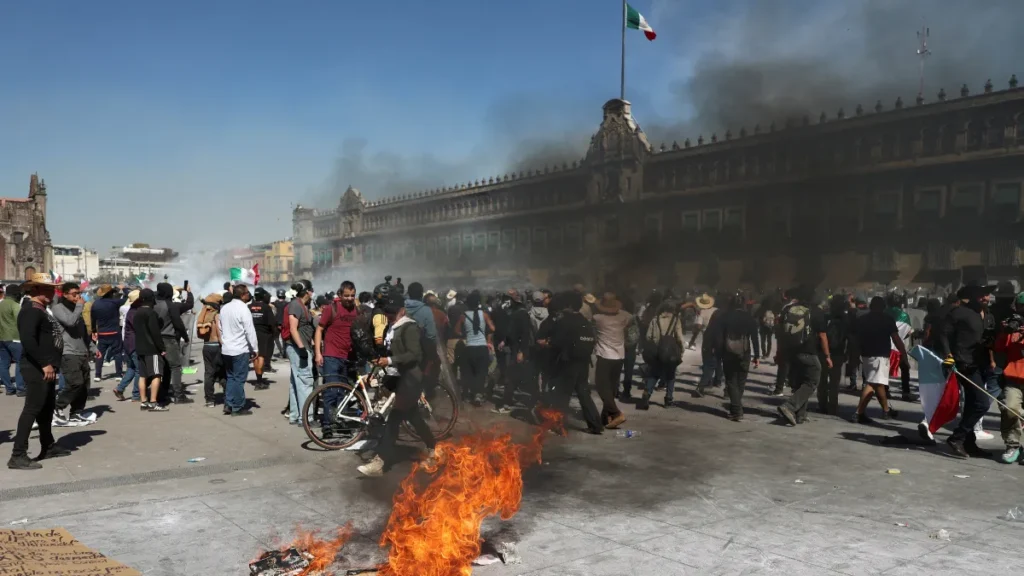
Mexico City — Mexico witnessed one of the largest youth-led demonstrations in recent years as thousands of Mexico Gen Z protesters flooded the streets on Saturday, voicing intense frustration over rising crime, deep-rooted corruption, unchecked violence, and what they describe as a state of “total impunity.”
The protest escalated dramatically when young demonstrators broke down security barricades protecting the National Palace — the official residence of Mexico’s president. Clashes soon erupted between police and demonstrators, leaving 120 people injured, including 100 police officers, according to Mexico City’s Secretary of Public Security, Pablo Vázquez. Authorities also confirmed at least 20 arrests.
The crowd, dominated by Mexico Gen Z youths but supported by citizens of all age groups, used stones, wooden sticks, chains, hammers, and fireworks to push back police lines. In response, riot-control units deployed tear gas, turning the central historic district into a chaotic battleground.
Youth Outrage Reaches Breaking Point
The Mexico Gen Z uprising is part of a wider global wave of youth movements protesting issues such as political corruption, deteriorating democratic values, violent crime, and collapsing public services. From Nepal to Latin America, Gen Z activism has surged, with young people increasingly unwilling to stay silent.
Many participants described life in present-day Mexico as “unsafe, unjust, and unbearable.”
“We need real security,” said 29-year-old business consultant Andrés Massa, who joined the march with friends.
“We are tired of impunity. Crimes happen every day and nobody is held accountable.”
Mexico has struggled with high rates of homicides, kidnappings, cartel-related violence, and widespread corruption across multiple levels of government. For Gen Z, who grew up witnessing this instability, the protest represents a demand for radical change — not incremental reforms.
Public Health Crisis Also Fuels Anger
While security and corruption remain the top concerns, protesters also demanded more funding for Mexico’s public healthcare system, which many describe as severely under-resourced.
“Doctors are unsafe too,” said 43-year-old physician Erisbeth García, who marched alongside Gen Z demonstrators.
“People die every day and nothing changes. We need a healthcare system that protects patients and medical staff alike.”
Her statement reflects a growing sentiment that Mexico’s health infrastructure has weakened significantly, especially after the pandemic. Many hospitals lack adequate medical supplies, equipment, or staff — problems that disproportionately affect young families and vulnerable communities.
Political Tension Intensifies as President Blames Opposition
The protests erupted shortly after a series of high-profile murders shook the nation, raising questions about the government’s ability to maintain law and order. Facing increasing public anger, President Claudia Sheinbaum claimed that opposition groups were “infiltrating” the protest movement and using social media manipulation to exaggerate its scale.
Her accusations sparked major controversy.
Just days earlier, several Mexico Gen Z social media influencers — who initially supported the protests — withdrew their backing, saying the movement risked being “politicized.”
Meanwhile, prominent public figures such as former President Vicente Fox and billionaire businessman Ricardo Salinas Pliego openly endorsed the demonstrations on social platforms.
The conflicting political messages have created deep divisions, with many young people insisting the movement is independent, organic, and citizen-led, not a tool for political rivals.
Why Mexico Gen Z Chose “Luffy” From One Piece as Their Symbol
An unexpected cultural twist has become central to this protest movement: demonstrators have adopted “Luffy,” the iconic character from the Japanese manga and anime series One Piece, as their symbol of resistance. Protesters wore hats with skull emblems, a trademark associated with Luffy’s pirate crew.
For Mexico Gen Z, the symbolism is powerful.
“Luffy frees people from corrupt rulers. That’s exactly how we feel here,” said student leader Leonardo Muñoz.
“We won’t stay silent anymore.”
Another student, Santiago Zapata, explained the emotional connection:
“We are done accepting death and corruption as normal. Our generation is not afraid to stand up. The government should fear its people, not the other way around.”
The One Piece reference has spread rapidly online, becoming a unifying image for young activists. The show’s themes — justice, freedom, courage, and rebellion against oppressive systems — resonate deeply with the mood of the movement.
A Nation at a Turning Point
The Mexico Gen Z protests reflect a broader crisis facing the country:
- Rising violent crime rates
- Perceived failure of government institutions
- Worsening economic inequality
- Longstanding political corruption
- Deteriorating public healthcare and education
- Youth feeling ignored and unprotected
Experts warn that the scale and intensity of the protests signal a growing disconnect between Mexico’s youth and its political leadership. Many analysts believe Mexico has reached a critical juncture where ignoring youth frustrations could fuel even larger, more volatile demonstrations.
Why Gen Z Is Leading the Movement
Globally, Gen Z is often described as politically aware, digitally organized, and socially fearless. In Mexico:
- They grew up during years of cartel violence.
- They witnessed widespread corruption scandals.
- They saw families, friends, and local communities suffer from crime.
- They learned to use social media as a mobilization tool.
Unlike previous generations, Mexico Gen Z is not willing to tolerate silence or conformity.
Many young people believe the government has repeatedly failed them, leaving them no choice but to take to the streets. Analysts suggest this generation could reshape the future of Mexican politics, becoming a major force in demand for transparency, accountability, and institutional reform.
International Reaction and Growing Global Support
Images and videos from the demonstrations quickly circulated on social media platforms across the world. Youth groups in the United States, Europe, and Asia expressed solidarity with the Mexico Gen Z movement, drawing parallels with their own struggles against inequality and governance failures.
Human rights organizations also raised concerns about the level of police violence captured in footage from Mexico City. Several international watchdogs urged the government to ensure peaceful protest rights are protected and that excessive police force is not used.
Also read: New York Film Festival Called Off Amid Claims of Pressure on Filmmakers From Chinese Authorities
What Comes Next for the Mexico Gen Z Movement?
The movement has no single leader, making it difficult for authorities to negotiate with a unified voice. Instead, it operates through decentralized networks of students, activists, young professionals, and community groups.
Experts say three possible outcomes could emerge:
1. Escalation of Protests
If government responses are viewed as dismissive or repressive, demonstrations could grow nationwide, becoming Mexico’s largest youth movement in decades.
2. Political Pressure for Reform
Sustained protests may force lawmakers to take action on key demands such as security reform, anti-corruption enforcement, and healthcare investment.
3. Attempts to Undermine or Discredit the Movement
Political actors may continue to accuse opponents or foreign groups of manipulating the protests, potentially weakening public momentum.
For now, one thing is certain: the Mexico Gen Z movement has fundamentally changed the national conversation.
Also read: Trump and BBC: Former President Rejects BBC Apology, Announces Plan for Major Lawsuit
A New Generation Determined to Change Mexico
Saturday’s mass protests were not just a fleeting expression of anger — they were a declaration of identity and purpose by Mexico’s emerging generation. With symbols of rebellion, voices filled with determination, and a clear demand for justice, Mexico Gen Z has signaled that they are ready to hold their leaders accountable.
In the heart of Mexico City, where tear gas mixed with defiant chants, a new message echoed loud and clear:
“We will no longer remain silent.”
The youth of Mexico have stepped into the political spotlight — and they do not plan to step back.