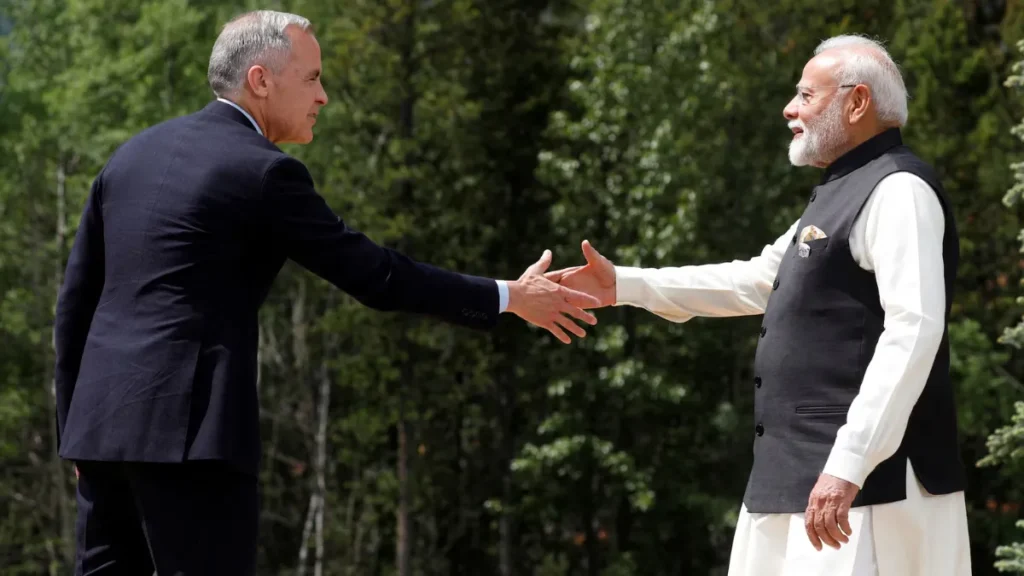
Canadian Prime Minister mark carney has arrived in India for a significant four-day official visit aimed at rebuilding diplomatic trust and deepening economic cooperation between the two nations. The trip marks a pivotal moment in India–Canada relations, which only a year ago were strained by serious political allegations and diplomatic expulsions.
Now, with a renewed focus on trade, clean energy, technology, and security cooperation, mark carney’s visit signals a deliberate effort to reset relations and position both countries as long-term strategic partners in a rapidly shifting global economy.
This is mark carney’s first official visit to India since assuming office as Canada’s Prime Minister in March 2025, following the tenure of Justin Trudeau. The visit is being closely watched in New Delhi, Ottawa, London, and Washington, as it could redefine the economic and geopolitical alignment between two major democracies.
A Strategic Visit with Economic Priorities at Its Core
The primary objective of mark carney’s India visit is to strengthen cooperation in key sectors including:
- Trade and investment
- Clean energy and energy transition
- Critical minerals
- Advanced manufacturing
- Artificial intelligence
- Infrastructure development
- National security
Carney is scheduled to meet Indian Prime Minister Narendra Modi in New Delhi on March 2 for high-level bilateral discussions. Talks are expected to focus heavily on restarting negotiations on the long-pending Comprehensive Economic Partnership Agreement (CEPA), a proposed free trade agreement that had stalled during the previous diplomatic tensions.
Before heading to New Delhi, mark carney will engage with business leaders in Mumbai, India’s financial capital, where discussions will center on expanding Canadian investment in India’s infrastructure, logistics, clean energy, and emerging technology sectors.
Canadian Official Signals Diplomatic De-escalation
Ahead of the visit, senior Canadian officials appeared to soften earlier accusations made against India. According to reports by CTV News, a high-ranking Canadian official stated that if Canada genuinely believed India was interfering in its democratic processes, the Prime Minister would not be undertaking this diplomatic trip.
This marks a notable shift in tone compared to 2023 and 2024, when relations between the two countries were at their lowest point in decades.
Comprehensive Economic Partnership Agreement (CEPA): A Central Agenda
One of the most important outcomes expected from mark carney’s visit is the formal relaunch of CEPA negotiations.
The proposed CEPA agreement would cover:
- Textiles and manufacturing
- Agriculture and agri-food exports
- Services and digital commerce
- Investment protections
- Intellectual property frameworks
Both governments are reportedly targeting completion of the agreement within the next 12 months. If finalized, bilateral trade could potentially expand to between $50 billion and $70 billion annually by 2030.
Current annual trade between India and Canada exceeds $21 billion, according to official Canadian government figures. However, both countries believe the potential is far greater.
Canada Seeks to Reduce Economic Dependence on the United States
Mark carney’s broader international tour, which includes stops in Australia and Japan after India, reflects Canada’s strategic goal of reducing its economic reliance on the United States.
Canada’s economy remains deeply integrated with the US market. However, Ottawa is increasingly seeking diversified trade partnerships across the Indo-Pacific region. India, currently one of the world’s fastest-growing major economies, presents a significant opportunity.
By strengthening economic ties with India, mark carney aims to open new trade corridors and reduce vulnerability to North American economic fluctuations.
Canadian Investment in India: A Growing Footprint
India has emerged as a major destination for Canadian capital.
- Over 600 Canadian companies are currently operating in India.
- Canadian pension funds have invested more than $100 billion in Indian sectors such as real estate, logistics, renewable energy, and infrastructure.
- Key Indian exports to Canada include pharmaceuticals, gems and jewellery, marine products, and textiles.
Canada now seeks to expand this investment footprint, particularly in clean energy and advanced technologies.
Mark carney has emphasized that despite past political disagreements, Canada views India as a reliable long-term economic partner.
Clean Energy and Critical Minerals Cooperation
Energy cooperation is expected to be one of the most critical components of the visit.
Uranium Supply Deal
Reports suggest that discussions may lead to a long-term uranium supply agreement worth approximately CAD 2.8 billion over a ten-year period. This would support India’s growing nuclear energy program and civil nuclear infrastructure.
Canada is one of the world’s leading uranium producers, while India is expanding its nuclear capacity as part of its low-carbon energy transition strategy.
LNG and Crude Oil
India is also exploring increased imports of:
- Heavy crude oil
- Liquefied Natural Gas (LNG)
- Other energy products
For Canada, diversifying its energy export destinations beyond the United States is a strategic priority.
In 2024, India accounted for approximately $761.5 million of Canada’s total energy exports, while Canada imported around $206 million worth of energy-related products from India. Both sides aim to significantly increase these numbers.
Critical Minerals
The global race for critical minerals—essential for electric vehicles, batteries, and renewable energy systems—has intensified. Canada’s vast natural resource base and India’s manufacturing ambitions create a mutually beneficial opportunity.
National Security and Law Enforcement Cooperation
Security ties are also expected to strengthen.
National security advisers from both countries have already engaged in high-level discussions to:
- Appoint diplomatic and law enforcement liaison officers
- Enhance counterterrorism cooperation
- Improve intelligence-sharing mechanisms
These efforts come after a year of diplomatic turbulence that deeply strained trust between Ottawa and New Delhi.
Technology, Education and Research Partnerships
Beyond trade and energy, mark carney’s visit could also pave the way for collaboration in:
- Artificial Intelligence
- Quantum computing
- Academic research exchanges
- Higher education partnerships
- Cultural cooperation
With India emerging as a global tech powerhouse and Canada maintaining strong research institutions, joint innovation initiatives could become a cornerstone of bilateral relations.
Diplomatic Tensions: The 2023–2024 Crisis
Relations between India and Canada deteriorated sharply in 2023 when then Prime Minister Justin Trudeau alleged that Indian agents may have been involved in the killing of Khalistani separatist Hardeep Singh Nijjar in Canada.
Trudeau described the alleged involvement as an attack on Canadian sovereignty and requested India’s cooperation in the investigation.
India strongly denied the allegations, calling them baseless and politically motivated. New Delhi countered that extremist elements advocating Khalistan were operating openly in Canada without adequate action from Canadian authorities.
The fallout included:
- Expulsion of diplomats on both sides
- Suspension of visa services
- Cancellation of trade missions
- Issuance of travel advisories
- Freezing of CEPA negotiations
Diplomatic dialogue nearly came to a halt.
However, since mark carney assumed office in March 2025, both governments have taken steps to rebuild communication channels and restore stability.
Immigration and Demographic Realities in Canada
Canada is one of the world’s most immigrant-friendly nations.
According to Statistics Canada, approximately 8.3 million people—about 23% of the country’s population—were born outside Canada, based on the 2021 census.
Immigration has played a vital role in Canada’s economic growth, labour market expansion, and demographic sustainability. However, it has also sparked domestic debates over housing, employment, and social integration.
The Indian diaspora represents one of the largest immigrant communities in Canada, with approximately 1.6 million people of Indian origin residing in the country. Around 300,000 residents are of Pakistani origin.
These diaspora communities add both opportunity and political complexity to bilateral relations.
Deportations and Immigration Enforcement in 2025
In the first ten months of 2025, Canada deported 2,831 Indian nationals, according to data from the Canada Border Services Agency.
Overall, Canada removed 18,785 individuals during that period. Mexican nationals accounted for the highest number of deportations at 3,972.
Currently, 29,542 individuals are undergoing deportation proceedings, including 6,515 Indian nationals.
Canadian authorities stated that deportations were carried out primarily in cases involving criminal charges or failure to comply with refugee and immigration regulations.
While immigration enforcement remains a sensitive topic, mark carney’s government has emphasized that such actions are based on legal compliance rather than nationality.
Also read: UAE President in India: PM Modi Receives Sheikh Mohammed Bin Zayed with Warmth and Historic Gifts
A Diplomatic Reset with Global Implications
India’s High Commissioner to Canada, Dinesh Patnaik, recently stated in Ottawa that mark carney’s visit represents a complete diplomatic reset and could unlock substantial trade and strategic opportunities.
The broader context of this visit includes:
- Geopolitical realignments in the Indo-Pacific
- Energy security concerns amid global volatility
- Supply chain diversification
- Climate transition goals
- Democratic cooperation in an increasingly polarized world
Both India and Canada are members of the G20 and share commitments to democratic governance, economic openness, and multilateral engagement.
What Comes Next?
If CEPA negotiations formally restart and energy agreements are finalized, mark carney’s visit could become a turning point in India–Canada relations.
The stakes are high:
- Canada wants diversified markets beyond the United States.
- India seeks reliable energy partners and greater foreign investment.
- Both nations aim to strengthen democratic alliances amid global uncertainty.
Diplomatic experts say that rebuilding trust after last year’s tensions will take time. However, this visit signals political will at the highest level.
As mark carney meets Narendra Modi in New Delhi, the world will be watching whether two democracies that recently faced serious friction can successfully chart a new, forward-looking partnership.
If the outcomes match the ambitions outlined during this visit, the India–Canada relationship may enter its most economically dynamic phase yet.