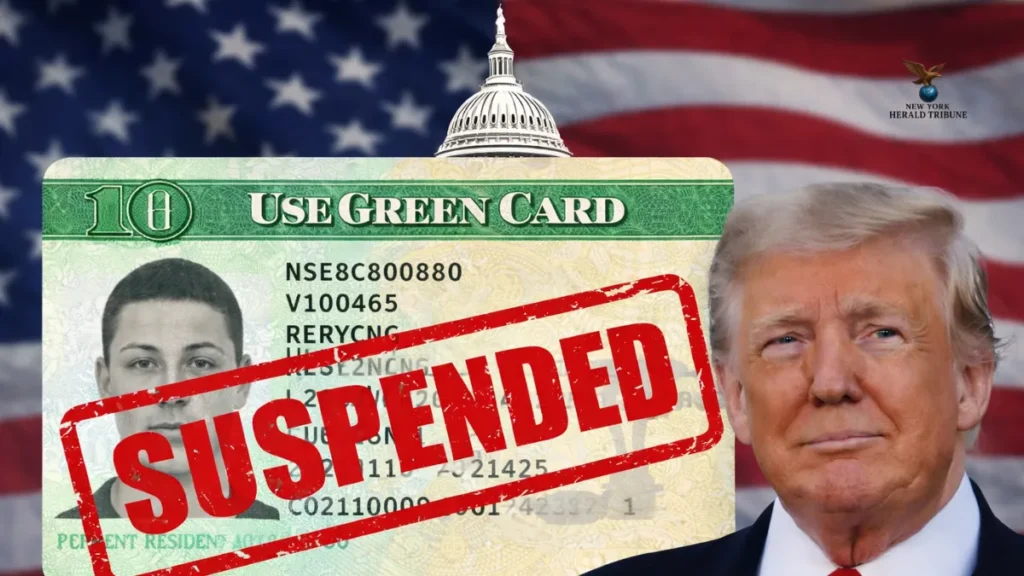
Green Card Lottery Suspended: The United States government has suspended the Green Card Lottery, officially known as the Diversity Visa (DV-1) Program, following two deadly shooting incidents linked to universities. The decision, announced on Friday, has sent shockwaves across immigrant communities worldwide and is expected to affect nearly 50,000 prospective immigrants who rely on the program each year to legally settle in the US.
The move comes in the aftermath of a fatal shooting at Brown University in Rhode Island on December 14, followed by the killing of a professor associated with the Massachusetts Institute of Technology (MIT) a day later. US officials say the suspension is aimed at strengthening national security and preventing future acts of violence.
Why the Green Card Lottery Was Suspended
According to the Department of Homeland Security, the Green card lottery suspended decision was taken under direct instructions from President Donald Trump. Homeland Security Secretary Christie Noem stated that the administration does not want “even a single American” to be harmed due to shortcomings in immigration screening processes.
“This step is being taken in the interest of public safety,” Noem said, adding that the president has long expressed concerns about the Diversity Visa system. She also recalled that President Trump had previously attempted to terminate the program after the 2017 truck attack in New York City, which killed eight people.
US authorities believe the recent university shootings have reignited concerns about individuals entering the country through lottery-based immigration without extensive vetting.
What Is the Green Card Lottery Program?
The Green Card Lottery, or Diversity Visa (DV-1) Program, was launched in 1990 to promote immigration from countries that historically have had low migration rates to the United States. Each year, the program allows individuals from eligible countries to apply for permanent residency through a random selection process.
Approximately 50,000 green cards are granted annually under the program. Applicants must meet basic education or work experience requirements, and winners are later subjected to background checks and interviews before final approval.
For the 2025 cycle alone, an estimated 20 million people worldwide applied for the lottery. Including selected applicants’ spouses and dependent children, the initial selection list included over 131,000 individuals, from which around 50,000 are eventually approved after screening.
Who Will Be Affected by the Suspension?
The suspension is expected to hit applicants from Africa, parts of Europe, and certain Asian and Latin American nations the hardest. However, Indian citizens will not be affected, as India is not eligible for the Diversity Visa Program.
Countries such as India, China, Canada, and the United Kingdom are excluded from the lottery because they already send large numbers of immigrants to the US through family-sponsored, employment-based, or other visa categories.
For many applicants from underrepresented nations, the DV-1 program has been one of the few legal pathways to permanent residency in the United States. Immigration experts warn that suspending the program could leave thousands of families in uncertainty.
Trump’s Longstanding Opposition to the DV-1 Program
President Donald Trump has consistently criticized the Diversity Visa Program, arguing that it poses security risks. He has claimed that selecting immigrants through a lottery system does not adequately prioritize skills, merit, or safety.
In past statements, Trump suggested replacing the DV program with a merit-based immigration system. His administration has repeatedly tightened immigration policies, particularly following violent incidents involving foreign nationals.
In November, a deadly attack on National Guard members raised further alarm when an Afghan national was found in possession of a firearm. Following that incident, the administration imposed stricter immigration checks on individuals arriving from Afghanistan and several other countries.
Details of the Brown University Shooting
The December 14 shooting at Brown University in Providence, Rhode Island, was one of the deadliest campus incidents in recent years. Two students were killed, and nine others were injured when gunfire erupted on campus.
The victims were identified as Ella Cook, 19, and Muhammad Aziz Umurzhokov, 18. Police named 48-year-old Claudio Neves Valente as the primary suspect. Investigators revealed that Valente entered the United States through the Diversity Visa Lottery in 2017 and later obtained a green card.
Authorities believe Valente was also responsible for the December 15 shooting death of Nuno Loureiro, a Portuguese professor affiliated with MIT, who was killed at his home in Massachusetts.
Suspect Found Dead After Manhunt
Following the shootings, law enforcement agencies launched a six-day multi-state manhunt. Valente was eventually found dead inside a storage facility in New Hampshire. Police recovered two firearms and a bag from the scene.
Officials have not yet confirmed whether Valente died by suicide or under other circumstances. Investigations into his background and possible motives are ongoing.
Brown University President Cristina Paxson clarified that Valente had no active role at the institution at the time of the attack. She stated that he had briefly pursued a PhD in physics at Brown during the 2000–2001 academic year but had no current academic or professional affiliation with the university.
Growing Debate Over Immigration Policy
The Green card lottery suspended decision has reignited debate across the US and internationally. Supporters argue that the move is necessary to reassess security measures, while critics claim the program unfairly links immigration with violent crime.
Immigration advocates emphasize that millions of DV applicants undergo extensive vetting and that isolated incidents should not define an entire program. They warn that ending or freezing the lottery could reduce diversity and limit opportunities for skilled and hardworking individuals seeking a better future.
Legal experts note that while the program is suspended, its permanent termination would require congressional approval. For now, applicants are advised to closely monitor official announcements from the US State Department and the Department of Homeland Security.
What Happens Next?
It remains unclear how long the suspension will last or whether pending applications will be processed once the program resumes. Until further notice, new entries into the Diversity Visa Program are expected to remain on hold.
As the investigation into the university shootings continues, the future of the Green Card Lottery hangs in the balance—impacting thousands of hopeful immigrants around the world who see the US as a land of opportunity.