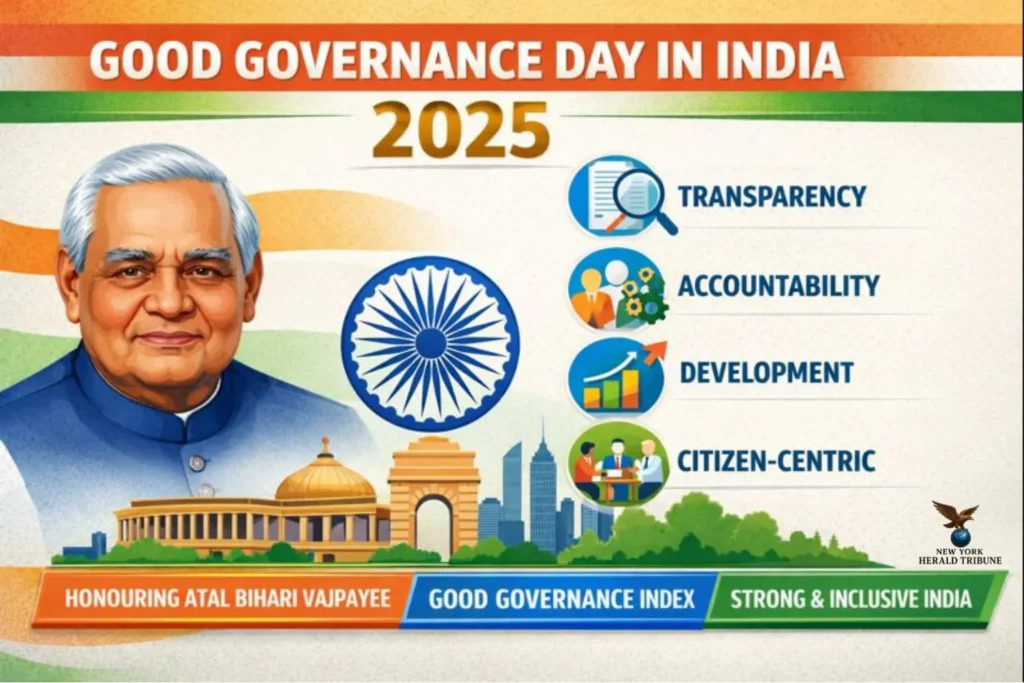
New Delhi, December 25, 2025India today observes Good Governance Day in India, a nationally significant occasion that highlights the country’s ongoing commitment to transparent, accountable, and citizen-focused administration. Marked every year on 25 December, the day coincides with the birth anniversary of former Prime Minister Atal Bihari Vajpayee, whose leadership left an enduring imprint on India’s democratic institutions and governance philosophy.
As India advances through complex economic, social, and technological transitions, Good Governance Day in India 2025 carries renewed importance. It is not merely a symbolic observance but a reminder of how governance shapes everyday life-from public service delivery and welfare schemes to economic growth and democratic accountability.
What Is Good Governance Day in India?
Good Governance Day in India is an annual observance dedicated to promoting the principles of effective governance across the country. These principles include accountability, transparency, efficiency, responsiveness, inclusivity, and participation of citizens in decision-making processes.
The Government of India instituted this observance to strengthen awareness about governance reforms and to encourage public institutions at every level-central, state, and local-to improve service delivery outcomes. Over the years, Good Governance Day has evolved into a platform for reviewing administrative performance, sharing best practices, and reaffirming the idea that governance must serve people, not procedures.
In 2025, the observance continues to focus on bridging gaps between policy formulation and grassroots implementation, especially in rural and underserved regions.
Why Is Good Governance Day Celebrated on 25 December?
The choice of 25 December is deeply symbolic. The date marks the birth anniversary of Atal Bihari Vajpayee, one of India’s most respected statesmen and a three-time Prime Minister. Vajpayee’s leadership was defined by moderation, consensus-building, and an unwavering belief in democratic values.
By observing Good Governance Day on his birthday, India honours his vision of governance that balances development with compassion, and growth with social justice. His belief that governance must be ethical, inclusive, and people-oriented remains central to the philosophy behind this national observance.
Good Governance Day in India 2025: Objectives and Purpose
The primary objective of Good Governance Day in India 2025 is to remind both administrators and citizens that governance is not limited to bureaucratic routines or paperwork. Instead, it is about improving the quality of life through efficient policies, transparent systems, and participatory governance.
Key objectives include:
- Reinforcing accountability and transparency in public institutions
- Promoting citizen-centric service delivery
- Encouraging participatory decision-making
- Improving administrative efficiency
- Strengthening trust between citizens and the state
Across India, ministries, state governments, district administrations, and public sector bodies mark the occasion through awareness campaigns, public outreach programmes, grievance redressal drives, workshops, and policy review meetings. These initiatives often extend beyond urban centres, reaching villages and remote areas to ensure that governance reforms are inclusive.
Atal Bihari Vajpayee: The Statesman Behind the Vision
The observance of Good Governance Day in India is inseparable from the legacy of Atal Bihari Vajpayee, whose approach to leadership continues to influence India’s governance framework.
Vajpayee’s Governance Philosophy
During his tenure as Prime Minister, Vajpayee emphasised:
- Ethical leadership and integrity in public life
- Strengthening democratic institutions
- Cooperative federalism, where states and the Centre worked collaboratively
- Consensus-based decision-making
- Inclusive development that balanced economic reforms with social welfare
Under his leadership, India witnessed major infrastructure initiatives, improved diplomatic relations, and a renewed focus on governance reforms. Vajpayee believed that economic growth must go hand in hand with social equity, and that governance should empower the weakest sections of society.
Good Governance Day in India serves as a tribute to this belief-that governance must be humane, responsive, and rooted in democratic values.
Governance Beyond Administration: A Citizen-Centric Approach
One of the defining ideas behind Good Governance Day in India is the shift from procedure-driven administration to citizen-centric governance. This approach recognises citizens not as passive recipients of services, but as active stakeholders in governance.
Citizen-centric governance focuses on:
- Timely delivery of public services
- Transparency in decision-making
- Easy access to information
- Responsive grievance redressal mechanisms
- Use of technology to reduce delays and corruption
Over the past decade, India has made significant progress in this direction through digital governance platforms, direct benefit transfers, and streamlined public service systems.
The Good Governance Index (GGI): Measuring Governance Performance
A major institutional development linked to Good Governance Day in India is the Good Governance Index (GGI).
Introduction of the Good Governance Index
The Government of India introduced the Good Governance Index on 25 December 2019, reinforcing the significance of the day. The index was developed by the Department of Administrative Reforms and Public Grievances (DARPG) under the Ministry of Personnel, Public Grievances and Pensions.
The GGI was designed as a comprehensive tool to assess governance performance across States and Union Territories, using objective and data-driven indicators.
Purpose of the Good Governance Index
The Good Governance Index serves several critical purposes:
- Measuring governance performance at the state and UT level
- Enabling evidence-based policymaking
- Identifying strengths and gaps in governance systems
- Encouraging healthy competition among states
- Promoting cooperative federalism
- Benchmarking best practices in governance
By translating policy goals into measurable outcomes, the GGI helps governments focus on results that directly impact citizens.
Key Features of the Good Governance Index
The Good Governance Index is not a narrow administrative ranking. Instead, it is a composite and diagnostic framework that evaluates governance across multiple sectors.
Key features include:
- Multi-sectoral assessment of governance
- Use of quantitative and qualitative indicators
- Focus on outcomes rather than intentions
- Data-driven evaluation methods
- Comparative analysis across states and UTs
This approach allows policymakers to identify specific areas requiring reform, rather than relying on broad generalisations.
Ten Key Sectors Covered Under the Good Governance Index
The Good Governance Index evaluates governance performance across ten critical sectors, each representing a vital dimension of public administration and service delivery:
- Agriculture and Allied Sectors
Focuses on agricultural productivity, farmer welfare, irrigation, and allied activities such as fisheries and livestock. - Economic Governance
Assesses fiscal management, investment climate, and economic policy effectiveness. - Human Resource Development
Covers education, skill development, and employment-related indicators. - Environment
Evaluates environmental sustainability, conservation efforts, and climate resilience. - Public Health
Measures healthcare access, infrastructure, and health outcomes. - Social Welfare and Development
Focuses on welfare schemes, poverty alleviation, and social inclusion. - Judiciary and Public Safety
Assesses law and order, access to justice, and public safety mechanisms. - Commerce and Industry
Examines industrial growth, ease of doing business, and entrepreneurship support. - Public Infrastructure and Utilities
Covers roads, transport, power, water supply, and urban infrastructure. - Citizen-Centric Governance
Evaluates service delivery efficiency, grievance redressal, and public participation.
Together, these sectors provide a holistic picture of governance quality across India.
Good Governance from a United Nations Perspective
Globally, the concept of good governance is strongly endorsed by the United Nations. According to the UN, good governance is characterised by:
- Participation
- Consensus orientation
- Accountability
- Transparency
- Responsiveness
- Effectiveness and efficiency
- Equity and inclusiveness
- Adherence to the rule of law
These principles closely align with India’s constitutional values and democratic framework. Good Governance Day in India reinforces the country’s commitment to these global standards while adapting them to local realities.
Why Good Governance Matters for India
Good governance is not an abstract ideal-it has direct and measurable impacts on national development.
Key Benefits of Good Governance
- Enhanced trust in public institutions
- Efficient implementation of welfare schemes
- Reduction in corruption and inefficiency
- Inclusive and sustainable economic growth
- Strengthening of democracy and rule of law
India’s progress in areas such as digital public infrastructure, financial inclusion, healthcare access, and social welfare reflects the outcomes of sustained governance reforms.
Good Governance Day and Civil Services Aspirants
For aspirants preparing for UPSC, APSC, and State Public Service Commission examinations, Good Governance Day in India holds special relevance.
It is a recurring topic in:
- General Studies (Polity and Governance)
- Ethics, Integrity, and Aptitude papers
- Essay writing
- Interview discussions
Understanding the principles behind Good Governance Day, the legacy of Atal Bihari Vajpayee, and the structure of the Good Governance Index provides aspirants with a strong conceptual foundation in public administration and ethical governance.
Governance Reforms and the Road Ahead
As India looks towards the future, governance challenges are becoming more complex. Urbanisation, climate change, technological disruption, and social inequality demand adaptive and innovative governance solutions.
Good Governance Day in India serves as a checkpoint—a moment to reflect on progress, identify gaps, and renew commitments. It encourages governments to move beyond compliance and focus on outcomes that genuinely improve citizens’ lives.
Read also: India New Zealand trade Enters a New Era as Landmark Free Trade Agreement Is Finalised
Conclusion: The Enduring Relevance of Good Governance Day in India
Good Governance Day in India 2025 stands as a powerful reminder that effective governance is the backbone of a strong and resilient democracy. By commemorating the legacy of Atal Bihari Vajpayee and institutionalising governance assessment through the Good Governance Index, India continues to strengthen its commitment to transparent, accountable, and people-first administration.
In an era where citizens increasingly demand efficiency, fairness, and responsiveness, good governance is no longer optional—it is essential. As India continues its journey toward inclusive growth and global leadership, the principles celebrated on Good Governance Day will remain central to shaping a just, equitable, and prosperous nation.