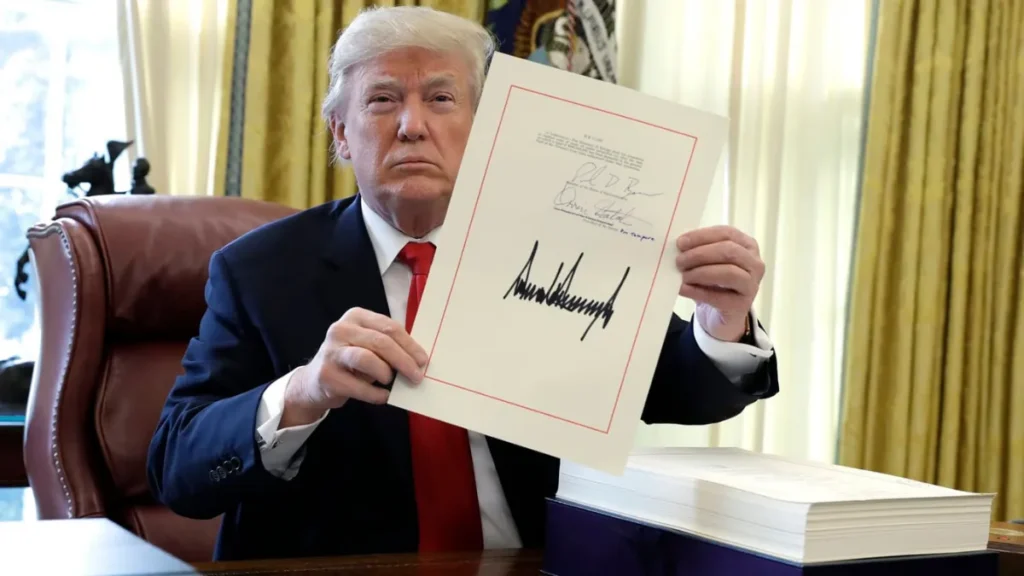
Did Trump Sign the Bill: In a major political development that has reignited national debate, US President Donald Trump has officially signed a bill requiring the Justice Department to release long-sealed files related to financier and convicted sex offender Jeffrey Epstein. The move, which rapidly dominated US political discourse, was framed by Trump as a crucial step toward transparency-while simultaneously being used as a political weapon against leading Democrats.
The question resonating across global search platforms –“Did Trump sign the bill?”– is now definitively answered: Yes, Trump has signed it, but the implications extend far beyond a simple confirmation. The decision has thrust the controversial Epstein saga back into the center of American politics, reopening sensitive discussions about political associations, accountability, and the credibility of ongoing investigations.
Trump’s Announcement: A Public Push for Transparency
President Trump unveiled the news through an extended post on Truth Social, presenting himself as the driving force behind the demand for public access to the Epstein documents. According to Trump, the release represents a victory for transparency and a win for his administration’s ongoing commitment to “uncovering the truth.”
In his statement, Trump claimed that Democrats had long attempted to hide their connections to Epstein. He wrote that Epstein was “a lifelong Democrat who contributed thousands of dollars to Democratic politicians” and maintained ties with several high-profile Democratic figures. The post specifically referenced former President Bill Clinton, ex-Treasury Secretary Larry Summers, and LinkedIn co-founder Reid Hoffman.
Trump declared, in characteristic all-caps emphasis, that the truth about these relationships would soon be brought to light.
“I HAVE JUST SIGNED THE BILL TO RELEASE THE EPSTEIN FILES!” he wrote, presenting himself as the sole figure enabling this public disclosure.
Political Theater and Strategic Timing
The bill’s signing came at a politically sensitive moment. The previous week, Florida Attorney General Pam Bondi, a long-time Trump ally, announced an investigation into Epstein’s reported associations with prominent Democrats. Trump seized the moment to align the bill with Bondi’s investigation, amplifying the political implications and turning the release into a campaign-style talking point.
This strategic alignment allowed Trump to frame the decision not just as a transparency initiative, but as a broader move against what he referred to as a “Democrat hoax.” According to Trump, Democrats had pushed for the disclosure of Epstein’s files as a distraction from his administration’s achievements—yet he claimed the files would ultimately expose more about Democrats than Republicans.
Blasting Democrats: Trump’s Counter-Attack
In another part of his Truth Social statement, Trump criticized the Biden administration for not releasing Epstein-related documents during its tenure. He accused Democrats of leveraging the Epstein case for political gain while simultaneously hiding their own vulnerabilities.
“The Biden Administration did not turn over a SINGLE file or page related to Democrat Epstein, nor did they ever even speak about him,” Trump claimed.
He argued that Democrats are more deeply entangled with Epstein than Republicans and suggested that pushing for the release of the files would backfire on them, as had other controversies he labeled as “hoaxes.”
“This latest Hoax will backfire on the Democrats just as all of the rest have!” Trump asserted.
The Justice Department’s Previous Findings
While Trump celebrated the bill as a transparency milestone, the Justice Department has previously stated that it “did not uncover evidence that could predicate an investigation against uncharged third parties.”
This stance has long frustrated members of Congress-on both sides-who have sought wider accountability related to Epstein’s network, including the individuals who may have been aware of or involved in his criminal activities.
These frustrations intensified recently when House Oversight Committee Republicans released more than 20,000 pages of documents from Epstein’s estate. Before that, Democratic lawmakers released emails from Epstein, some of which referenced Trump himself.
The simultaneous release of materials from both parties has fueled widespread online speculation and renewed public demand for clarity.
Trump’s Sudden Shift in Tone
Interestingly, Trump’s decision to support the bill came after a period of hesitation. Until recently, he resisted efforts to release the Epstein files, a stance that baffled some of his own supporters, especially those who believed he would expose Epstein-related secrets if returned to office.
However, on Sunday, Trump abruptly changed course. He urged House Republicans to approve the bill, adding, “We have nothing to hide.”
This shift was seen by many analysts as politically strategic, allowing Trump to regain momentum among voters who believed his administration had not been transparent about Epstein’s connections, including Epstein’s interactions with Trump prior to the financier’s 2008 conviction.
Long-Standing Ties and Public Scrutiny
The release of the Epstein files could shed new light on Epstein’s network, including his associations with Trump and other influential figures before his 2008 conviction for soliciting a minor for prostitution. Photos and social interactions between Trump and Epstein from the early 2000s have surfaced repeatedly over the years, creating tension within Trump’s MAGA base.
This community includes many voters who believe there has been a government-led cover-up of Epstein’s connections to powerful individuals across political, financial, and global elite circles.
The controversy intensified after Epstein’s 2019 death in a Manhattan jail-officially ruled a suicide-while awaiting trial on federal sex trafficking charges. Trump himself has often referenced conspiracy theories surrounding Epstein’s death, fueling public skepticism.
The MAGA Base and Rising Pressure
A significant segment of Trump supporters holds the belief that Epstein’s full network of associates has never been exposed and that government institutions have protected influential individuals—including politicians, billionaires, and celebrities—who may have been connected to Epstein’s criminal activities.
Trump’s public commitment to releasing the files appears to be partly driven by this pressure from his own base. The move allows him to reclaim the narrative and distance himself from allegations that his administration shielded the truth during his first term.
Why the Question “Did Trump Sign the Bill?” Went Viral
The keyword “Did Trump sign the bill” surged globally across search engines, particularly in the UK, US, Canada, Australia, and India. The worldwide curiosity reflects several factors:
- Growing global attention on political transparency
- Continued fascination with the Epstein case
- International concern over high-profile figures linked to Epstein
- The political implications for Democrats and Republicans
- Speculation surrounding Trump’s motivations
Trump’s signing of the bill has now answered the question definitively, but has generated a new wave of speculation and debate.
Also read: What Marjorie taylor greene trump Political Shift Reveals About Trump and the Future of MAGA
What Happens Next?
With the bill now signed, the Justice Department is legally required to release the Epstein files. However, the timeline, extent of redactions, and level of public access remain unclear.
Analysts anticipate the following outcomes:
- Renewed bipartisan scrutiny of federal investigations
- Potential political fallout for individuals named in the documents
- Increased public pressure for transparency regarding Epstein’s associates
- Fresh debates over the handling of Epstein’s death and earlier prosecutions
- Political weaponisation of the contents by both parties
Regardless of the ultimate findings, the release is expected to reshape public understanding of the Epstein case and intensify political battles ahead of the upcoming election cycle.
Conclusion: A Political Earthquake with Global Impact
The signing of the bill by President Trump has revived the long-dormant Epstein controversy and positioned it firmly at the center of American political discourse. The move is being celebrated by Trump supporters as a step toward exposing hidden truths, while critics accuse Trump of using the release as a political shield and distraction.
Yet one fact now remains clear: Trump has officially signed the bill, bringing renewed focus, heightened scrutiny, and global attention to one of the most explosive cases in recent US history.
The world will now watch closely as the Justice Department prepares to release documents that could redefine public understanding of the Epstein network and its connections to political and social elites.