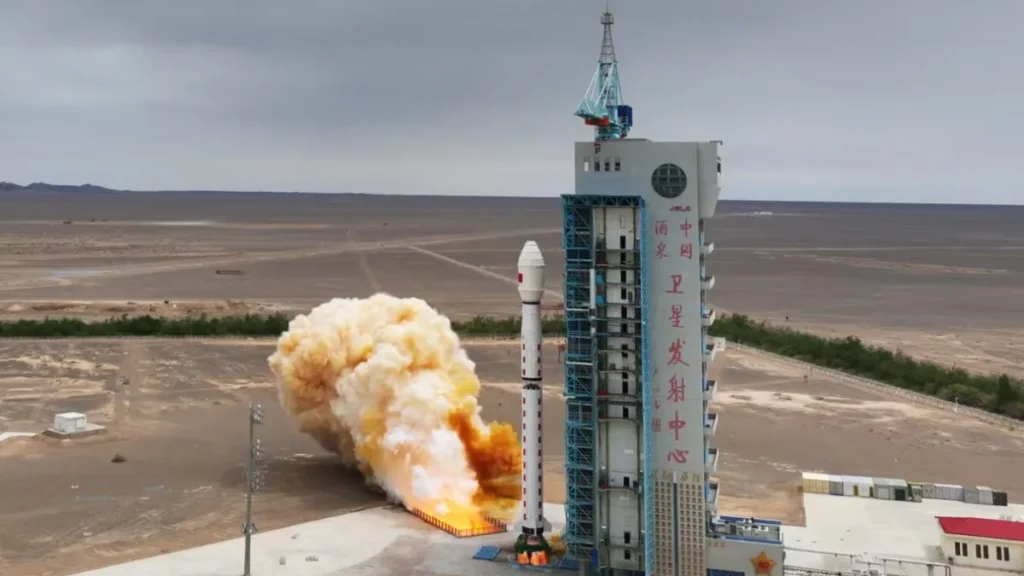
China has carried out a critical space operation by launching a replacement return vehicle to support its astronauts aboard the Tiangong Space Station. The Chinese spacecraft successfully launched on Tuesday marks the first emergency crew-support mission under China’s expanding human spaceflight program. The new spacecraft—Shenzhou-22—will serve as a safe return capsule for the three astronauts currently orbiting Earth, who are scheduled to come back next April.
Emergency Launch After Previous Return Vehicle Was Damaged
The latest mission became necessary after China’s earlier crew return spacecraft was struck by orbital debris. According to the China Manned Space Agency (CMSA), the damaged vehicle’s window suffered an impact that compromised its safety systems. The flaw was discovered shortly after the previous crew returned to Earth on 14 November using the same spacecraft.
The incident left the current crew of three astronauts without a secure escape option in case of emergency, prompting China to activate its first rapid-response replacement launch. Although space agencies routinely track debris in orbit, the growing population of space junk continues to pose serious risks. The event highlights the increasing challenges faced by nations operating long-term missions in low Earth orbit.
Shenzhou-22: A New Lifeline for the Orbiting Crew
In response to the damage, China proceeded with the emergency deployment of Shenzhou-22. The Chinese spacecraft successfully launched atop a Long March-2F Y22 rocket from the Jiuquan Satellite Launch Center in northwest China. The spacecraft separated from the rocket approximately ten minutes after lift-off, entered its designated orbit, and later achieved a successful docking with the Tiangong Space Station.
CMSA confirmed that the mission went exactly as planned and that all systems performed smoothly.
Shenzhou-22 is currently docked at the station and will remain attached until it is used to return the three astronauts to Earth in April next year. This ensures that the existing crew continues to operate with a fully functional and reliable escape and return vehicle—a crucial requirement for long-duration missions.
Supplies Delivered Alongside the Spacecraft
Although Shenzhou-22 is primarily a crew-return capsule, it also carried essential supplies. The mission delivered space food, fresh vegetables and fruits, and medical equipment to support the astronauts’ daily needs. In addition to these necessities, CMSA said the spacecraft transported repair tools and components required to fix the damaged window on the previous return vehicle, Shenzhou-20.
These materials will enable astronauts to conduct maintenance and possibly restore the original spacecraft in orbit. Once repaired, CMSA plans to send the damaged Shenzhou-20 back to Earth in an unmanned cargo-only configuration. The agency emphasized that no astronauts will travel aboard it during the return journey.
How the Damage Occurred
Orbital debris strikes are becoming increasingly common as thousands of satellites, rocket remnants, and tiny fragments circulate uncontrollably around Earth. The window of the Shenzhou-20 spacecraft was hit while docked to the Tiangong Space Station, rendering the vehicle unsafe for emergency use. For astronauts living and working in orbit, a functioning return ship is not optional—it is a mandatory safety asset.
China rotates the crew of its Tiangong Space Station every six months, a schedule similar to those used by the ISS partners. Without a safe return capsule readily available, the current crew technically had no evacuation option during a critical window of their mission.
Tiangong: China’s Answer to the International Space Station
China launched its own modular space station, Tiangong, after being excluded from participation in the International Space Station (ISS) program. The U.S. and several partner nations have long expressed concerns that China’s space program is closely linked to its military, leading to restrictions on collaboration.
As a result, China accelerated its independent human spaceflight development. Tiangong now serves as the centerpiece of China’s long-term presence in orbit, hosting rotating scientific teams, conducting microgravity experiments, and advancing the nation’s technological capabilities.
A Critical Milestone in China’s Spaceflight Capabilities
The Chinese spacecraft successfully launched in this mission represents more than a routine resupply or rotation. It demonstrates China’s increasing preparedness for unexpected complications in orbit. Emergency launch capabilities, rapid spacecraft deployment, and autonomous docking illustrate a level of operational maturity typically associated with the world’s most advanced space agencies.
This mission also underscores the growing importance of redundancy in human spaceflight. With increasing debris in low Earth orbit, space stations and spacecraft face elevated risks. The ability to swiftly replace damaged equipment is essential for keeping astronauts safe and maintaining uninterrupted scientific activity.
What Happens Next?
The Shenzhou-22 spacecraft will remain docked at Tiangong until April, when the current crew completes its mission and returns to Earth. CMSA will then continue evaluating the repaired Shenzhou-20 to determine when it can safely be brought back in its cargo-only mode.
Scientists will also study the debris impact incident to refine shielding, tracking, and collision-avoidance strategies. As China expands its human spaceflight ambitions—including long-term station operations and future lunar missions—managing orbital hazards will remain a top priority.
Conclusion
With the Chinese spacecraft successfully launched to safeguard its orbiting crew, China has showcased its ability to respond swiftly to emergencies in space. The mission not only ensures astronaut safety but also highlights the nation’s broader determination to strengthen and sustain its independent presence in low Earth orbit. As global attention intensifies around space operations and orbital safety, China’s emergency launch sets an important precedent for future international human spaceflight efforts.