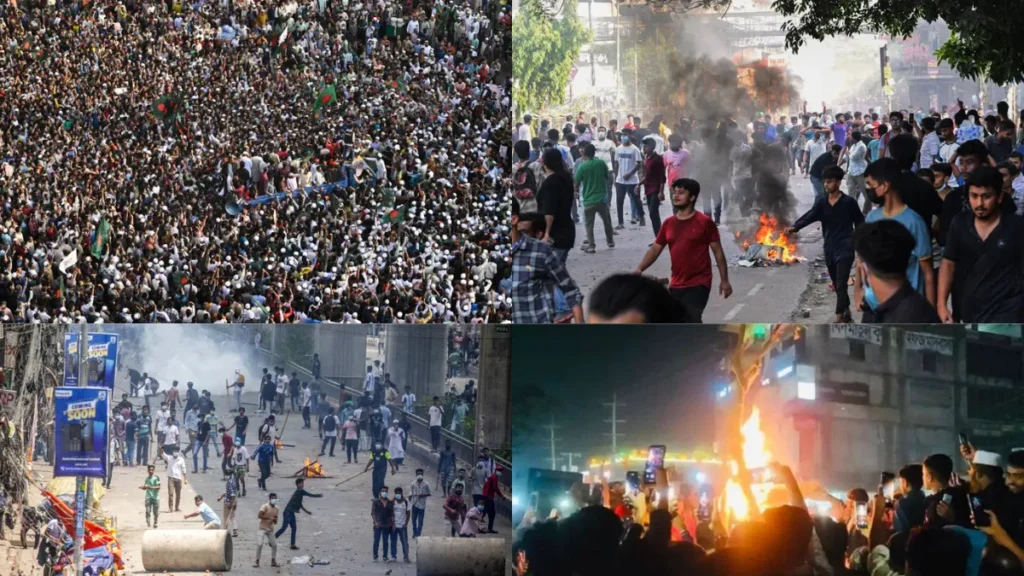
Bangladesh Violence: Bangladesh is witnessing one of its most volatile phases in recent history as widespread unrest, extremist demonstrations, political uncertainty, and targeted violence against minorities converge into a deepening national crisis. The latest wave of Bangladesh violence erupted following the death of opposition student leader Usman Hadi, triggering protests that rapidly turned aggressive across several parts of the country. From marches toward the Indian border to religious sloganeering outside temples, and from alleged government inaction to rising regional security concerns, the situation has sent shockwaves across South Asia.
Extremist Marches Toward the Indian Border Raise Alarm
On Friday, extremist groups associated with Inquilab Manch and Jamaat-e-Islami organized a provocative march from Benapole toward the India–Bangladesh border. Chanting inflammatory slogans, the demonstrators demanded that former Prime Minister Sheikh Hasina-currently in exile in India-be handed over to Bangladesh.
The march heightened tensions in border districts already on edge, prompting heightened vigilance on both sides. Protest leaders openly accused India of sheltering Hasina and alleged foreign interference in Bangladesh’s internal affairs. Security analysts warn that such rhetoric risks destabilizing an already fragile border environment.
In response to the growing unrest, the Indian Army moved into high alert mode, particularly along the eastern frontier. Lieutenant General R.C. Tiwari, Chief of the Indian Army’s Eastern Command, visited sensitive border areas on Thursday evening to review security preparedness and coordinate intelligence-sharing mechanisms.
Religious Slogans Outside Temples Trigger Fears Among Minorities
As protests intensified, religious minorities became direct targets of intimidation. In Chattogram, extremist groups gathered outside the historic Chandranath Temple, raising aggressive religious slogans that sparked fear among Hindu devotees and local residents.
In Dhaka, authorities were forced to deploy additional police units around the Dhakeshwari National Temple, one of the most revered Hindu religious sites in Bangladesh. Extremist demonstrators also surrounded the Shilpi Goshti Cultural Center on Topkhana Road, chanting slogans and creating a tense standoff atmosphere.
Minority rights organizations have expressed grave concern, warning that such actions signal a dangerous escalation in communal polarization. Several advocacy groups have urged the interim government to take firm action to protect religious sites and prevent further attacks.
Usman Hadi’s Body Returns to Dhaka Amid Renewed Violence
The body of Usman Hadi, the slain student leader and spokesperson of Inquilab Manch, was flown back to Dhaka from Singapore on Friday evening. Hadi had been undergoing treatment there after being critically injured in a targeted shooting earlier this month.
The interim government led by Mohammad Yunus declared a national day of mourning on Saturday, with Hadi’s funeral scheduled for the same day. However, the return of his body did little to calm the streets.
Instead, violent protests erupted again in the capital. Demonstrators set fire to the office of the Udichi Shilpi Gosthi, a well-known cultural organization recognized for its outspoken opposition to extremism. The arson attack has been widely condemned by civil society groups, journalists, and artists, who see it as an assault on Bangladesh’s secular and cultural heritage.
Allegations of Government Inaction Fuel Public Anger
Exclusive information obtained by local media outlets suggests that the Yunus-led interim government may have allowed rioters a free hand during the initial hours of unrest. According to these reports, neither police nor military forces were deployed to affected areas for nearly two hours after violence broke out.
Critics argue that this delay enabled mobs to attack media houses, political offices, and cultural institutions with impunity. Two major media organizations in Dhaka were reportedly torched, along with offices belonging to the Awami League, the party of former Prime Minister Sheikh Hasina.
Opposition voices accuse the interim administration of deliberately allowing chaos to unfold as part of a broader political strategy aimed at reshaping the electoral landscape ahead of the upcoming general elections.
Political Calculations and Election Uncertainty
Bangladesh is scheduled to hold general elections on February 12, as announced by Chief Election Commissioner A.M.M. Nasiruddin. These elections come nearly 18 months after the dramatic ouster of Sheikh Hasina’s government in August 2024, following a student-led movement that culminated in a coup.
Since then, Bangladesh has been governed by an interim administration under Nobel laureate Mohammad Yunus. However, the political environment remains deeply fractured.
The Awami League, Bangladesh’s largest and historically dominant political party, has been effectively sidelined. Its registration was canceled by the Election Commission in May 2025, barring it from participating in elections or engaging in political activities. Several senior party leaders have been arrested, further weakening its organizational capacity.
Meanwhile, BNP leader Tariq Rahman is expected to return to Dhaka from London on December 25. Political observers note that the BNP has struggled to regain momentum, leaving a vacuum that could benefit hardline Islamist groups.
Analysts suggest that Yunus may be seeking to delay or manipulate the electoral process. With both the Awami League and BNP marginalized, Jamaat-e-Islami-which is believed to enjoy tacit support from elements within the interim government-could emerge as a major beneficiary. Some critics even speculate that Yunus could position himself for a return to the presidency under a reconfigured political order.
Brutal Killing of Hindu Youth Sparks International Outrage
Amid the broader unrest, a particularly horrifying incident has intensified concerns over Bangladesh violence and minority safety. In Bhaluka, near Dhaka, a young Hindu man named Deepu Chandra Das was brutally beaten to death on accusations of insulting religion.
According to a BBC Bangla report, Das was stripped naked, beaten by a mob, hanged from a tree, and then set on fire. Videos of the attack, widely circulated on social media, show perpetrators chanting religious slogans during the lynching.
The incident has drawn condemnation from human rights groups worldwide, who describe it as a chilling example of mob justice fueled by religious extremism. Police have confirmed the incident and say investigations are ongoing, though arrests have been limited so far.
Murder Probe: Accused Allegedly Flees to India
In a separate but related development, Bangladeshi media have reported that Faisal Karim, the main suspect in the murder of Usman Hadi, may have fled to India. This claim emerged after two alleged accomplices-Sibian Deu and Sanjay Chisim-reportedly told a court that Karim escaped across the border.
According to Bangladeshi security officials, Karim had checked into a resort with his girlfriend just a day before Hadi was shot. Investigators allege that during their stay, Karim hinted that “something big” was about to happen-an event that would “shake Bangladesh.” He allegedly showed his girlfriend a video of Hadi during the conversation.
Authorities are now working with regional partners to verify Karim’s whereabouts and assess whether cross-border cooperation will be required to bring him to justice.
Timeline of the Assassination: December 12 Shooting
Usman Hadi was shot on December 12 in Dhaka while traveling in a rickshaw. A bike-borne assailant opened fire at close range, leaving Hadi critically injured. He was rushed to Dhaka Medical College Hospital before being airlifted to Singapore for advanced treatment, where he later succumbed to his injuries.
In the hours leading up to the attack, Hadi had reportedly shared a controversial map of “Greater Bangladesh” on social media, which included parts of northeastern India known as the “Seven Sisters.” The post sparked outrage and raised questions about whether it played a role in motivating the attack.
Who Was Usman Hadi?
Usman Hadi was a prominent student leader and spokesperson for Inquilab Manch, an Islamic organization that rose to prominence following the August 2024 student movement. That movement ultimately led to the collapse of Sheikh Hasina’s Awami League government.
Hadi was preparing to contest the upcoming elections as an independent candidate from Dhaka. Inquilab Manch has been vocal in its opposition to the Awami League, labeling it a terrorist organization and demanding its complete dismantling.
The group claims to champion national sovereignty, youth security, and independence, and played a key role in the political developments that resulted in the Awami League’s dissolution in May 2025.
Regional and International Implications
The ongoing Bangladesh violence has implications far beyond the country’s borders. India, which shares a long and porous frontier with Bangladesh, is closely monitoring developments. Any escalation could trigger refugee flows, cross-border tensions, and security challenges in India’s northeastern states.
International observers, including human rights organizations and diplomatic missions, have urged the interim government to restore law and order, protect minorities, and ensure free and fair elections.
Read also: Visit of PM to Oman Strengthens Strategic, Economic and Cultural Partnership
A Nation at a Crossroads
Bangladesh now stands at a critical juncture. The convergence of political uncertainty, extremist mobilization, targeted violence against minorities, and allegations of state complicity threatens to undo decades of social and economic progress.
As the country moves toward the February elections, the path forward remains unclear. Whether the interim government can rein in violence, restore public trust, and safeguard democratic processes will determine not only Bangladesh’s immediate future but also regional stability in South Asia.
For now, the streets remain tense, borders are on alert, and millions of citizens anxiously await signs that peace and accountability will prevail over chaos and fear.