Namrup, Assam:
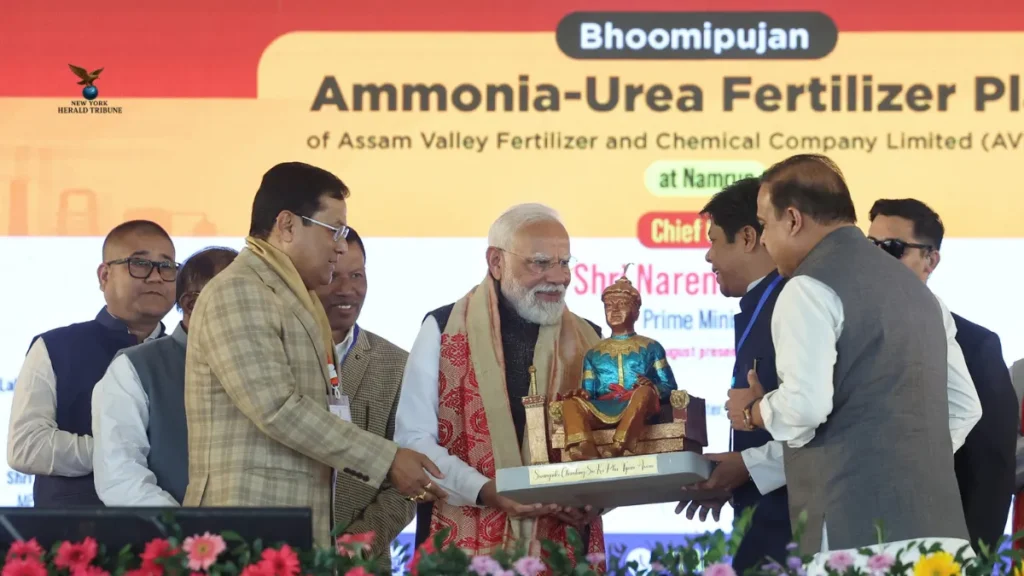
Prime Minister Narendra Modi on Sunday laid the foundation stone of the Assam Ammonia Urea Fertilizer Project at Namrup in Assam’s Dibrugarh district, marking a major milestone in the state’s industrial revival and agricultural transformation. Addressing a massive public gathering, the Prime Minister said Assam has entered a new phase of development momentum and is ready to play a decisive role in India’s journey towards becoming a developed nation.
The project, to be implemented by Assam Valley Fertilizer and Chemical Company Limited (AVFCL), is being seen as one of the most significant industrial investments in the Northeast in recent decades. With an estimated investment of around ₹11,000 crore, the fertilizer plant is expected to produce more than 12 lakh metric tonnes of urea annually, strengthening India’s food security and reducing dependence on imports.
Calling the day “historic” for Assam and the entire Northeast, Prime Minister Modi said the foundation stone of the Namrup fertilizer plant fulfils a long-pending aspiration of the people of the region. He described the project as the beginning of a new chapter in Assam’s industrial story, one that will create jobs, empower farmers, and contribute to balanced national growth.
The Bhoomi Pujan of the Ammonia-Urea Fertilizer Project in Namrup will empower our hardworking farmers. It will boost the agriculture sector across Assam and the Northeast. https://t.co/U0yiOB10zL
— Narendra Modi (@narendramodi) December 21, 2025
A Historic Moment for Assam and the Northeast
In his address, the Prime Minister underlined the emotional and economic importance of the project, particularly for the people of Upper Assam. Namrup has long been associated with fertilizer production, but years of neglect, outdated technology, and lack of investment had stalled its potential.
“Today is a historic day not just for Assam, but for the entire Northeast. The long-standing demand to revive and strengthen industrial activity in Namrup has finally been fulfilled,” PM Modi said. He added that the Assam Ammonia Urea Fertilizer Project symbolises the Centre’s commitment to inclusive and regionally balanced development.
He stressed that Assam is no longer viewed as a remote frontier, but as a vital partner in India’s economic growth. According to the Prime Minister, the Northeast is now emerging as a hub of opportunity, connectivity, and productivity.
Tribute to Assam’s Legacy of Valour and Sacrifice
At the outset of his speech, Prime Minister Modi paid homage to Assam’s legendary heroes, including Chaolung Sukapha, the founder of the Ahom kingdom, and Lachit Borphukan, the iconic warrior who defended the region from foreign invasions. He also remembered several other prominent figures from Assam who made immense sacrifices for the nation.
He said Assam’s land has always been a land of courage, sacrifice, and patriotism, and its contribution to India’s cultural and historical fabric is unmatched. The Prime Minister remarked that development in such a land carries a deeper responsibility-to honour its past while securing its future.
Assam has picked up a new momentum of development. pic.twitter.com/gfa0h2zDao
— PMO India (@PMOIndia) December 21, 2025
Strengthening India’s Farmers Through Fertilizer Security
One of the central themes of the Prime Minister’s address was the government’s focus on farmers and agricultural sustainability. He said the new fertilizer plant at Namrup will ensure uninterrupted availability of urea, particularly for farmers in Assam and neighbouring eastern states.
The Assam Ammonia Urea Fertilizer Project will significantly reduce transportation and logistics costs, which have historically increased fertilizer prices and caused delays in supply. By producing urea closer to consumption centres, the project will help farmers receive timely inputs during critical sowing seasons.
PM Modi emphasised that fertilizer availability is directly linked to national food security. “When farmers have access to affordable and timely fertilizers, agricultural productivity increases, rural incomes rise, and the entire economy benefits,” he said.
Our government is placing farmers' welfare at the centre of all its efforts. pic.twitter.com/e0peEY5m06
— PMO India (@PMOIndia) December 21, 2025
Massive Investment and Employment Generation
The Prime Minister highlighted that the ₹11,000 crore investment in the Namrup fertilizer project will have a multiplier effect on the regional economy. Beyond fertilizer production, the project is expected to generate thousands of employment and self-employment opportunities.
These opportunities will include permanent jobs within the plant, as well as indirect employment in allied sectors such as transportation, maintenance, supply chains, packaging, and logistics. PM Modi said local youth will benefit the most, as skill development and technical training will open new career pathways.
He added that such large-scale industrial projects also encourage the growth of small and medium enterprises, creating an ecosystem of economic activity around the plant.
Initiatives to promote farming and support farmers. pic.twitter.com/EIDKA3MxRG
— PMO India (@PMOIndia) December 21, 2025
Learning from the Past: Reversing Years of Neglect
Reflecting on the past, the Prime Minister pointed out that fertilizer units in Namrup and several other parts of the country had suffered due to outdated technology and policy neglect. He said earlier governments failed to modernise plants or invest in new capacity, leading to closures that adversely affected farmers and workers alike.
“The shutdown of fertilizer units caused immense hardship to farmers, increased import dependence, and weakened our agricultural resilience,” PM Modi said. He asserted that his government has consciously reversed this trend by reviving old units and commissioning new fertilizer plants across India.
The Namrup project, he said, is a clear example of how policy vision and political will can restore lost industrial strength.
Guided by the vision of Sabka Saath, Sabka Vikas, our efforts have transformed the lives of poor. pic.twitter.com/RtOPpFJELK
— PMO India (@PMOIndia) December 21, 2025
India’s Rising Urea Production Capacity
Providing national context, the Prime Minister shared data on India’s growing fertilizer production capacity. He noted that urea production has increased from around 225 lakh metric tonnes in 2014 to nearly 306 lakh metric tonnes today.
India’s annual urea requirement stands at approximately 380 lakh metric tonnes, and efforts are underway to bridge this gap through new plants and capacity expansion. The Assam Ammonia Urea Fertilizer Project will play a crucial role in meeting this demand, especially for eastern India.
PM Modi also highlighted the financial commitment of the government towards farmers. Despite sharp increases in global fertilizer prices, Indian farmers continue to receive urea at heavily subsidised rates. The additional cost burden, he said, is borne by the government to protect farmers’ interests.
Call for Sustainable and Balanced Fertilizer Use
While emphasising availability, the Prime Minister also urged farmers to use fertilizers judiciously. He encouraged the adoption of balanced nutrient management and sustainable farming practices to protect soil health and long-term productivity.
He reiterated the government’s push towards natural farming, reduced chemical dependency, and efficient irrigation practices. According to PM Modi, sustainability and productivity must go hand in hand for Indian agriculture to remain resilient in the face of climate change.
Farmer-Centric Schemes Transforming Rural India
During his address, PM Modi outlined a series of farmer-focused initiatives launched over the past decade, describing them as pillars of rural transformation. These include:
- PM-Kisan Direct Benefit Transfer, providing income support directly to farmers
- Pradhan Mantri Fasal Bima Yojana, offering crop insurance against natural calamities
- Improved procurement mechanisms to ensure fair prices
- Expansion of Kisan Credit Card coverage to livestock and fisheries farmers
- Formation of 10,000 Farmer Producer Organisations (FPOs) to strengthen collective bargaining
- Promotion of natural and organic farming practices
He also mentioned newly launched initiatives such as the PM Dhan Dhanya Krishi Yojana and the Dalhan Atmanirbharta Mission, aimed at boosting crop diversification and self-reliance in pulses and oilseeds.
Transforming Tea Garden Communities
Special attention was given to the development of Assam’s tea garden areas, which employ millions of workers and form the backbone of the state’s economy. PM Modi said that tea workers, who were long excluded from formal banking, have now been brought into the financial system through Jan Dhan accounts.
As a result, they are benefiting from direct benefit transfers, insurance coverage, and pension schemes. The Prime Minister also highlighted improvements in infrastructure in tea garden regions, including better schools, roads, electricity supply, drinking water facilities, and healthcare services.
“These changes are not just about welfare; they are about dignity and opportunity,” he said.
Sabka Saath, Sabka Vikas: Inclusive Growth in Action
Reiterating his government’s guiding philosophy of Sabka Saath, Sabka Vikas, PM Modi said inclusive development over the last 11 years has lifted around 25 crore people out of poverty across India.
He noted the rise of a “neo-middle class,” particularly in rural and semi-urban areas, as evidence of improved living standards. Access to housing, toilets, electricity, clean cooking fuel, and digital services has transformed everyday life for millions, he said.
According to the Prime Minister, Assam’s development journey reflects this broader national transformation, where growth is no longer limited to a few regions or sections of society.
Northeast and Eastern India as India’s Growth Engine
PM Modi reiterated that Eastern India and the Northeast will serve as the growth engine of the country in the coming decades. Strategic investments in infrastructure, connectivity, energy, and industry are laying the foundation for sustained economic expansion.
The fertilizer produced under the Assam Ammonia Urea Fertilizer Project will not only meet the needs of Assam but will also supply key agricultural states such as Bihar, Jharkhand, West Bengal, and eastern Uttar Pradesh.
This regional integration, he said, will strengthen national unity while ensuring equitable development.
A Symbol of a Self-Reliant India
Concluding his address, Prime Minister Modi said projects like the Namrup fertilizer plant represent the growing role of the Northeast in building a self-reliant India (Atmanirbhar Bharat). By reducing import dependence, strengthening domestic manufacturing, and empowering farmers, the project aligns perfectly with the country’s long-term development goals.
“Assam is no longer on the margins of development. It is at the centre of India’s growth story,” he said, expressing confidence that the state will emerge as a model of sustainable and inclusive progress.
Dignitaries Present at the Event
The foundation stone-laying ceremony was attended by several prominent leaders, including Assam Governor Lakshman Prasad Acharya, Chief Minister Himanta Biswa Sarma, Union Minister Sarbananda Sonowal, senior officials, and representatives of Assam Valley Fertilizer and Chemical Company Limited.
The presence of senior leadership underscored the strategic importance of the Assam Ammonia Urea Fertilizer Project and its central role in reshaping the economic future of Assam and the Northeast.
With the launch of this landmark project, Assam stands at the threshold of a renewed industrial era-one that promises prosperity for farmers, employment for youth, and a stronger foundation for India’s agricultural and economic security.