New Delhi, India–ACITI partnership:India and Canada are set to significantly deepen their economic and strategic partnership, with a renewed emphasis on cooperation in critical minerals, emerging technologies, clean and nuclear energy, and supply-chain diversification. The announcement came as India’s Commerce and Industry Minister Piyush Goyal addressed leading industry representatives at the Indo-Canadian Business Chamber in New Delhi on Monday, outlining fresh momentum in bilateral trade, investment, and innovation.
Goyal emphasised that India and Canada are “natural allies” with shared democratic values, strategic interests, and complementing strengths. He highlighted that the rapid growth of technology-driven industries, combined with India’s scale and talent pool, makes the economic collaboration not only timely but also mutually beneficial. India, he said, stands among the global leaders in artificial intelligence (AI), quantum computing, machine learning, and next-generation data centres — sectors supported by the world’s largest annual output of STEM graduates.
Bilateral Relations Anchored in Trust and Growth
According to Goyal, the India-Canada partnership has matured into a stable and high-trust economic relationship. Despite global uncertainties, the two countries have continued to broaden cooperation across trade, investment, innovation, manufacturing, and energy security. He noted that bilateral trade and investments have expanded steadily over the last decade, with Canada’s sovereign funds emerging as one of the most influential foreign investment blocs in India.
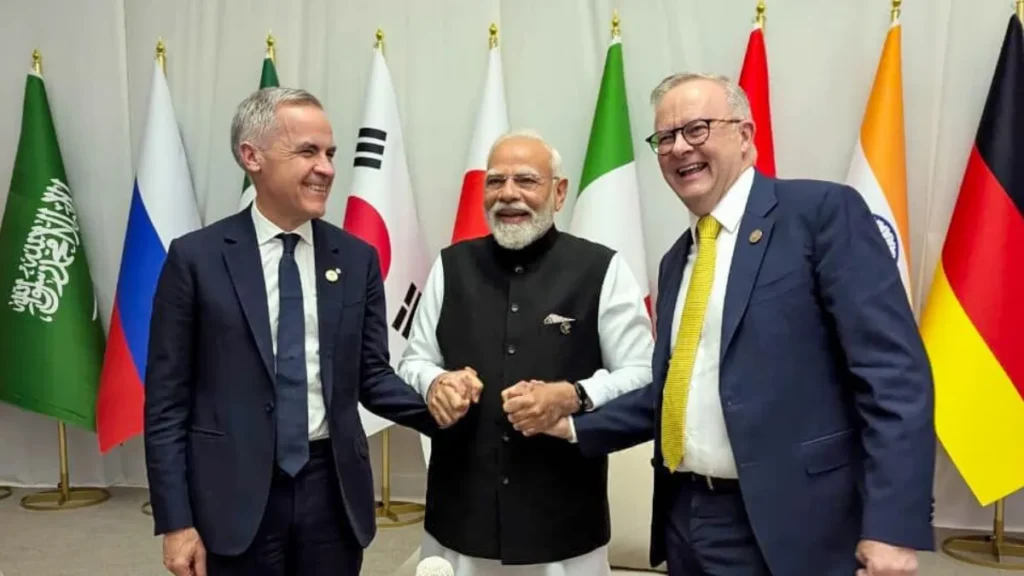
The minister highlighted that recent diplomatic and economic engagements have created renewed optimism across business communities on both sides. A major catalyst was the discussion between Prime Minister Narendra Modi and newly appointed Canadian Prime Minister Mark Carney on the sidelines of the G20 Summit in Johannesburg. Both leaders agreed to accelerate negotiations on the Comprehensive Economic Partnership Agreement (CEPA) — a high-ambition trade pact designed to eliminate barriers and create smoother investment pathways.
Goyal stated that the shared goal is to double bilateral trade from current levels to USD 50 billion by 2030, with CEPA acting as a central enabling mechanism. The fast-tracked negotiation timeline is widely seen as a promising sign of political alignment and commercial priority.
New Momentum Through Technology and Institutional Collaboration
One of the most critical policy breakthroughs contributing to this renewed momentum is the adoption of the Australia-Canada-India Technology and Innovation (ACITI) partnership — a major trilateral agreement unveiled during the G20 Summit. Goyal noted that the ACITI partnership reflects the growing need for technology-aligned democracies to collaborate on secure digital infrastructure, innovation ecosystems, semiconductor supply chains, and advanced manufacturing.
He also pointed to the bilateral strategic roadmap launched in October, which includes targeted action plans to support innovation, boost investment, protect intellectual property rights, and streamline regulatory cooperation. The combined push from CEPA, the new roadmap, and the ACITI partnership provides what Goyal called a “reliable institutional backbone” for long-term economic engagement.
Clean Energy and Critical Minerals as the Cornerstone of Collaboration
A major theme of Goyal’s address was energy security and sustainability. Canada remains one of the largest holders of critical minerals and rare-earth reserves — minerals essential for the manufacturing of electric vehicles, batteries, solar panels, semiconductors, and AI-optimised hardware. India, meanwhile, is one of the world’s fastest-growing clean-energy markets and has emerged as an attractive location for global manufacturers seeking reliable green power at internationally competitive rates.
Goyal stated that India currently operates a 500-GW power grid, with more than half of its electricity generated from clean energy sources. The national target is to double clean energy capacity to 500 GW by 2030, making India the only major democracy pursuing renewables at such scale.
He underscored that India’s clean energy transformation is not only reshaping domestic consumption but also supporting industrial capability building. The ability to offer low-cost round-the-clock renewable power strengthens India’s position as a preferred manufacturing destination for energy-intensive sectors, including AI-driven data infrastructure and semiconductor fabrication.
Strengthening Institutional and Industrial Engagement
Goyal recalled that earlier this month, the seventh India-Canada Ministerial Dialogue took place, with both nations agreeing to reactivate business-to-business cooperation mechanisms. Key policy commitments included:
- Reviving the India-Canada CEO Forum to promote high-level commercial engagement
- Encouraging reciprocal industry delegations
- Expanding collaboration in education, space, defence, and advanced manufacturing
- Supporting joint R&D projects and academic-industry partnerships
He expressed satisfaction that Canada continues to channel strong investment into India — particularly through large pension funds — while Canadian companies across multiple sectors are actively evaluating India for expansion and diversification.
India’s Transformation to a Global Economic Powerhouse
Goyal devoted a significant portion of his speech to India’s economic evolution over the past decade. Calling it a “fundamental transformation”, he noted that India has progressed from being labelled part of the global “Fragile Five” economies to becoming the world’s fifth-largest economy. Based on current growth dynamics, India is expected to rise to third place within the next two to two-and-a-half years.
Key drivers of investor confidence include:
- Solid macroeconomic stability
- Expanding foreign exchange reserves
- Massive national infrastructure upgrades
- Transparent governance and regulatory predictability
- A vibrant capital market that has grown more than fourfold in the past decade
Goyal stated that India’s economic scale, combined with its demographic dividend and technology leadership, positions it as a central growth hub for the global economy.
A Five-Pillar Strategy for the Next Decade of India–Canada Collaboration
The Commerce and Industry Minister laid out a strategic blueprint to guide bilateral relations — one focused on measurable outcomes and long-term commitment. The five pillars include:
- Sector-specific roadmaps to guide collaboration across clean energy, technology, education, agriculture, and defence
- Revitalisation of the India-Canada CEO Forum to accelerate private-sector-led investment
- Stronger cooperation in advanced and critical technologies, especially through the ACITI partnership
- Deep participation in the India AI Impact Summit in 2026, with Canada encouraged to lead innovation pavilions and youth-driven research exchanges
- Support for joint innovation projects backed by a USD 12 billion R&D fund and India’s robust intellectual property architecture
Goyal described this model as a way to build “real, measurable progress” rather than symbolic interactions.
A Call to Canadian Investors and Innovators
As India pursues its long-term goal of becoming a developed nation by 2047, Goyal invited Canadian companies to further expand their presence in the Indian market. He stressed that India offers unparalleled policy stability, market scale, skilled human capital, and opportunities in sunrise sectors that can drive next-generation economic growth.
The minister stressed that combining Canada’s innovation strength with India’s scale, manufacturing capacity, and digital infrastructure could unlock value chains worth hundreds of billions of dollars over the next decade.
A Partnership Positioned for the Future
Concluding his address, Goyal expressed strong confidence in the trajectory of the India–Canada relationship. While acknowledging that global geopolitics and economic conditions remain uncertain, he underlined that both countries share strategic alignment on climate security, supply-chain resilience, technological sovereignty, and democratic values.
He reiterated that cooperation built on trust, transparency and shared interests will define the coming era of engagement. With the CEPA negotiations gaining speed, the ACITI partnership driving new-age technology alignment, and business-to-business interaction accelerating, Goyal predicted that the next decade will be one of unprecedented economic partnership between India and Canada.
Also read: “I’ll Be Cheering for Him”: Key Takeaways from the Surprisingly Warm Trump mamdani meeting
Conclusion
The renewed engagement between India and Canada marks a turning point in bilateral ties. With both nations prioritising clean energy, critical minerals, AI-driven innovation and secure supply-chain architecture, the partnership is evolving beyond trade into a long-term strategic economic alliance. The launch of the ACITI partnership, fast-track CEPA negotiations, and India’s rapidly expanding role in global technology ecosystems collectively highlight the beginning of a deeper phase of cooperation — one that holds transformative possibilities for industry, research and sustainable development in the decades to come.