By [New York Herald Tribune]
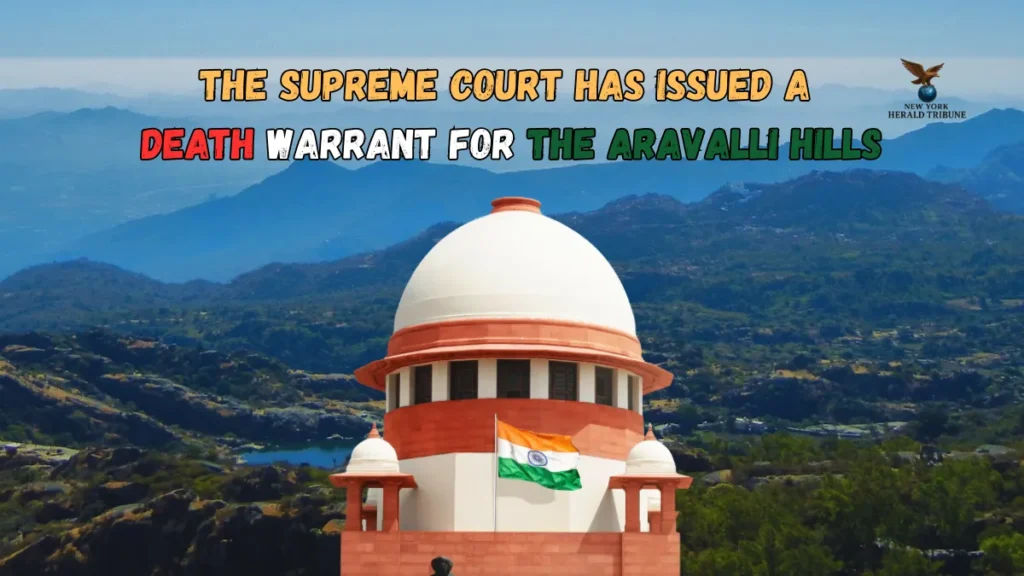
Aravalli Protests: The Aravalli mountain range, one of the oldest geological formations on Earth and often described as northern India’s “Great Green Wall”, is once again at the centre of a growing national debate. A recent change in how the Aravalli hills are legally defined has triggered widespread concern, sparking Aravalli protests across parts of Delhi-NCR, Haryana, Rajasthan, and beyond. Environmentalists, water experts, urban planners, and local residents fear that weakening protection for this fragile range could have devastating consequences-not just for forests and wildlife, but for the future of Delhi itself.
At the heart of the controversy lies a simple but far-reaching question: if large sections of the Aravalli are stripped of forest status, could India’s capital gradually turn into a desert?
This is not alarmism, activists insist, but a warning grounded in science, history, and lived experience.

“When Mountains Speak”: Why the Aravalli Matter More Than Ever
“Sometimes the voiceless mountains speak, and when they do, hearts tremble.”
These poetic lines, written decades ago by lyricist Anand Bakshi, feel uncannily relevant today. Across the Aravalli belt, from Gurugram to Faridabad, from Rajasthan to the southern edges of Delhi, the hills that once stood silent are now at the centre of protests, petitions, and public outrage.
The Aravalli range has endured centuries of erosion, mining, urban expansion, and deforestation. Yet despite this, it continues to perform a silent service: filtering air, recharging groundwater, blocking desert winds, regulating temperature, and sustaining biodiversity.
Environmentalists warn that weakening legal protections now could be the final blow to a mountain system already pushed to its limits.

The Supreme Court Definition That Sparked the Aravalli Protests
The immediate trigger for the current wave of Aravalli protests is a recent Supreme Court ruling that clarified how the Aravalli range should be identified for legal and land-use purposes.
According to the ruling:
- Only hills above 100 metres in height will be considered part of the Aravalli range.
- Smaller hills, scrub forests, and rocky outcrops that were earlier treated as part of the range may now fall outside this definition.
- Land classification will depend on a mix of height criteria, revenue records, government notifications, and ground realities.
While the court described this as a move to bring legal clarity, environmental groups argue that the real danger lies in how this definition will be implemented on the ground.
Once land slips out of “forest” classification, it becomes vulnerable to:
- Mining and stone quarrying
- Real estate development
- Infrastructure projects
- Commercial construction
This shift, critics say, opens the door to irreversible ecological damage.
Why Activists Say Implementation Is the Real Threat
Many legal experts acknowledge that the Supreme Court ruling itself does not explicitly order destruction of the Aravalli. However, environmentalists caution that state governments and local authorities now hold enormous discretionary power.
Jitendra Bhadana, an office-bearer of the Save Aravalli Trust, explains the concern:
“By excluding hills below 100 metres, a large portion of the Aravalli landscape suddenly becomes ‘non-forest’ on paper. This dramatically increases the risk of mining, construction, and land conversion. Once these hills are gone, they cannot be recreated.”
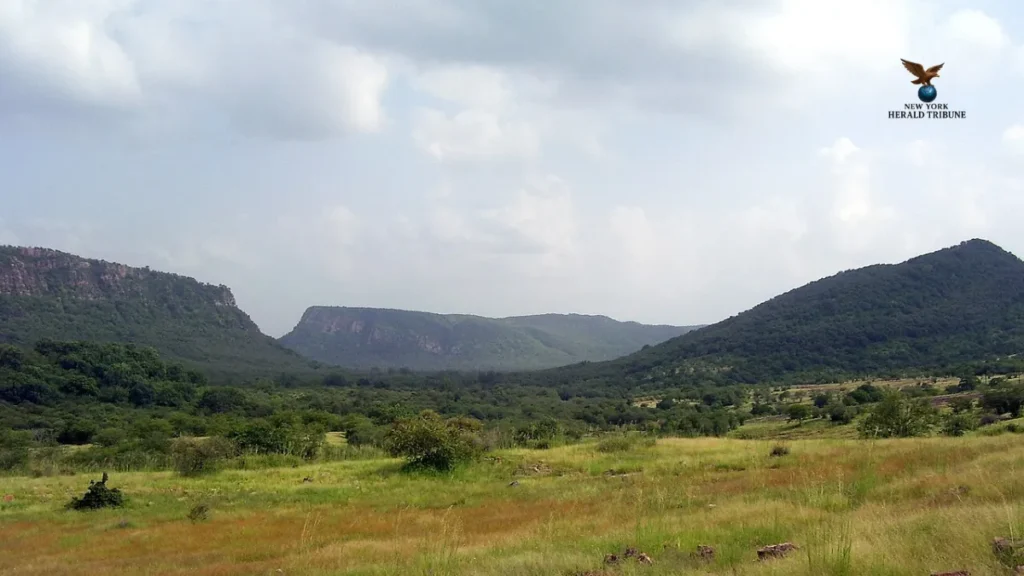
According to activists, the Aravalli is not a neat chain of tall peaks but a complex ecological system of low hills, ridges, forests, grasslands, and rocky terrain. Removing legal protection from any part of this system weakens the whole.

How Much of Delhi Is Built on the Aravalli?
Few residents of the capital realise how deeply the Aravalli range is woven into Delhi’s geography.
Experts estimate that 20 to 25 percent of Delhi sits on Aravalli rock formations. Several prominent neighbourhoods are located directly on or alongside these ancient hills, including:
- Mehrauli
- Saket
- Vasant Kunj
- Chhatarpur
- Parts of Dwarka
Beyond Delhi, the Aravalli extends into:
- Gurugram
- Faridabad
- Manesar
- South Sonipat
In these regions, the hills act as natural buffers against floods, heat, pollution, and water scarcity. Their removal, urban planners warn, would fundamentally alter the region’s environmental stability.
Rising Anger on the Ground: Protests in Gurugram and Beyond
Following the Supreme Court clarification, Aravalli protests erupted in several parts of Haryana and Rajasthan. In Gurugram, local residents and environmental activists gathered outside the residence of state minister Rao Narbir Singh, demanding stronger protection for the hills.
Protesters carried placards reading:
- “Save Aravalli, Save Future”
- “No Aravalli, No Water”
- “Stop Desertification”
- “Mountains Are Not Real Estate”
Similar expressions of anger have been reported from Faridabad, Udaipur, Alwar, and other Aravalli-linked regions. For many residents, the issue is deeply personal.
“These hills give us water, clean air, and some relief from extreme heat,” said a Gurugram resident who joined the protests. “If they are destroyed, cities like ours will become unliveable.”
A Mountain Range Older Than Time Itself
The Aravalli range is not just another set of hills. It is one of the oldest mountain systems in the world, formed more than two billion years ago. Long before the Himalayas rose, the Aravalli stood tall, shaping the climate and geography of western India.
Stretching approximately 800 kilometres, the range begins near Kutch in Gujarat, passes through Rajasthan, Haryana, and ends in Delhi. Over millennia, erosion has worn it down into lower hills-but its ecological importance remains immense.
Geologists often describe the Aravalli as a “living fossil” of Earth’s early history.
Biodiversity at Risk: Wildlife of the Aravalli
The Aravalli range supports a surprising richness of life, especially considering its proximity to major urban centres. Its forests and grasslands are home to several endangered and vulnerable species, including:
- Indian wolves
- Caracals
- Bengal foxes
- Striped hyenas
- Jackals
- Leopards (in some pockets)
- Hundreds of bird species
- Medicinal and native plant varieties
These animals depend on fragmented forest corridors that run across state boundaries. Environmentalists warn that breaking these corridors through construction or mining could wipe out entire populations.
The Aravalli as Delhi’s Invisible Water Tank
Perhaps the most critical function of the Aravalli range is one most people never see: groundwater recharge.
Studies show that the Aravalli hills help recharge nearly two million litres of groundwater per hectare every year. Rainwater seeps through rocky layers and soil, replenishing aquifers that supply water to:
- Delhi
- Gurugram
- Faridabad
- Parts of western Rajasthan
If these recharge zones are destroyed, experts predict:
- Rapid depletion of groundwater
- Drying of wells and ponds
- Increased dependence on tanker water
- Rising water costs
- Deepening social inequality
With Delhi already facing an annual water crisis, the loss of the Aravalli could push the region toward permanent scarcity.
What Happens to the Yamuna If Aravalli Disappears?
Ironically, weakening the Aravalli could also increase pressure on surface water sources like the Yamuna River, which is already among India’s most polluted rivers.
As groundwater levels fall:
- Cities draw more water from rivers
- Pollution concentration increases
- Treatment costs rise
- Ecological flow declines
Experts warn that no river can compensate for the loss of groundwater recharge provided by forests and hills.
A Natural Shield Against Desertification
One of the Aravalli’s most critical roles is acting as a barrier against the Thar Desert.
For centuries, the range has blocked desert winds, reduced dust storms, and prevented sand from advancing eastward. Without it, climatologists warn, desertification could creep steadily toward Delhi and western Uttar Pradesh.
This is not hypothetical. Parts of Rajasthan where Aravalli forests have been heavily mined already show signs of:
- Increased sand movement
- Soil infertility
- Declining rainfall
- Extreme temperature variations
Heat, Pollution, and Urban Flooding: A Triple Threat
Beyond water and desertification, the Aravalli plays a major role in:
- Regulating local temperature
- Acting as a dust barrier
- Absorbing carbon emissions
Without it:
- Delhi-NCR’s heat island effect will intensify
- Summers will become longer and harsher
- Air pollution levels will rise further
- Flash floods may increase in Gurugram and Faridabad due to loss of natural drainage
Ironically, while some fear drought, others face floods-both outcomes of ecological imbalance.
Expert Voices: “We Are Playing With a Tipping Point”
Sandy Khanda, social worker, author, and founder of the Green Pencil Foundation, has been working on Aravalli conservation for years. He warns that the region is dangerously close to an irreversible tipping point.
“Gurugram, Faridabad, and South Delhi are already facing severe groundwater depletion. The Aravalli absorbs rainwater and allows it to recharge aquifers. Destroying these hills will accelerate water collapse.”
According to Khanda, no amount of artificial water management can replace the natural services provided by ancient ecosystems.
Is Development Being Pitted Against Survival?
Supporters of relaxed land-use rules argue that development and housing are necessary for growing cities. Environmentalists counter that unchecked development without ecological safeguards is short-sighted.
“Development that destroys water sources is not progress,” says one urban planner. “It is delayed disaster.”
The Aravalli protests reflect a growing public realisation that environmental protection is not anti-development-it is essential to sustainable growth.
The Road Ahead: Can the Aravalli Still Be Saved?
Despite decades of damage, experts believe the Aravalli can still recover if:
- Forest protections are strengthened
- Illegal mining is halted
- Native vegetation is restored
- Wildlife corridors are preserved
- Transparent land records are enforced
Several citizens’ groups are now demanding:
- Reconsideration of the height-based definition
- Uniform environmental safeguards across states
- Independent ecological audits
Conclusion: A Choice That Will Define the Future
The Aravalli range has survived for billions of years. The question now is whether it can survive modern governance, short-term economic interests, and unchecked urbanisation.
The Aravalli protests are not just about hills and forests. They are about water security, climate resilience, public health, and the right to a livable future.
If the Great Green Wall falls, the consequences will not be confined to maps or courtrooms. They will be felt in every glass of water, every breath of air, and every scorching summer that follows.
The mountains are speaking. Whether we listen may determine whether Delhi remains a city-or slowly turns into a desert.