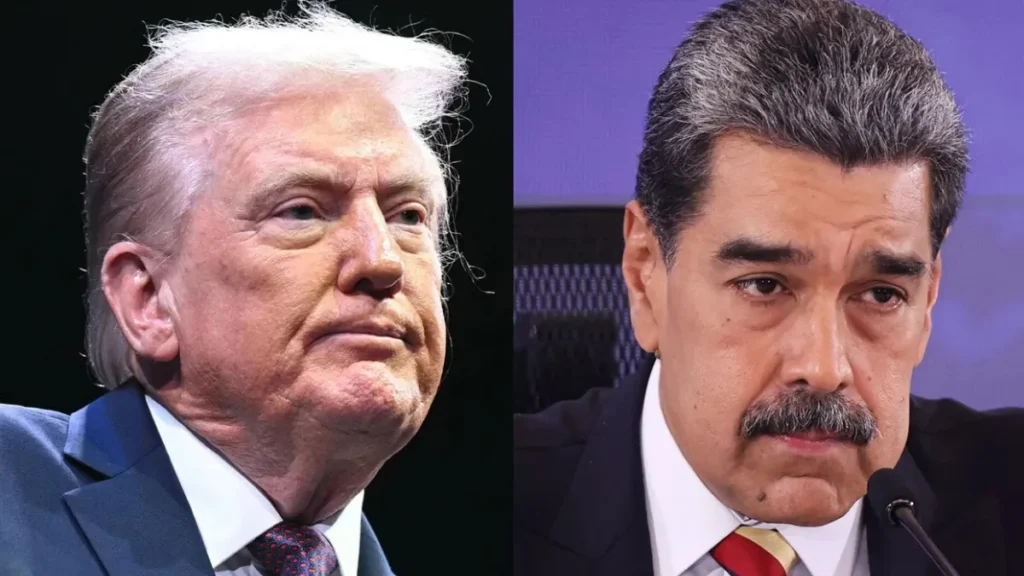
US Venezuela News: In a rapidly intensifying geopolitical confrontation, Venezuelan President Nicolás Maduro has issued a sharp warning to former US President Donald Trump, urging him not to drag the region into what he described as a new “forever war.” His comments come amid a significant American military build-up near Venezuelan waters, raising concerns about the possibility of escalating conflict in the Western Hemisphere. This development has placed US Venezuela news at the forefront of global attention.
Within days, the US Navy’s most advanced aircraft carrier, the USS Gerald R. Ford, is expected to reach the Caribbean region near Venezuela. The carrier, which carries thousands of sailors and an arsenal of advanced fighter jets, represents a major show of force from Washington. It has historically been used as a symbol of strategic deterrence and geopolitical signaling, often influencing foreign governments without the need for direct military engagement.
Maduro Urges Washington to Avoid a New Era of Endless Conflicts
Speaking to CNN on Thursday night, Maduro declared that Venezuela would not allow itself to be pulled into another prolonged military conflict similar to the wars waged by the United States in Afghanistan or Libya.
“No more forever wars. No more unjust wars. No more Libya. No more Afghanistan. Long live peace,” he said, surrounded by large pro-government crowds outside the presidential palace in Caracas. The 62-year-old leader, who has faced international criticism and accusations of election manipulation, attempted to portray his message as a plea for regional stability rather than a political maneuver.
Maduro’s remarks were triggered by reports confirming the imminent arrival of the USS Gerald R. Ford. With its significant strike capability, the carrier’s presence has heightened fears inside Venezuela, where government officials and civilians alike worry about the possibility of US intervention.
Washington Defends Its Actions as Anti-Narcotics Operations
The US government has insisted that its growing military presence near Venezuela forms part of a broader strategy to dismantle what it calls “organized criminal narcoterrorist networks.” Secretary of State Marco Rubio emphasized this objective while addressing the new deployment, stating that the mission is aimed at protecting Americans from drug trafficking routes that allegedly originate in or pass through Venezuelan territory.
Rubio, a long-standing critic of Maduro, reiterated that Washington does not recognize him as Venezuela’s legitimate leader. Instead, he referred to the Venezuelan government as a “trans-shipment organization” that collaborates with criminal groups moving narcotics toward the United States.
Pressed by international reporters on whether the military build-up serves deeper political or strategic goals beyond narcotics control, Rubio maintained that the Trump administration was purely focused on countering what it describes as narcoterrorist activities. “That’s what he’s authorized. That’s what the military’s doing. That’s why our assets are there,” Rubio said.
The heightened tension and deployment continue to dominate US Venezuela news, drawing global scrutiny from governments and security analysts.
Operation Southern Spear Announced Amid Expanded Military Presence
US Defense Secretary Pete Hegseth added more clarity to Washington’s intentions by announcing the formal name of the operation: Operation Southern Spear. He stated that the mission reflects the United States’ commitment to securing the Western Hemisphere—a region he described as “America’s neighborhood.”
Hegseth stressed that the US military presence is aimed at protecting the nation’s homeland from the flow of drugs that he says are responsible for thousands of American deaths each year. The operation seeks to intensify Washington’s focus on monitoring and disrupting maritime routes in the Caribbean and eastern Pacific, where US forces have already carried out strikes leading to more than 75 fatalities in recent months.
Once the USS Gerald R. Ford reaches the area, the mission will include nearly a dozen naval vessels and an estimated 12,000 sailors and marines. This expanded presence signals one of the most substantial US deployments in Latin America in recent years.
Analysts Question Whether the Build-Up Is Really About Drug Control
Despite Washington’s official explanation, security analysts and regional experts are raising doubts about the true purpose behind the deployment. Some argue that the presence of an aircraft carrier—primarily a tool of power projection—has limited practical use in anti-drug operations.
“It’s clear this deployment is more geared toward political pressure on Caracas than drug interdiction,” said Elizabeth Dickinson, senior analyst for the Andes region at the International Crisis Group. According to Dickinson, the military capabilities of the USS Gerald R. Ford far exceed what is necessary for counter-narcotics missions.
“There’s nothing that an aircraft carrier brings that is useful for combating the drug trade,” she noted, adding that the operation seems more aligned with attempts to force political change in Venezuela.
Dickinson’s analysis reflects a broader concern among regional observers who believe the US is signaling its readiness to intensify pressure on Maduro. She added that the deployment has “raised a lot of anxieties in Venezuela but also across Latin America. Everyone is watching closely to see how far the US is willing to go.”
Regional Tensions Rise as International Community Watches Closely
Across South America, governments are monitoring the situation with growing apprehension. Many nations are wary of foreign military intervention in the region, particularly given the historical backdrop of US involvement in Latin American political affairs throughout the 20th century.
Diplomats fear that even a minor confrontation or miscalculation at sea could spark a dangerously rapid escalation, potentially destabilizing the region. The presence of the USS Gerald R. Ford has added a new layer of unpredictability, and with the operation now formally named and expanded, the stakes are higher than they have been in years.
For Venezuelans, the specter of a military conflict adds to the country’s already severe economic crisis. Food shortages, inflation, and political repression have driven millions to flee in recent years, creating one of the world’s largest migration crises.
Also read: “Come to the US, Train Americans, Go Home”: Trump’s New Vision for the H-1B Visa Program
A High-Stakes Moment for US–Venezuela Relations
This dramatic escalation marks a critical moment in the complex relationship between Washington and Caracas. As the world continues to follow US Venezuela news, international analysts say the next few weeks will be crucial in determining whether the situation remains a show of force—or spirals into something far more dangerous.
With both sides standing firm—Maduro warning against a new “forever war” and US officials doubling down on their mission—the region finds itself at a crossroads. The world’s attention is now focused on the Caribbean, where a single misstep could reshape the geopolitical landscape of the Americas.