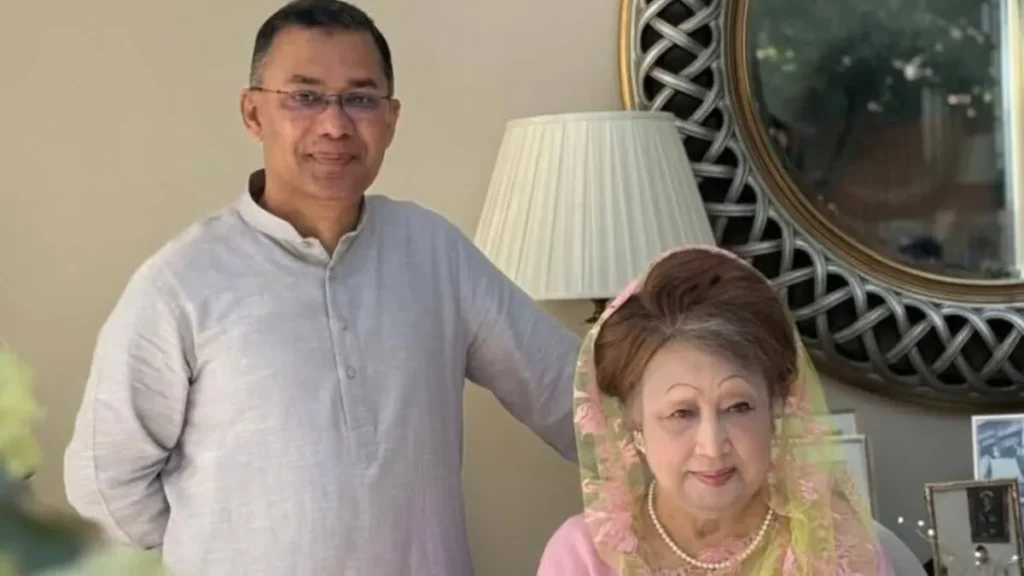
After nearly two decades in exile, one of the most polarising and closely watched figures in Bangladeshi politics is preparing to come home. Tarique Rahman, acting chairperson of the Bangladesh Nationalist Party (BNP) and elder son of former prime minister Khaleda Zia, is expected to return to Dhaka on 25 December, ending an 18-year absence that has shaped both his personal trajectory and the country’s political landscape.
His return is not merely symbolic. It comes at a moment of extraordinary political transition in Bangladesh, just 50 days before a pivotal national election scheduled for 12 February, and amid sweeping institutional reforms following the dramatic ousting of Sheikh Hasina in 2024. For supporters, Tarique Rahman’s homecoming represents renewal and momentum. For critics, it raises old questions about leadership, accountability, and whether the past is returning under a new banner.
What is undeniable is this: Tarique Rahman’s arrival marks a turning point that could redefine Bangladesh’s politics for the next decade.
A Long Road Home: Exile, Absence, and Survival
Tarique Rahman left Bangladesh in 2008 amid intense political pressure, legal challenges, and a rapidly deteriorating security situation. What was initially framed as a temporary departure for medical treatment in the United Kingdom soon turned into a prolonged exile as successive cases, convictions, and travel restrictions made return impossible.
From London, Tarique Rahman became an unusual figure in South Asian politics: a party leader directing a major political organisation from abroad. Despite the distance, he gradually consolidated his authority within the BNP, eventually becoming its acting chairperson during his mother Khaleda Zia’s imprisonment and declining health.
For nearly 18 years, Tarique Rahman remained physically absent but politically present-issuing statements, guiding strategy, appointing party officials, and shaping electoral narratives from thousands of miles away. Supporters describe this as evidence of resilience and commitment. Detractors argue it weakened the BNP’s grassroots engagement and deepened perceptions of elitism.
Now, that long-distance chapter is coming to an end.
Why the Timing Matters
The timing of Tarique Rahman’s return is as significant as the return itself.
Bangladesh is heading into its first national election since the 2024 student-led uprising, which fundamentally altered the country’s political order. The protests forced Sheikh Hasina from power and ushered in an Interim Government led by Nobel laureate Muhammad Yunus, tasked with stabilising the nation and steering it toward democratic renewal.
In a historic decision, the interim authorities barred the Awami League from participating in the upcoming election, citing its role in repression and electoral manipulation during previous years. This has left a political vacuum-and an unprecedented opportunity for opposition forces.
Against this backdrop, Tarique Rahman’s return is widely seen as the final strategic move by the BNP before the campaign enters its decisive phase.
A Party in Waiting, Now in Motion
For the BNP, Tarique Rahman’s return is more than a morale boost. It is a strategic lifeline.
The party has struggled for years under repression, internal divisions, and leadership gaps created by exile, imprisonment, and legal battles. Khaleda Zia, twice prime minister and one of Bangladesh’s most influential political figures, remains in fragile health, limiting her ability to campaign or lead.
In this context, Tarique Rahman is expected to serve not only as a symbolic heir but as the operational leader capable of mobilising supporters, energising candidates, and transforming the BNP from an opposition force into a governing contender.
Senior BNP figures believe that Tarique Rahman’s physical presence will galvanise undecided voters, reassure international observers, and unify party ranks ahead of the election.
Legal Barriers and a Changing Judicial Landscape
One of the most consequential aspects of Tarique Rahman’s return is what it signals about his legal status.
For years, multiple convictions handed down during the Awami League era prevented his return. BNP supporters consistently argued that these cases were politically motivated, designed to neutralise a powerful rival rather than deliver justice.
Recent acquittals and legal reversals have dramatically altered that landscape. While debates about accountability persist, the removal of legal obstacles has effectively cleared the path for Tarique Rahman to re-enter Bangladesh without immediate risk of detention.
His return, therefore, represents not only a political shift but a judicial and institutional recalibration in post-Hasina Bangladesh.
An Election Like No Other
The 12 February election stands apart in Bangladesh’s history.
Voters will not only choose a new parliament but will also participate in a national referendum on the July Charter, a reform framework agreed upon by 25 political parties in 2025.
The Charter proposes sweeping changes, including:
- The creation of a bicameral legislature, introducing an upper house
- A two-term or 10-year limit for the prime minister
- Structural reforms to electoral, constitutional, and administrative institutions
Citizens will vote “Yes” or “No” on whether to adopt these principles, making the election a rare blend of parliamentary contest and constitutional referendum.
International observers describe this as a critical test of whether Bangladesh can move from protest-driven change to institutional reform.
Global Attention and Expert Analysis
Think tanks and analysts worldwide are watching closely.
Chatham House, the London-based policy institute, has noted that while political consensus exists on paper, implementation remains uncertain. The February referendum will test whether public support matches elite agreements reached after the 2024 upheaval.
Naomi Hossain, Professor of Development Studies at SOAS University of London, has suggested that the most likely outcome is a BNP victory with Jamaat-e-Islami emerging as the main opposition-a scenario that would fundamentally reshape Bangladesh’s political balance.
Yet, experts caution that public sentiment remains fluid, particularly among young voters who played a central role in the 2024 uprising.
The Hawa Bhaban Shadow
No discussion of Tarique Rahman can avoid the lingering legacy of Hawa Bhaban.
During the BNP-led government from 2001 to 2006, Hawa Bhaban became notorious as an alleged alternative power centre. Critics accused it of fostering corruption, patronage networks, and political intimidation. Tarique Rahman, often dubbed the “Prince of Hawa Bhaban,” was widely associated with this period.
For older voters, these memories remain vivid. For younger voters, they are historical narratives competing with more recent experiences of authoritarianism under the Awami League.
Tarique Rahman now faces a crucial challenge: convincing the electorate that his leadership represents reform and renewal rather than a return to past practices.
A Crowded and Competitive Political Field
The BNP is not alone in seeking to capitalise on the post-Hasina moment.
Jamaat-e-Islami’s Resurgence
The lifting of the ban on Jamaat-e-Islami has reinvigorated the country’s largest Islamist party. Its strong showing in student union elections at Dhaka University has signalled growing youth support, particularly among conservative and religious constituencies.
The National Citizen Party
Born out of the 2024 uprising, the National Citizen Party (NCP) positions itself as the authentic voice of revolutionary youth. Anti-corruption, reform-driven, and sceptical of established elites, it seeks to disrupt traditional political alignments.
However, despite its rhetoric, the NCP has struggled electorally, failing to secure representation in recent student elections-a reality acknowledged by party leaders themselves.
The Risk of a Hung Parliament
Opinion polls suggest the BNP is the frontrunner, but not necessarily on course for a landslide.
A December survey by the International Republican Institute placed BNP support at around 30 percent, with Jamaat-e-Islami close behind at 26 percent. The NCP lagged significantly.
Another survey found nearly half of respondents believe Tarique Rahman will become the next prime minister-a striking indicator of public expectations.
Yet analysts warn that vote-splitting among urban and youth demographics could produce a hung parliament, forcing coalition negotiations the BNP would prefer to avoid.
Security, Stability, and the Weight of Expectation
Authorities are taking no chances with security. A retired brigadier-general has been appointed as Chief Security Officer to oversee arrangements for both Khaleda Zia and Tarique Rahman, underscoring concerns about political violence and instability.
Bangladesh’s institutions remain in transition. Electoral reforms are incomplete, public trust is fragile, and the memory of unrest is still fresh.
In this environment, Tarique Rahman’s return carries enormous expectations-and risks.
Read also: Deva Art Exhibition Showcases India’s Spiritual Art Heritage in Dubai
A Moment That Will Define a Generation
When Tarique Rahman steps off the plane in Dhaka on 25 December, it will mark the end of one era and the uncertain beginning of another.
Supporters see a leader finally ready to face voters on home soil. Critics see unresolved questions returning to centre stage. For the nation, the moment encapsulates the broader struggle to reconcile past mistakes with future aspirations.
Whether Tarique Rahman can transform long-awaited homecoming enthusiasm into credible governance will determine not only his political fate, but the direction of Bangladesh itself.
One thing is certain: Bangladesh’s political temperature is about to rise-sharply.