The ICC T20 World Cup 2026 has officially begun its global journey in dramatic fashion, with the tournament’s trophy tour launching from the iconic Ram Setu. In a first-of-its-kind moment, the coveted trophy was lifted into the skies by a two-seater paramotor, setting the tone for one of the most ambitious and culturally symbolic cricket events in history.
A Spectacular Start to the T20 World Cup 2026 Journey
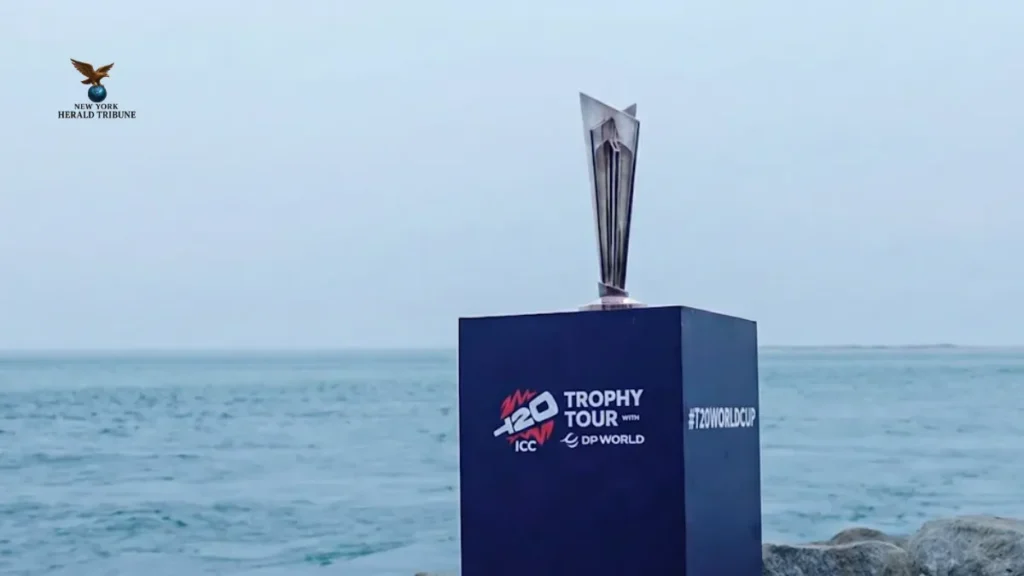
The countdown to the T20 World Cup 2026 has begun with an unforgettable visual spectacle. The International Cricket Council (ICC) officially launched the T20 World Cup Trophy Tour from Ram Setu—also known internationally as Adam’s Bridge-marking a deeply symbolic and visually stunning start to the tournament build-up.
In a scene that blended technology, heritage, and sporting passion, the T20 World Cup trophy was carried aloft by a two-seater paramotor, gliding over the historic stretch of Ram Setu. The aerial launch not only captured global attention but also reinforced the ICC’s vision of cricket as a force that connects cultures, nations, and communities.
This innovative launch has already been hailed as one of the most memorable moments in World Cup promotional history, underlining the scale, ambition, and emotional resonance of the 2026 edition.
Why Ram Setu Was Chosen for the Trophy Launch
Ram Setu holds immense cultural, historical, and geographical significance. Stretching between India and Sri Lanka, the limestone shoals have long been regarded as a bridge connecting the Indian subcontinent with the island nation.
For the T20 World Cup 2026, which will be jointly hosted by India and Sri Lanka, Ram Setu represents far more than a physical location. It symbolises unity, shared heritage, and cooperation—values that lie at the heart of international cricket.
The ICC explained that the choice of Ram Setu perfectly reflects the tournament’s theme: connecting fans across borders through the universal language of cricket. As two neighbouring nations prepare to co-host the global spectacle, the launch location stands as a reminder that sport has the power to transcend political and geographical boundaries.
ICC’s Vision: More Than Just a Trophy Tour
According to the ICC, the T20 World Cup Trophy Tour is not merely a promotional exercise but a carefully designed global journey aimed at bringing fans closer to the game. The organisation described the tour as a celebration of cricket’s unifying spirit, intended to engage fans from established cricketing nations as well as emerging markets.
Ram Setu, whose very meaning revolves around connection, perfectly encapsulates this vision. Through this tour, the ICC aims to foster a sense of shared excitement and belonging among cricket lovers worldwide, regardless of nationality.
Jay Shah on the Significance of the Ram Setu Launch
ICC Chairman Jay Shah described the launch of the trophy tour from Ram Setu as a powerful and inspiring moment for world cricket. He emphasised that beginning the journey at such a culturally and historically rich site sends a strong message ahead of the T20 World Cup 2026.
According to Shah, the trophy tour is not just about showcasing silverware; it is about connecting people, cultures, and cricketing communities across continents. He highlighted that cricket has always been more than a sport-it is a shared emotion for millions-and the trophy tour embodies that spirit.
Shah also noted that as the tournament approaches, the ICC wants fans everywhere to feel personally connected to the World Cup, whether they are in traditional cricket powerhouses or nations where the game is still growing.
A Truly Global Trophy Tour Across Asia and Beyond
As part of the extensive T20 World Cup Trophy Tour, the trophy will travel across several countries in Asia and beyond. In addition to India and Sri Lanka, the tour will include stops in Qatar, Oman, Nepal, Bahrain, and Mongolia.
This broad itinerary reflects the ICC’s commitment to expanding cricket’s global footprint. Fans in these countries will get a rare opportunity to see the T20 World Cup trophy up close, participate in interactive fan experiences, and engage with the game in meaningful ways.
The tour will feature fan meets, public exhibitions, cricket carnivals, and interactive events designed to attract new audiences and strengthen cricket’s presence in regions where the sport is still developing.
Special Focus on Schools, Colleges, and Young Fans
One of the most impactful elements of the T20 World Cup 2026 Trophy Tour is its strong focus on youth engagement. Under a dedicated initiative, the trophy will be taken to schools and colleges across various countries.
This outreach programme aims to inspire the next generation of cricket fans and players by giving young people a tangible connection to the world’s biggest T20 tournament. Students will have the opportunity to learn about the history of the T20 World Cup, interact with cricket ambassadors, and experience the excitement of the global event firsthand.
In addition to educational institutions, the trophy will also make appearances at major T20 leagues and selected bilateral series, ensuring maximum visibility and fan engagement throughout the cricket calendar.
Tournament Overview: Dates, Teams, and Format
The T20 World Cup 2026 will officially begin on February 7 and run for 29 days, featuring 20 teams competing for cricket’s most prestigious T20 title.
The tournament will follow a structured format designed to ensure competitive balance and maximum excitement:
- Group Stage: Each team will play four matches within its group.
- Qualification: The top two teams from each group will advance to the Super-8 stage.
- Super-8 Stage: Teams will play three matches each against other teams in their Super-8 group.
- Final Stages: The best-performing teams will progress to the semi-finals and final.
Teams reaching the final will have played a total of eight matches, testing squad depth, adaptability, and consistency.
High-Profile India vs Pakistan Clash on February 15
One of the most anticipated matches of the T20 World Cup 2026 will be the blockbuster encounter between India and Pakistan, scheduled for February 15. Matches between the two rivals are among the most-watched sporting events in the world, drawing massive audiences in the UK, US, and beyond.
The ICC had announced the full tournament schedule on November 25, confirming several high-profile fixtures early to build anticipation among fans.
India’s Group Stage Fixtures
India will begin its T20 World Cup 2026 campaign on February 7, the opening day of the tournament. Their group-stage schedule includes:
- February 7: India vs United States (evening match)
- February 12: India vs Namibia
- February 15: India vs Pakistan
- February 18: India vs Netherlands
The opening match of the tournament will see the Netherlands take on Pakistan in Colombo earlier on February 7, setting the stage for a thrilling World Cup opener.
World-Class Venues Across India and Sri Lanka
The T20 World Cup 2026 will be played across eight iconic venues in India and Sri Lanka, showcasing some of the finest cricket stadiums in the world.
Indian Venues:
- Narendra Modi Stadium, Ahmedabad
- MA Chidambaram Stadium, Chennai
- Arun Jaitley Stadium, New Delhi
- Wankhede Stadium, Mumbai
- Eden Gardens, Kolkata
Sri Lankan Venues:
- R. Premadasa Stadium, Colombo
- Sinhalese Sports Club Ground, Colombo
- Pallekele International Cricket Stadium, Kandy
These venues combine rich cricketing history with modern infrastructure, ensuring world-class playing conditions and unforgettable fan experiences.
A Look Back at T20 World Cup History
The T20 World Cup was first introduced in 2007, revolutionising international cricket with its fast-paced format and global appeal. India claimed the inaugural title by defeating Pakistan in a thrilling final, setting the stage for the tournament’s rapid rise in popularity.
After a long wait of 17 years, India lifted the trophy again in 2024, defeating South Africa in the final and reclaiming T20 supremacy. Alongside India, West Indies and England have each won the title twice, while Pakistan, Sri Lanka, and Australia have claimed the championship once each.
This rich history adds further significance to the T20 World Cup 2026, as teams aim to etch their names into cricketing folklore.
A Tournament That Promises to Unite the Cricketing World
With its innovative trophy tour launch, ambitious global outreach, and carefully planned tournament structure, the T20 World Cup 2026 is shaping up to be one of the most inclusive and culturally meaningful editions yet.
Starting the journey from Ram Setu sends a clear message: cricket is a bridge between nations, cultures, and generations. As the trophy travels across continents and the world’s best teams prepare for battle, fans everywhere can look forward to a celebration of sport that goes far beyond the boundary rope.
The road to February 7 has officially begun, and with it, the promise of unforgettable moments, fierce rivalries, and the unifying magic of the T20 World Cup.