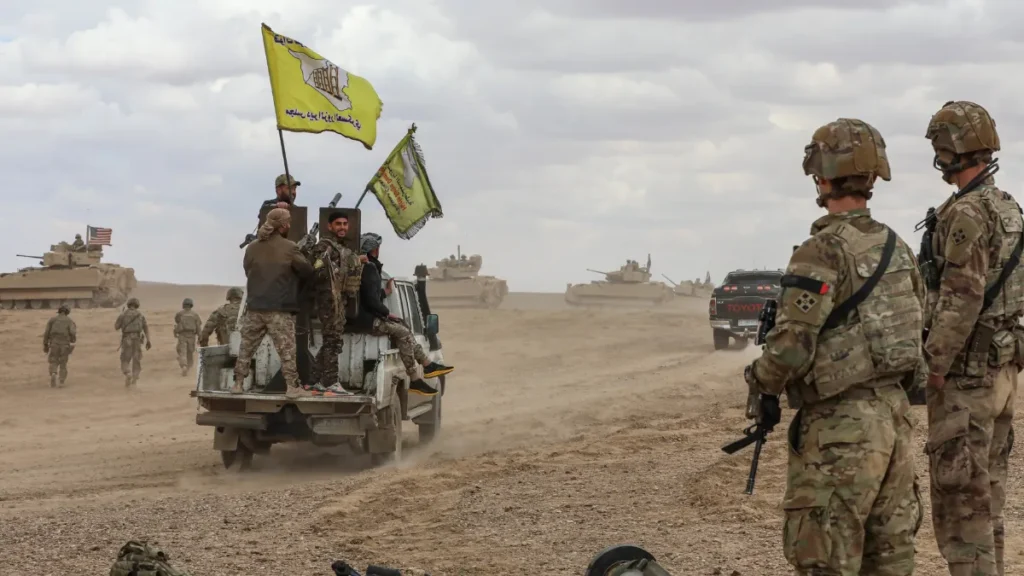
Palmyra, Syria: An ISIS attack on US soldiers in Syria has killed three people, including two American service members and one US civilian, marking the first deadly assault on American forces since the fall of former Syrian President Bashar al-Assad. The attack took place on Saturday in the central Syrian city of Palmyra, once a stronghold of the extremist group.
According to the US Central Command (CENTCOM), the attack occurred while American troops were attending a meeting as part of ongoing counterterrorism operations against ISIS. A single ISIS attacker targeted the gathering, causing multiple casualties before being shot dead by Syrian forces at the scene.
In addition to the fatalities, three US soldiers were injured in the assault. Syrian media outlets also reported that several members of the Syrian security forces were wounded during the incident. All injured personnel were evacuated by helicopter to the US military base at al-Tanf for emergency medical treatment. Officials later confirmed that the wounded American soldiers were in stable condition and showing signs of recovery.
First Attack After Assad’s Fall
This ISIS attack on US soldiers in Syria is particularly significant because it is the first such incident since Bashar al-Assad was removed from power following a rebellion in December 2024. After Assad’s fall, Ahmed al-Sharaa assumed office as Syria’s interim president, ushering in a transitional phase that has seen improving diplomatic and security ties between Damascus and Washington.
Under al-Sharaa’s leadership, Syria recently joined the US-led international coalition against ISIS, signaling a shift in regional cooperation. Despite these developments, the attack underscores that ISIS remains a persistent threat, even after losing territorial control years ago.
Trump Vows Strong Retaliation
Reacting strongly to the incident, US President Donald Trump described the assault as an attack not only on the United States but also on Syria itself. In a statement posted on social media, Trump warned that those responsible would face “a very serious and forceful response.”
“This was a cowardly act of terror carried out by ISIS against both American and Syrian interests,” Trump said. “We will respond decisively, and there will be consequences.”
Trump also revealed that Syrian President Ahmed al-Sharaa was “deeply saddened and furious” over the attack. He added that the Syrian leadership had expressed solidarity with the US and reaffirmed its commitment to joint counterterrorism efforts. The president further noted that the injured American troops were receiving the best possible care and were expected to recover.
Questions Over the Attacker’s Identity
Some media reports have claimed that the attacker may have been a member of the Syrian security forces who was in the process of being removed due to suspected extremist views. However, Syrian authorities have not officially confirmed these reports, and investigations into the attacker’s background are still ongoing.
CENTCOM has stated that a thorough inquiry is underway to determine how the attacker was able to carry out the assault and whether there were any internal security lapses.
ISIS Sleeper Cells Still Active
Although ISIS was territorially defeated in 2019, intelligence assessments suggest that the group continues to operate through sleeper cells across Syria and Iraq. Experts estimate that ISIS still has between 5,000 and 7,000 fighters dispersed throughout the region, capable of launching sporadic but deadly attacks.
Saturday’s ISIS attack on US soldiers in Syria highlights the group’s continued ability to exploit instability and target high-value military assets, despite sustained pressure from coalition forces.
US Military Presence in Syria
The United States has maintained a military presence in Syria since 2014. Initially, American forces were deployed to counter threats from ISIS, Iran-backed militias, and Russian influence. Over time, the mission narrowed to focus primarily on preventing an ISIS resurgence.
Under Operation Inherent Resolve, US troops have worked closely with local partners to dismantle ISIS networks. Although the number of American soldiers in Syria has been gradually reduced, the mission remains active.
As of December 2025, approximately 1,000 US troops are stationed in eastern and northeastern Syria, down from about 2,000 earlier in the year. These forces operate alongside the Kurdish-led Syrian Democratic Forces (SDF) and, more recently, in coordination with Syrian security units loyal to the interim government.
Their responsibilities include training local fighters, conducting airstrikes on ISIS hideouts, gathering intelligence, and preventing the group from regrouping. While Washington has scaled back troop numbers, officials have repeatedly stated that a full withdrawal is not imminent.
A Reminder of Ongoing Risks
The latest ISIS attack on US soldiers in Syria serves as a stark reminder that the extremist group remains a serious security challenge. Despite changes in Syria’s political leadership and improved international cooperation, ISIS continues to pose a lethal threat to both local forces and foreign troops operating in the region.
As investigations continue and the US prepares its response, the attack has renewed debate over the future of America’s military role in Syria and the long-term strategy needed to ensure lasting stability.